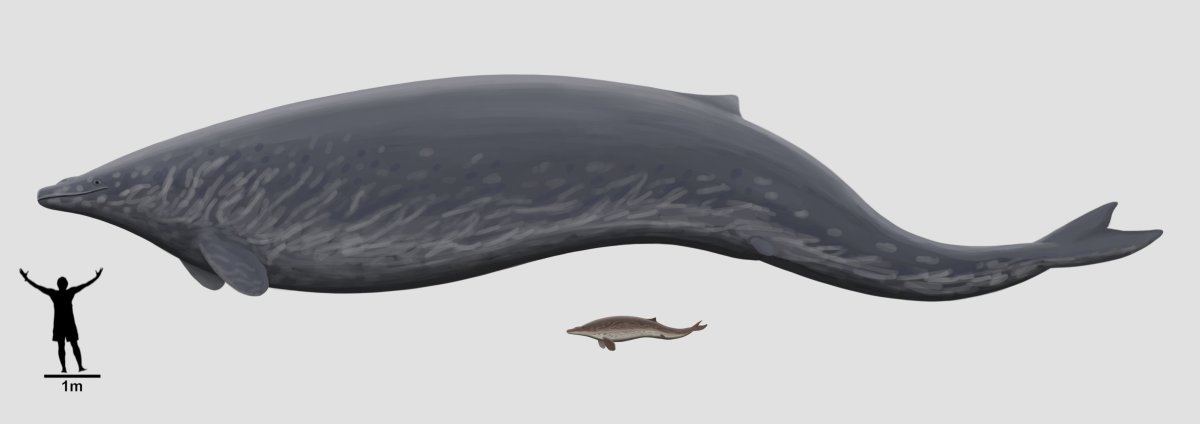
In paleontology, the largest and smallest members of lineages often get the most media attention and hype from paleonerds like me.
Luckily for the basilosaurids – a family of extinct toothed whales – both have been discovered within a week.
On August 2nd, a research team working out of Peru published the discovery of something big. The researchers – led by Italian paleontologist Giovanni Bianucci – had spent the last decade excavating the remains of a whale from the Atacama Desert. While cetacean fossils are well known from western South America, this specimen was special for one main reason: its titanic size. Amongst the 1.4-meter-long ribs and hip bone were 13 vertebrae, each reportedly weighing over 100 kilograms[i]. In other words, the lightest vertebrae are heavier than an average human!
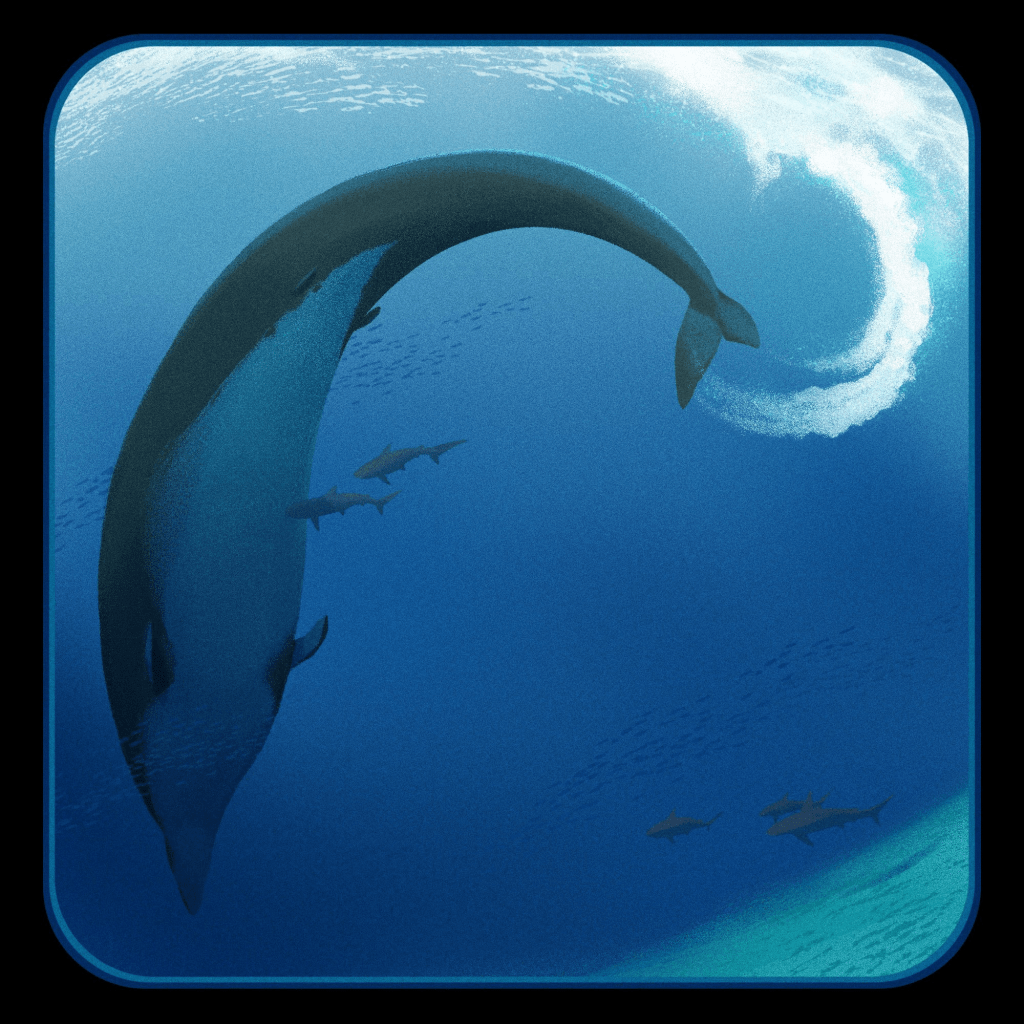
To commemorate the titanic size and location of discovery, the team named their colossal whale Perucetus colossus. Subsequent studies revealed Perucetus was a basilosaurid, an ancient lineage of toothed whales that proliferated in the Eocene epoch between 56-34 million years ago. While some basilosaurids reached large sizes, the 24-meter-long Perucetus dwarfed them all[ii]. Even more astounding is the projected weight of Perucetus, ranging between a whopping 85-340 (!!!) tonnes. Talk about a heavyweight!
The titanic weight of Perucetus puts it in contention for the title of heaviest animal ever. The record holder is the extant Blue Whale, which weighs ~145 tonnes on average but has been documented to reach 190 tonnes[iii]. Despite being shorter than Blue Whales, the extremely dense bones of Perucetus more than offset this difference. Even if the Blue Whale does (somehow) manage to hold onto its throne – which is possible given the difficulties of projecting the weight of prehistoric animals – Perucetus was the heaviest animal alive in the Eocene. That’s an accomplishment in and of itself!

On the other side of the basilosaurid spectrum is Tutcetus rayanensis from the Fayum of Egypt. First described on August 10th, the name of this diminutive basilosaurid comes from King Tut, the king who famously died as a weak, malformed teenager. While Tutcetus may not have been quite as… pitiful as its namesake, it was a small subadult, measuring in at a measly 2.5 meters long[iv]. While this dolphin-sized whale was not fully grown, analysis of its bones has revealed that it was in the advanced stages of sub-adulthood, meaning it wouldn’t have grown much more.

Despite Tutcetus only comprising a skull and a single vertebra, it has provided important information about the basilosaurids. First, they were much more diverse than previously imagined, filling in numerous ecological niches in their Eocene habitats. For further evidence, look no further than the differences between Tutcetus and Perucetus and what roles they would have occupied!
Second, analysis of Tutcetus’ bones reveals much about its life history. The replacement rate of Tutcetus’ teeth indicates that it experienced sexual maturity while relatively young, signalling a comparatively short lifespan[v]. The live-fast, die-young model of Tutcetus is not seen in most modern whales, signalling that some basilosaurids followed a different life history than their modern cousins.

While Perucetus and Tutcetus may not be the ancestors of modern whales, they demonstrate the sheer versatility of the cetaceans. In different parts of the world, one basilosaurid challenged the Blue Whale’s heavyweight title over 30 million years earlier than believed possible; the other remained small and stuck to hunting fish. While Tutcetus may have been tiny compared to its titanic cousin, they are both a testament to how whales came to conquer the oceans like few others before them.
Thank you for reading this article! If the basilosaurids interest you, I suggest you watch the BBC’s docuseries Walking with Beasts. This series features not one but two species of basilosaurids duking it out in the ancient Tethys Sea. Once you’re done, come back to Max’s Blogosaurus to read “Dino Docs: Walking with Beasts (2001)” to get my full thoughts on the fantastic series!
I do not take credit for any image found in this article. Header image courtesy of @aberrantologist on twitter
Works Cited:
[i] Chung, Emily. “This May Be the Heaviest Animal That Ever Lived | CBC News.” CBC news, 2 Aug. 2023, http://www.cbc.ca/news/science/perucetus-whale-fossil-heavy-1.6925284.
[ii] Bianucci, Giovanni, et al. “A Heavyweight Early Whale Pushes the Boundaries of Vertebrate Morphology.” Nature, 2023, https://doi.org/10.1038/s41586-023-06381-1.
[iii] “Whale and Dolphin Record Breakers – Whale and Dolphin Conservation.” Whale & Dolphin Conservation UK, uk.whales.org/whales-dolphins/record-breakers/#:~:text=The%20heaviest%20blue%20whale%20was,as%2025%20adult%20African%20elephants. Accessed 13 Aug. 2023.
[iv] Antar, Mohammed S., et al. “A Diminutive New Basilosaurid Whale Reveals the Trajectory of the Cetacean Life Histories during the Eocene.” Communications Biology, vol. 6, no. 1, 2023, https://doi.org/10.1038/s42003-023-04986-w.
[v] See Above.
 Max's Blogo-Saurus