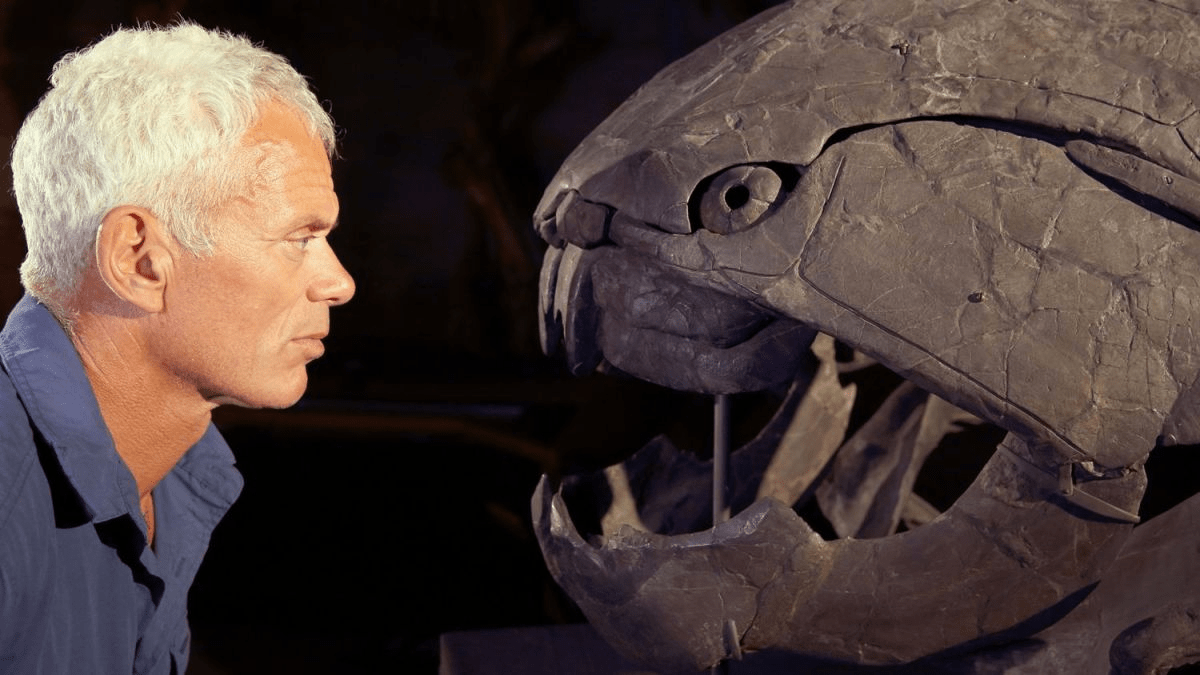
Growing up, River Monsters was always one of my favourite television shows. For those who have missed out, the series followed angler and biologist Jeremy Wade as he travels the globe in the hopes of catching a myriad of giant freshwater animals. From Goliath Tigerfish to Giant Salamanders, Wade’s unmatched ability to reel in some of the largest aquatic animals on our planet (before releasing them, of course) was so proficient that he ran out of species to catch! As the number of animals left to find began to dwindle, Wade set his eyes on different kinds of river monsters: those that lived in prehistory.
River Monsters’ prehistory episode, aptly titled Prehistoric Terror, premiered in April 2015 as part of the series’ 7th season. The episode does not follow the typical format of a River Monsters episode, which usually involves Jeremy Wade investigating reports of a man-eating fish from the other side of the planet. Instead, Prehistoric Terror follows Wade as he describes some of prehistory’s largest fish and catches some of their modern equivalents. Throughout the 43-minute episode, Wade investigates six prehistoric terrors, eventually naming one the ultimate river monster.
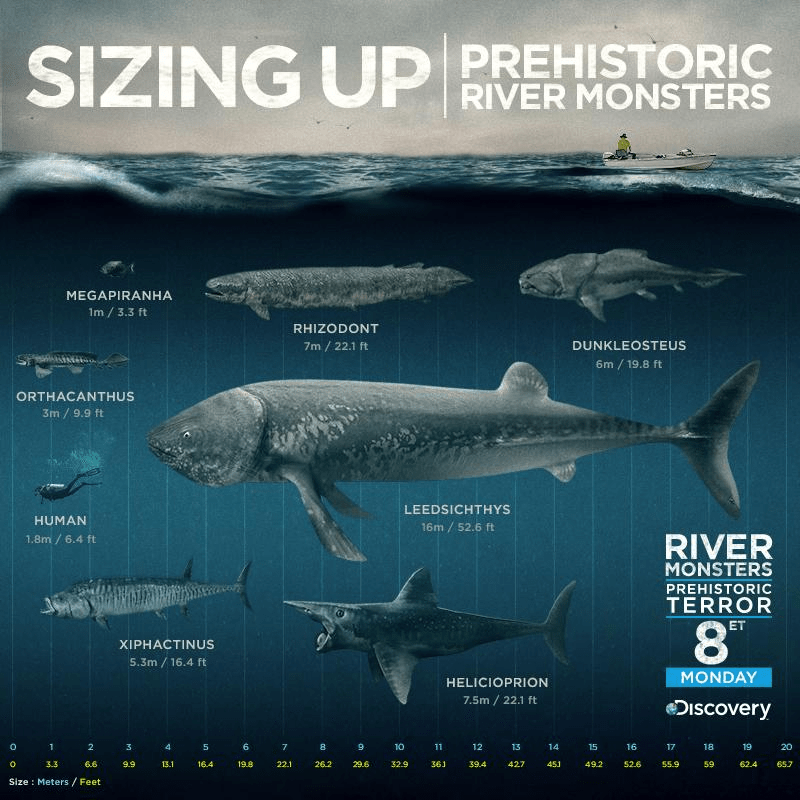
The first strength of the episode is the choice of organisms. In the episode, Wade pursues the freshwater cartilaginous fish known as Xenacanths; the pug-faced carnivorous fish Xiphactinus; the giant filter feeder Leedsichthys; the buzzsaw killer Helicoprion; the “bone crusher” Dunkleosteus; and, the family that Wade would dub the greatest river monsters of all time, the Rhizodonts.
While they may not all be classic ‘river monsters,’ as over half the genera featured lived in marine settings, they all fit in with the show’s spirit and feel like animals Jeremy Wade would dedicate an episode to pursuing. Though Dunkleosteus and Helicoprion are species familiar to many, the inclusion of the lesser-known Xenacanths and Rhizodonts were fantastic additions to the series for paleonerds and casual viewers alike.

The next big positive is one of the biggest draws of the entire series: Jeremy Wade’s presentation ability. While Jeremy Wade does not speak with the zeal or excitement of someone like David Attenborough, his dramatic narration style has an uncanny ability to draw viewers into his every word. River Monsters relies on his ability to introduce a mystery to the audience and decipher the truth behind it, which makes his coverage of prehistory – very much a classic scientific mystery – a perfect fit for his skills as a wildlife presenter.
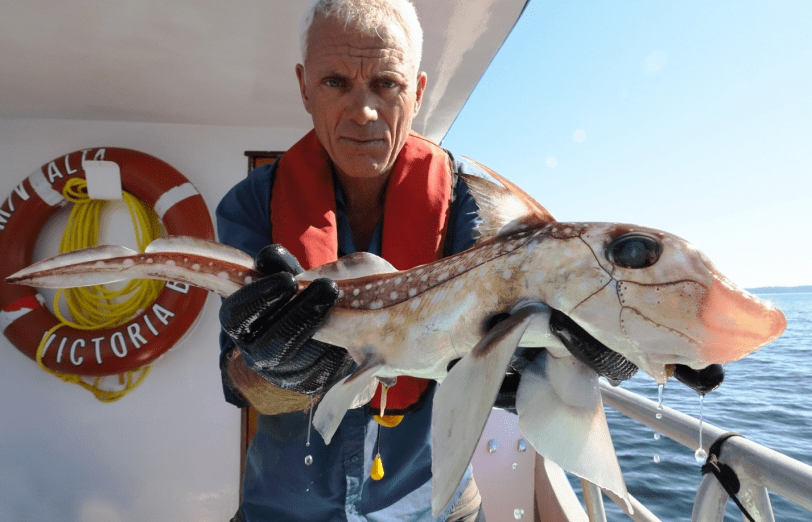
Using modern analogues to represent extinct taxa was a brilliant editorial choice. It allowed Jeremy Wade to show off his skills as an angler (he is on a Steph Curry-level heater in this episode!) and gave the audience a sense of what these extinct animals may have looked or behaved like. Some choices are perfect, namely using a Whale Shark to represent the 15-meter-long Leedsichthys and a Ratfish to represent its ancient cousin Helicoprion. The representation of a White Sturgeon to fill the void of the armoured Dunkleosteus seems bizarre, but finding a perfect analogue for the extinct Placoderms is simply impossible. Additionally, while comparing Rhizodonts to a Saltwater Crocodile may seem ludicrous, these extinct tetrapods likely hunted like the reptilian predators, hiding in shallow waters and ambushing their prey using powerful bursts.
On that topic, I love the science featured in the episode. All information presented throughout the program is accurate and based on well-founded studies and specimens. I feared that the size of some species would be exaggerated, namely Leedsichthys, a genus once hypothesized to reach almost 30 meters long. But the series refrains from including errors in the pursuit of viewership, showing commendable restraint. It feels like the episode was well-researched and well-planned, down to the chalk diagrams Jeremy Wade uses to demonstrate the size of the titanic monsters. In a field with series like Jurassic Fight Club, the presentation of extinct species in River Monsters is a refreshing take.
This may be a more subtle observation, but another strength of Prehistoric Terror is the lack of creative bias. Even the best dinosaur documentaries or series are inherently biased due to the work of paleontologists offering scientific advice behind the scenes. Don’t get me wrong, this isn’t (usually) an issue, as their input is required for a quality program and can even lead to intriguing scenes being presented from their biases. However, having something like River Monsters, where all information presented is accepted as scientific fact and not from an offbeat theory of the program’s advisor, is welcomed – on occasion. I doubt any other series could do it quite as well, so if you intend to do a dinosaur program sometime soon, please seek the advice of a paleontologist!

Overall, River Monsters: Prehistoric Terror is a brilliant and insightful special. Jeremy Wade’s skills as a wildlife presenter allow him to bring a handful of unique and enigmatic taxa to life, with the help of the fishes (and crocodiles) he encounters, of course! If you haven’t already, I highly recommend viewing this special when you can.
Thank you for reading today’s article! River Monsters will always hold a special place in my heart, not only because of my history of watching the series but also because it was always accompanied by time with my grandparents. My grandmother would feign surprise whenever Jeremy Wade caught a catfish (which seemed to happen every episode!), and my grandfather would always ask me what the fish tasted like, as though I had sampled Australian Sawfish before! Following my grandfather’s passing in late 2023, these memories have become ones I cherish immensely. For Opa, this article is dedicated to you – and may you finally get to taste the bloody catfish!
I do not take credit for any images found in this article. River Monsters is the property of Discovery and Animal Planet.
 Max's Blogo-Saurus