Welcome back to paleoart of the month!
After a short exam-induced hiatus, my favourite series of articles is back with a vengeance. Today’s article will feature a handful of paleoart from March and April of 2024, including pieces featuring primordial hallucinations, mating turtles, and one truly unlikely pairing of Pleistocene mammals. Part two will be released later this week, so stay tuned for more paleoart!
An Imposter Among Us
Subject(s): Champsosaurus laramiensis; Borealosuchus sternbergii.
Artist: Kaitlin T. Lindblad (@Crocodontist)
Here we find a classic case of mistaken identity. In this illustration, a hatchling Champsosaurus – a genus of aquatic lizard that resembled modern crocodilians – finds itself amongst Borealosuchus (an actual crocodile) hatchlings in the jaws of their mother. The look on the Champsosaurus face is priceless and can be interpreted in one of two ways. How in the name of Hell’s Creek did I end up here? Or: how long will it take mamma croc to realize I don’t have the right kind of armour? The use of shading in the piece is fantastic, and the attention to detail used by Kaitlin Lindblad to differentiate the baby Borealosuchus and Champsosaurus – from their colours down to the arrangement of their osteoderms – makes the situation at hand all the more humorous.

The Hallucination from the Primordial Mist
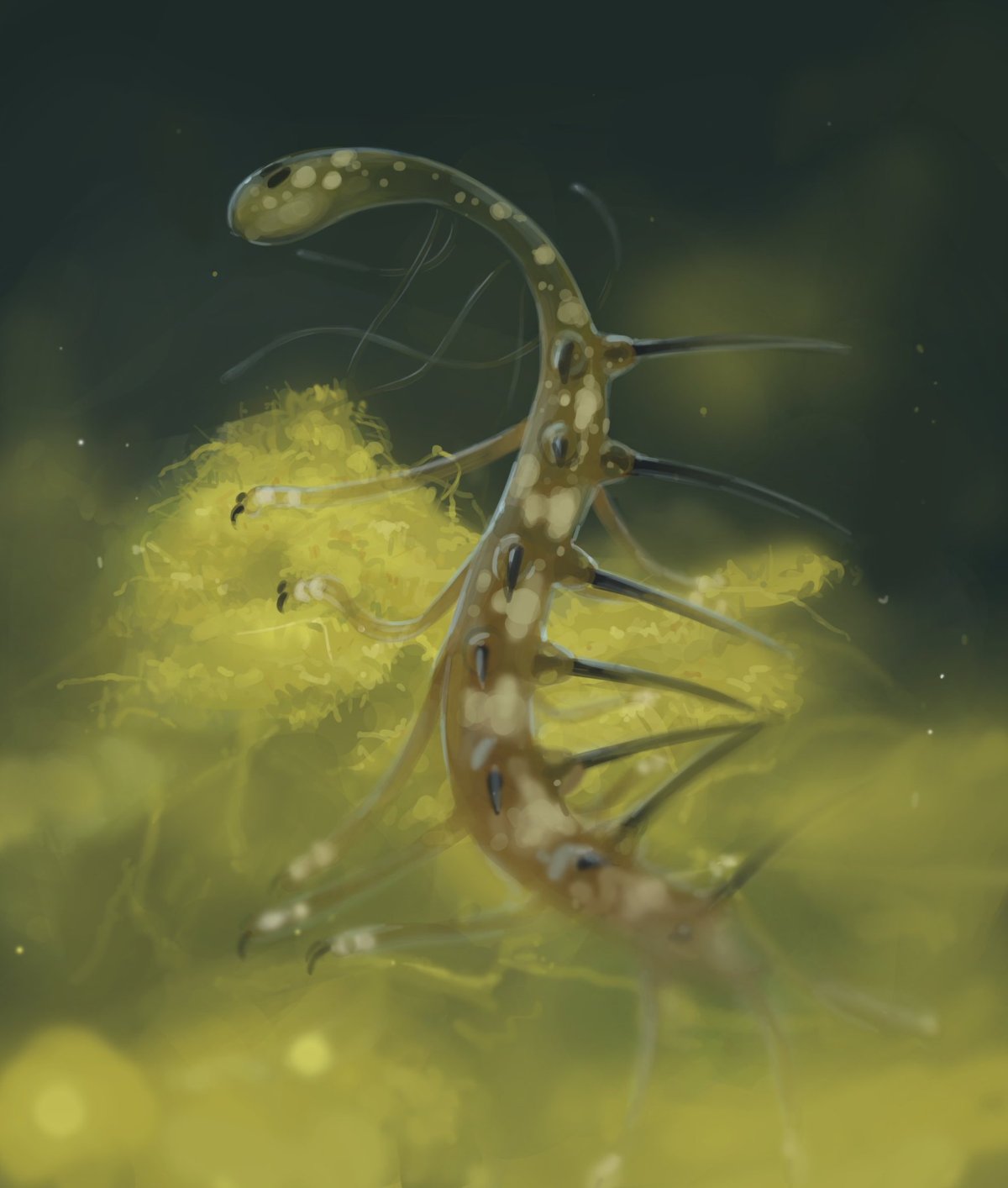
Subject: Hallucigenia sparsa
Artist: Ashley Patch (@AshleyPalaeo)
It’s a well-known fact that life during the Cambrian Period was a menagerie of strange-looking creatures unlike any alive today. While it’s hard to personify this alien world with a single genus, Hallucigenia is a good candidate. An invertebrate that is not related to any modern lineage, Hallucigenia is famous for the rows of paired spines that lie along its back. The greens of both Hallucigenia and the surrounding algae bring a sense of serenity to the piece, making it seem as though the Hallucigenia has been born from the sludge surrounding it in the ancient Cambrian oceans.

Dinosaur Mosaics: Oviraptor
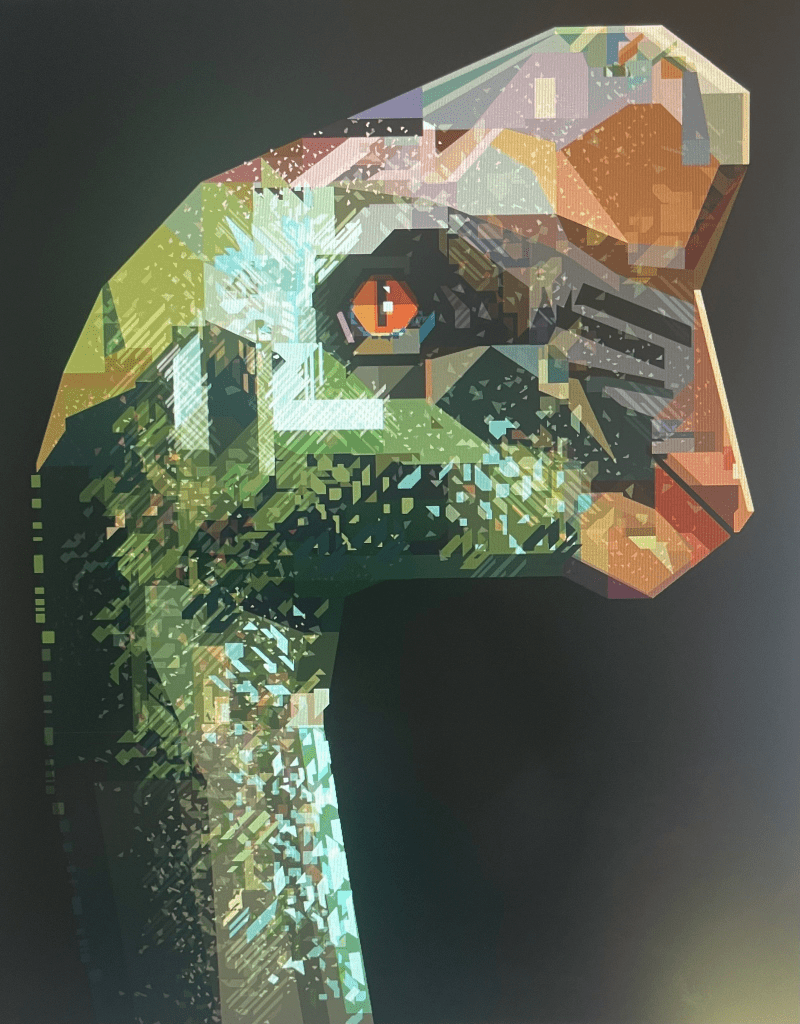
Subject: Oviraptor philoceratops
Artist: James Gilleard (@jgilleard)
Not all good paleoart needs to adhere to strict realism, as demonstrated by James Gilleard’s mosaic portrait of Oviraptor. Though the overlapping polygons may seem disorienting at first, the greens and oranges of the portrait slowly blend to craft the unmistakable visage of everyone’s favourite egg thief. The positioning of Oviraptor’s eye at the direct center of the piece brings all the elements together, as the contrast of the bright orange with muddy colours makes it seem as though the dinosaur is staring a hole through the viewer – a truly hair-raising feeling.
The Dance of the Giant Turtles
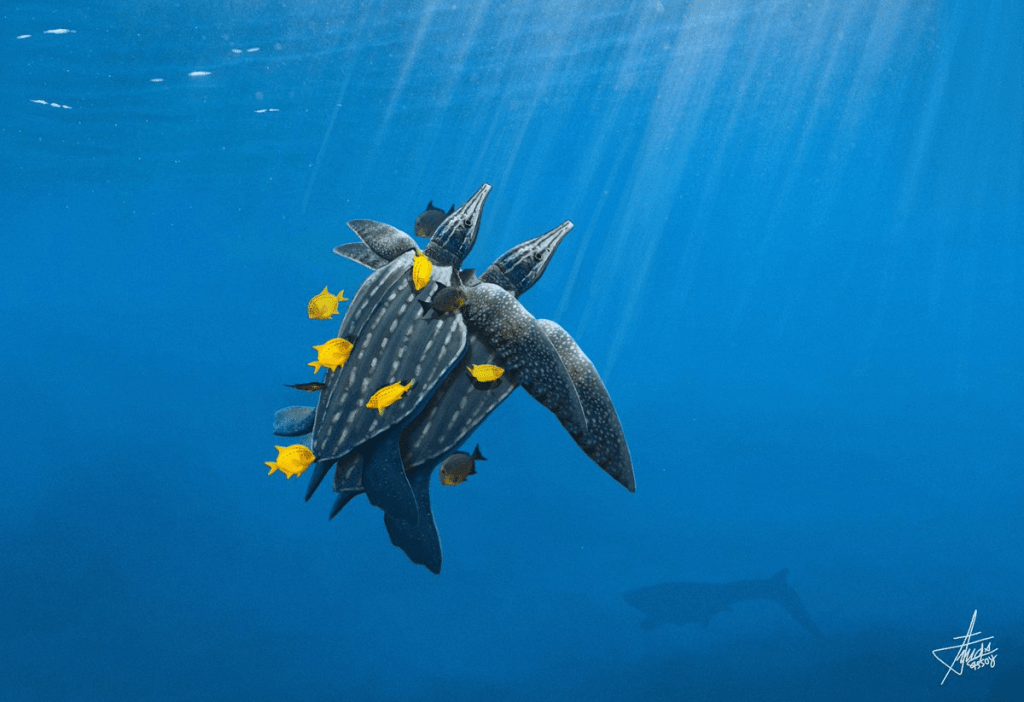
Subjects: Ocepechelon bouyai, fish, Mosasaur
Artist: @firdAssoy
Giant Protostegid turtles were common sights in the waterways of the Late Cretaceous, including the Moroccan genus Ocepechelon. In this image, a pair of turtles attempt to copulate as a shoal of small fish surround them and a mosasaur looms in the background. I love the contrast of the leatherback-inspired colours of the turtles with the yellow hues of the fish, accentuating both animals and drawing the eye of the viewer. The rays of sunlight penetrating from the surface is another fantastic detail, making it seem as though the turtles are being illuminated by the ocean that surrounds them.
Paleostream to Yixian!
Subjects: Numerous Dinosaurs and Pterosaurs from the Yixian Formation of China
Artist: Joschua Knüppe (@JoschuaKnuppe)
The Paleostream channel on Twitch is perhaps the best online forum for paleoart, with weekly streams dedicated to illustrating a handful of prehistoric animals at a time. Recently, Paleostream has taken to depicting various prehistoric locations chosen at random, and while each stream has produced some truly fantastic pieces, the Cretaceous Yixian Formation of China has stood out. Not only does Joschua Knüppe’s piece instil a calm sense of serenity in the morning glow of Yixian, but it also captures the sheer diversity of the formation. Anytime 7 different feathered dinosaurs can be convincingly fit into a single piece, it becomes elite in my books!

Beavers and Armadillos: Unlikely Companions
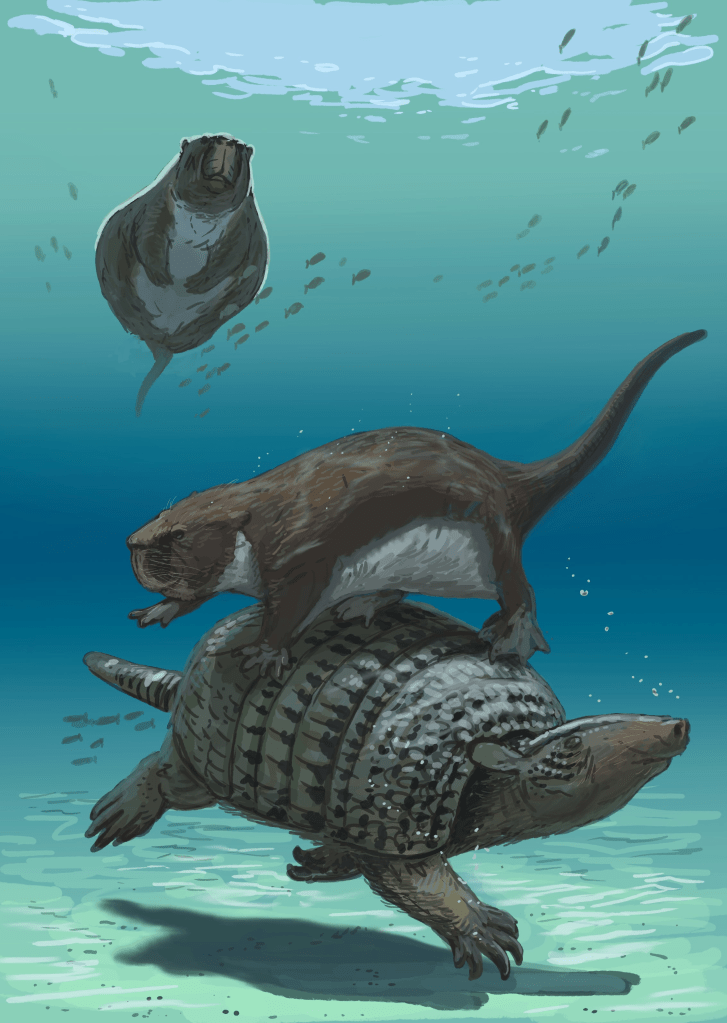
Subjects: Holmesina, Castoroides dilophidus
Artist: Artist: Joschua Knüppe (@JoschuaKnuppe)
The Pleistocene of North America was truly a wild time. Where else could you see giant Beavers and Armadillos interact? The sheer absurdity of this pairing is captured perfectly in this piece from Joschua Knüppe, as the expressions of both the giant beaver Castoroides and the Pampatheriid Armadillo Holmesina display confusion at the other. While it is unclear if the 500-pound Holmesina could swim as portrayed, modern Armadillos are quite good swimmers who paddle along the bottom of waterways, meaning such strange interactions may have occurred. The addition of small details to the scene by Knüppe, including sunlight reflecting off the Castoroides back and gas bubbles around the extinct mammals, goes along way in bringing the strange scene to life.
Zombie Fish: A Tale as Old as Time
Subject: Oncorhynchus rastrosus (the spike-toothed salmon)
Artist: Hodari Nundu (@HodariNundu)
Zombies aren’t just creatures of fiction, as some cases of zombie-like animals have been documented in the wild. No example is more famous than Salmon, whose bodies begin to decompose while the fish are still alive following spawning. There is no reason to believe that their extinct relatives, including the giant spike-toothed (née sabertoothed) salmon Oncorhynchus rastrosus, didn’t as well. What I love about Hodari’s piece is the murky colour of the water around the salmon, making it seem almost as though the water is rotting alongside the dying fish.

Thank you for reading this article! Paleoart is a crucial component of paleontology, and so it is of the utmost importance to celebrate it and the artists who work tirelessly to create it. This is now the third entry into my paleoart of the month series, one I hope to continue for a long time! For previous entries in the series, check out the paleoart category here at Max’s Blogosaurus.
https://maxs-blogo-saurus.com/category/paleoart/
I do not take credit for any images found in this article. All images belong to artists accompany each piece. Header image courtesy of Ashley Patch, whose work can be found on their twitter page linked above.
 Max's Blogo-Saurus