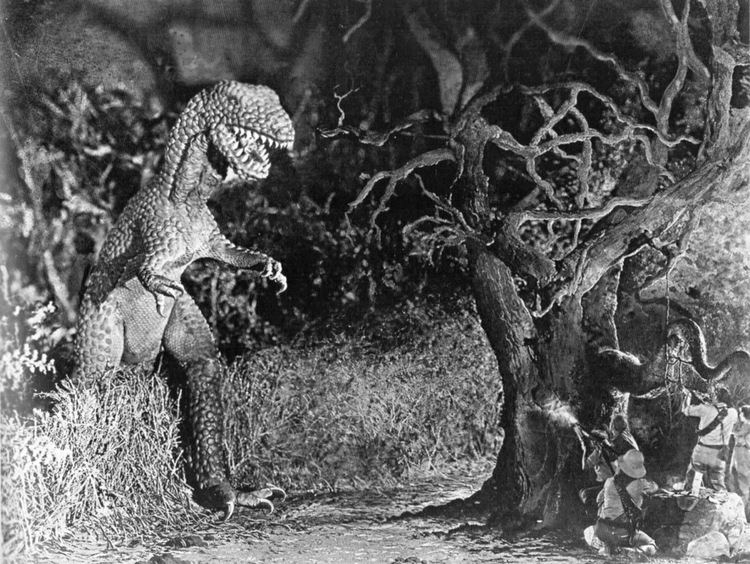
Welcome back to the 3-part 100th anniversary special of The Lost World, the first blockbuster dinosaur film! In part 1, the origins of The Lost World were covered in detail, from its inception as a way for Sir Arthur Conan Doyle to escape Sherlock Holmes to its legacy in the world of paleontology. I would recommend reading that article prior to today’s installment, which can be found at the following link. Part 2 will focus on the film itself, including the plot synopsis, inspiration behind the dinosaur models, and my own review. With that out of the way, let’s get right into it!
Table of Contents
- Film Link & Plot Summary: Facing Dinosaurs in the Name of Love?
- Film Conclusion: Brontosaurs in in London!
- Film Review: Enjoyable Camp, But Uncomfortably Dated
- Charles R. Knight: The Beauty Behind the Madness
- A Note on Miscast Jaguars
Film Link & Plot Summary: Facing Dinosaurs in the Name of Love?
Disclaimer: Many different versions of The Lost World can be found both online and on some streaming services. For the purposes of this article, the 1 hour and 43-minute-long cut, including the foreword by Sir Arthur Conan Doyle, will be used to review the film. Spoilers are present; if you would like to watch the film first, follow the YouTube link below.
The Lost World opens with Sir Arthur Conan Doyle inviting man-child audiences (real-quote) to enjoy the thrill of what is to come. We then transition to one of the central protagonists, Edward Malone (Lloyd Hughes), as he tries to convince his reluctant fiancée Gladys (Alma Bennett) to continue their engagement. Stating her desire for a man of action and courage, Malone is unceremoniously dumped and returns to his work as a reporter for the fictional London Record newspaper.
At the London Record, Malone overhears talk of Professor George Edward Challenger (Wallace Beery) and his seemingly wild tales of living dinosaurs in a hidden South American plateau. Sensing an opportunity to win his fiancée back – what could be more courageous than braving giant dinosaurs? – Malone attends Professor Challenger’s talk about his journey at a zoological meeting. Ridiculed by his contemporaries, Challenger implores the members of his audience to journey with him back to South America to see for themselves the long extinct animals roaming the hidden corners of the Amazon basin. Though Malone attempts to take him up on this offer, Challenger is enraged given that he is currently pursuing legal action against the London Record for defamation and chases Malone out of the building.

Later in the night, Malone breaks into Challenger’s home to make him reconsider. After a short tussle, Malone informs Challenger of his friendship to John Roxton (Lewis Stone), a fellow adventurer who was also present at Challenger’s talk. Now more accepting of the intrepid reporter, Challenger shows Malone a journal containing illustrations of the animals encountered in South America, including Brontosaurus and Allosaurus. Challenger also discloses the true purpose of the return mission: adventurer Maple White has gone missing in the plateau and his daughter Paula (Bessie Love) has requested his assistance in retrieving her father. Malone agrees to help fund the rescue mission through the London Record in exchange for the paper getting sole coverage of their journey to the lost world.
The crew – which includes Challenger, Paula, Malone, Roxton, uptight professor Summerlee (Arthur Hoyt), Challenger’s butler Austin (Francis Finch-Smiles) and servant Zambo (Jules Cowles) – set sail for South America. After camping in wooden huts, the crew heads upriver towards the plateau, encountering a variety of native animals including Sloths, Jaguars, and Constrictors. Eventually, the crew set up camp across the plateau and prepare for their journey.
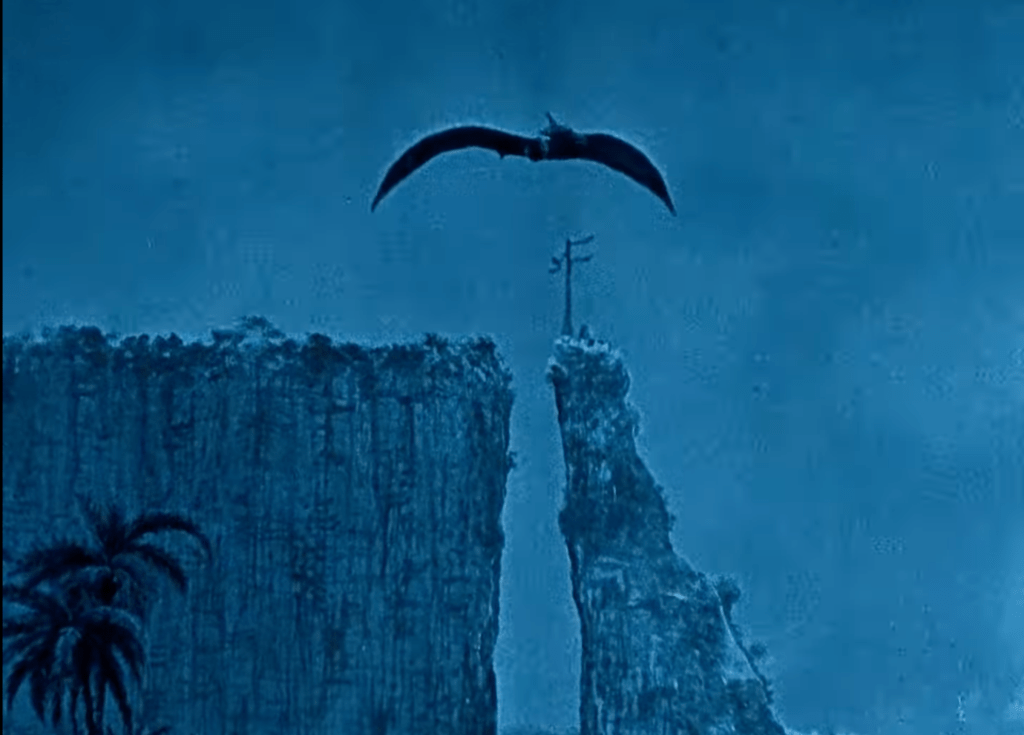
Before they can embark, the crew encounter their first prehistoric creatures. From atop the plateau, a clan of homicidal “ape-men” begin dropping boulders on their campsite. Shortly after, a large pterosaur Pteranodon is spotted soaring in the sky overhead before landing on a large perch. We zoom in on the Pteranodon to see it munching down on what is supposed to be a juvenile Toxodon, showing the intrepid travellers how dangerous their journey will be.
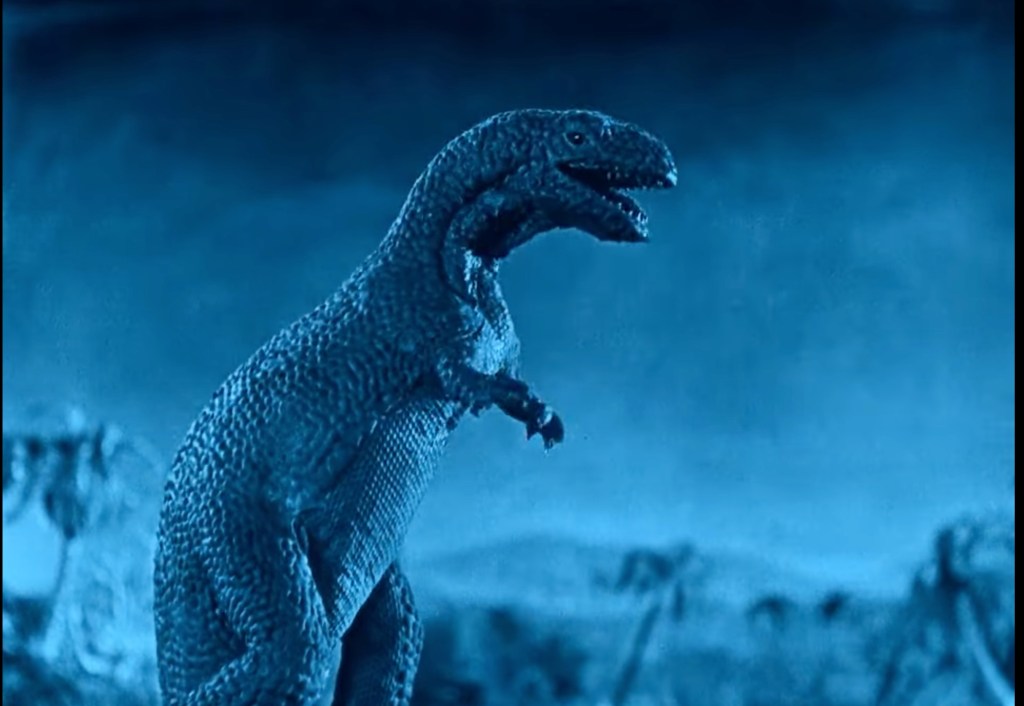
After the crew (minus Austin and Zambo, who remain at the base camp) cross into the plateau over a fallen log, we see the first real dinosaur as a Brontosaurus eats vegetation next to a river. Disturbed by the human’s presence, the giant dinosaur knocks the log down the cliffside, seemingly trapping the rescue team on the plateau. As the crew continues their mission, we see several dinosaurs including a family of Triceratops; an Allosaurus as it hunts the other dinosaurs on the plateau, killing an Edmontosaurus (called Trachodon) before being gouged by an Agathaumas (Triceratops, but spikier); and a Tyrannosaurus rex, who defeats the Agathaumas before snatching a Pteranodon out from midair.
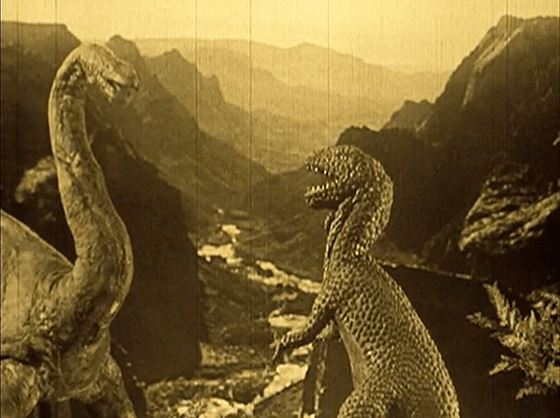
The crew’s attempts to view the carnage is interrupted by the ape-men who attempt to push Malone out of a tree. After Challenger shoots the escaping ape, the crew move into a series of nearby caves where Roxton finds the remains of Maple White. In his exploration of the cave, Roxton locates a tunnel to the outside world where he contacts Austin and Zambo to help them escape. Elsewhere, Malone begins a romantic relationship with Paula despite him being there to woo back his fiancée. Nice guy! Professor’s Challenger and Summerlee explore the surface, witnessing a battle between Brontosaurus and Tyrannosaurus rex that results in the Brontosaurus surviving a massive fall off the plateau to the world below.
Chaos begins once a dormant volcano starts to erupt, bathing the film in red light and causing the dinosaurs to panic. Deciding that it is time to end the mission, the crew escapes to the land below the plateau before one final encounter with the ape men. After seeing the fallen but still breathing Brontosaurus, Challenger decides he must bring it back to London as proof of the dinosaurs still roaming South America. Though it is not shown on screen, the team pack the dinosaur in a shipping container and embark on the journey back to the UK.
Film Conclusion: Brontosaurs in in London!
Upon their return, Malone discovers that his fiancée has left him for another man, thereby freeing him to pursue his relationship with Paula. Challenger calls another zoological meeting where he plans to present the living proof of the crew’s discoveries to those who doubted him. Amidst his announcement, he receives a call from Malone who informs him that the Brontosaurus has escaped and is now wreaking havoc.

In a scene that feels like the perfect trial run for his later work in King Kong, Willis O’Brien’s stop motion Brontosaurus brings chaos and destruction across downtown London. In its tirade, the Brontosaurus topples a large statue and brings down an entire building standing in its path, leading to frightened citizens fleeing at the sign of danger. Eventually, the Brontosaurus makes its way to Tower Bridge, where the immense weight of the sauropod causes it to collapse. But worry not! The immense sauropod, that has to this point survived an attack from a Tyrannosaurus rex and a fall of a massive plateau, begins to swim away into the Strait of Dover. The final shot of the movie is of the Brontosaurus swimming in the sea as a large ship looms in the background; in other words, the scene that Jurassic World copied in not one, but two of its films with its Mosasaur.

Rumour has it, the sauropod made its way to Scotland where it became the inspiration for the Loch Ness Monster…
Film Review: Enjoyable Camp, But Uncomfortably Dated
Before watching The Last World, the only other silent film I had viewed was Nosferatu: A Symphony of Horror, the original vampire movie and inspiration for Robert Eggers’ 2024 sequel. After watching two silent films released relatively close together (1922 and 1925), I have come to appreciate and enjoy the art.
To compensate for a lack of sound, every motion and action made by the actors are overexaggerated. Want to convey fear? Zoom in on the horrified face of your lead actress for 30 seconds. Trying to make sure the audience knows two characters are fighting with each other? Have one chase the other around half of London for a good five minutes. It may not be the most nuanced way of acting, but it is charming and easy to have fun with. I too would stare with pure horror if a Pteranodon started munching on a Toxodon head in front of me!

The other beauty of silent films is the accompanying orchestra. It feels bizarre to watch a film in which almost every second of its runtime is accompanied by orchestral music, but the lack of dialogue makes it necessary for silent films. The atmosphere of each scene is captured perfectly by the music, with tense scenes accompanied by swelling symphonies and more relaxed moments being reflected in slower clarinet solos. As has been demonstrated on numerous occasions, having a great soundtrack is a vital part of quality filmmaking (cough, Star Wars, cough). The Lost World excels in this department.
The plot of the film is enjoyable and easy to follow. All the major tropes that would come to define lost-island films – an adventurer in need of rescue, a daring and somewhat crazy professor leading the expedition, a cataclysm bringing an end to the hidden paradise, and more – are present here. It’s clear that although Doyle left the project, those who remained paid great respect to bring his novella to life; if only this were the case in subsequent lost-world films, where these original ideas became overused and uninspired.
One major problem with The Lost World is the racist overtones. One character, the Indian servant Zambo, is played by a white actor in blackface. The symbolism of ape men living deep in the unexplored wilderness who seek to murder the white, European characters is not what I would call subtle. From all accounts, the book is even more heavy-handed in this allegory, with non-white characters being dehumanized to make Challenger’s crew appear superior to them.

If this content makes the film difficult or outright unwatchable, I understand completely. It is the unfortunate reality of Western civilization that such portrayals were commonplace in the late 19th and 20th centuries, and while it is easy to dismiss these depictions as being par for the times, ignoring history is how we have become a society where open racism is tolerated by some and embraced by others. So, while The Lost World is a relatively fun movie in a vacuum, the racist societal overtones of the early 20th century can make it an uncomfortable watch, to say the least.
Charles R. Knight: The Beauty Behind the Madness
For those familiar with the early days of paleoart, the clay dinosaurs featured in The Lost World may be recognizable. That’s because the main inspiration for Willis O’Brien’s creations was the work of Charles R. Knight, a revolutionary artist who is considered by many to be one of the greatest and most influential paleoartist to have ever lived[i].

Beginning in 1894, Knight was employed as the world’s foremost paleoartist by the American Museum of Natural History (AMNH) in New York City, USA. First commissioned to recreate several of the museum’s mammalian discoveries such as Entelodon, it wouldn’t take Knight long to move onto the many dinosaurs populating the AMNH’s halls. In 1897, Knight created three murals of the dinosaurs Agathaumas, Trachodon, and Laelaps (now Dryptosaurus); the first two would serve as inspiration for the dinosaurs of the same name in The Lost World, while his “leaping Laelaps” mural was one of the first pieces to bring active postures and behaviours to prehistoric animals.
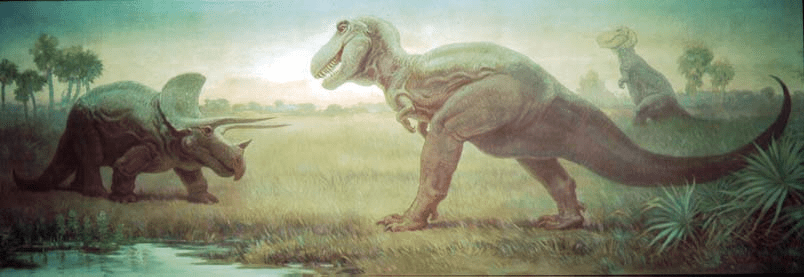
Knight’s work became so renowned that, according to paleontologist Mark Witton, fossil displays became secondary to his work[ii]. If you find this hard to believe, consider that institutions such as the Carnegie Museum in Pittsburgh, the Smithsonian in Washington, the Field Museum in Chicago, the Natural History Museum of LA County, and Yale’s Peabody Museum – all well-respected paleontological institutions – built exhibits off the back of Knight’s illustrations[iii]. In fact, many of those museums still use Knight’s work in the present day, signifying just how beautiful and timeless his work is.
Prior to The Lost World’s cinematic adaptation, Knight reportedly met Sir Arthur Conan Doyle in the 1890’s[iv]. This would not result in Knight’s work being used for the concept art of The Lost World novel in 1912, with those honours instead being given to other artists including Harry Rountree and Joseph Clement Coll[v]. For the film adaptation, O’Brien’s familiarity with paleontology likely meant he had followed Knight’s work for some time, resulting in his artistry being incorporated into the final designs of the film.
It seems clear where O’Brien got inspiration from when creating designs for dinosaurs such as Triceratops, Brontosaurus, Allosaurus, Stegosaurus, and Agathaumas:


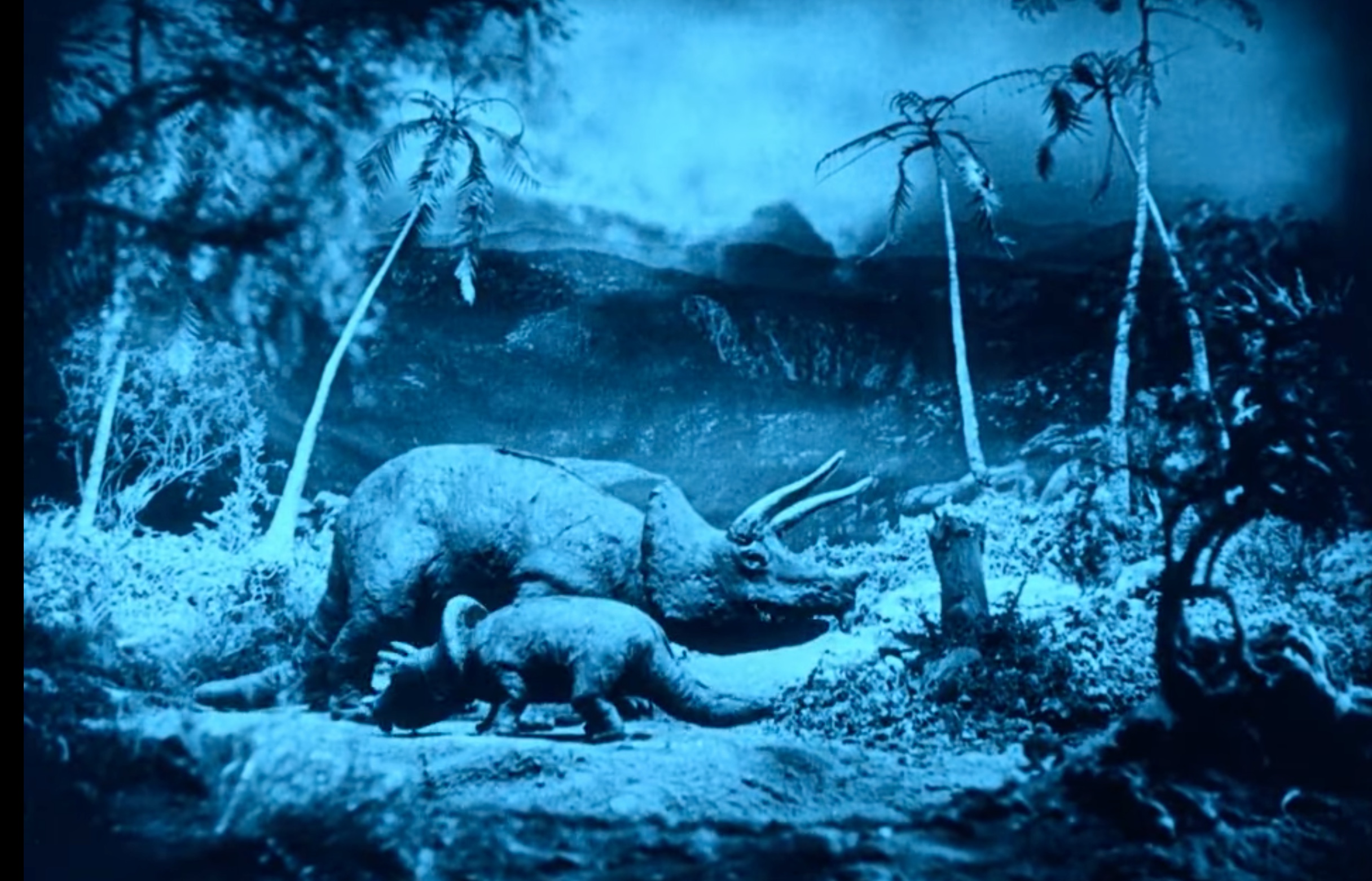
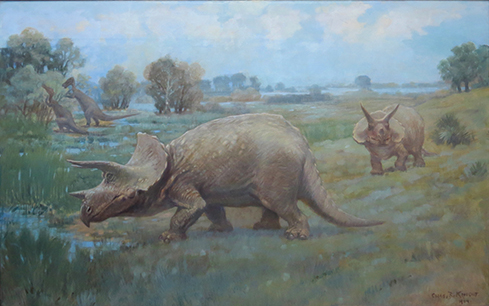


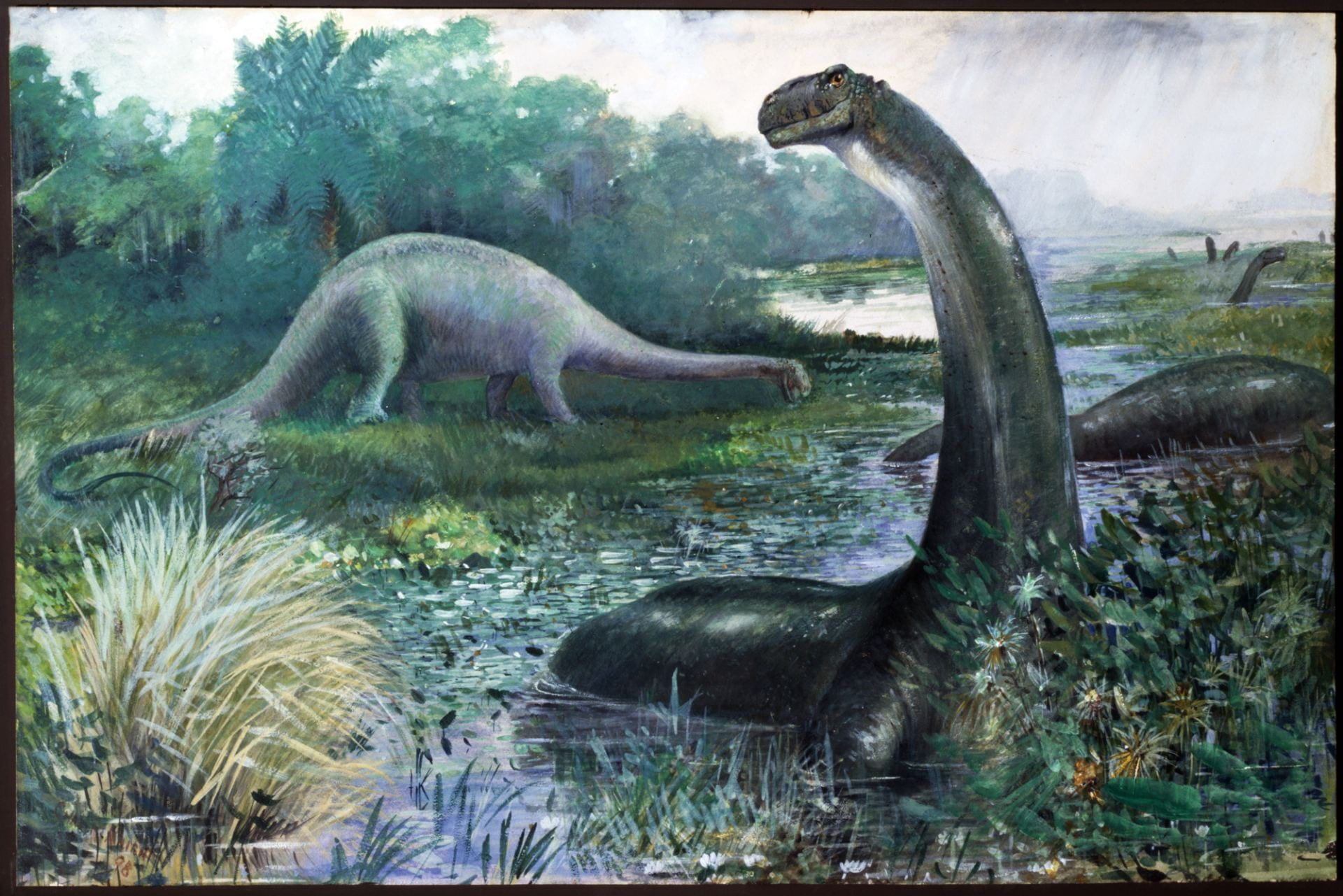

Knight may have not needed The Lost World to establish or even solidify his legacy in paleontology, but it doesn’t hurt to have been the inspiration for the first dinosaur blockbuster.
A Note on Miscast Jaguars
When Challenger’s crew first traversed the heart of South America, they encounter several of the continents living wildlife, including sloths, monkeys, and…
…wait, is that supposed to be a Jaguar?

When I first laid eyes on the stock footage of South America’s deadliest predator, something felt off. The big cat featured on screen appeared to be far too slim to be a Jaguar (even with the 10 pounds added on from the camera!), and the spot patterns looked just a little bit wrong. I checked with several of my friends to confirm my hunch, all of whom shared my opinion: the big cat featured in The Lost World is not a Jaguar, but a Leopard.
I couldn’t find any direct confirmation from the production of the film, but the appearance of the big cat speaks for itself. Why the film’s producers made this change is something I have puzzled over for some time. At one point, it seemed as though this choice reflected a lack of captive Jaguars in the 1920’s. However, this is incorrect as captive Jaguars had been present in North America starting in 1875[vi]. Perhaps no Jaguars were available at the time of filming; after all, there are less than 200 captive Jaguars currently in the world and the species has been noted to have difficulties living in captivity[vii][viii].
In any scenario, it is quite hilarious to see a Leopard masquerading as a Jaguar, and even more hilarious to consider that most of the film’s original audience would have been none the wiser. After all, it’s not as though citizens living in New York and Boston during the 1920s were knowledgeable about big cats!
Thank you for reading part 2 of The Lost World anniversary special! To finish things off, part 3 will look at how the dinosaurs have changed since their cinematic debut, including comparisons of what was known at the time and what is known today!
I do not take credit for any images found in this article. All images come courtesy of the tagged artists.
Works Cited:
[i] Black, R. (2012, January 6). Charles R. Knight’s Prehistoric Visions. Smithsonian Magazine, https://www.smithsonianmag.com/science-nature/charles-r-knights-prehistoric-visions-16099537/
[ii] Witton, M. P. (2020). Life Through the Ages II: Twenty-first Century Visions of Prehistory. Indiana University Press.
[iii] Hannotte, D. (n.d.). Charles R. Knight: Learn about Knight’s life. http://www.charlesrknight.com/Biography.htm
[iv] Hannotte, D. (n.d.). Charles R. Knight: Learn about Knight’s life. http://www.charlesrknight.com/Biography.htm
[v] The Lost World – The Arthur Conan Doyle Encyclopedia. (n.d.). https://www.arthur-conan-doyle.com/index.php/The_Lost_World
[vi] Cañizales, I. (2021). Comparative Morphometric Analysis Of Captive Jaguars Vs. Wild Jaguars (Panthera onca) In Venezuela. bioRxiv (Cold Spring Harbor Laboratory). https://doi.org/10.1101/2021.05.04.442612
[vii] Jaguars struggle for survival. (2024, October 7th). Wild Earth News & Facts. https://www.adoptananimalkits.com/advocate/wild-earth/params/post/1286153/jaguars-struggle-for-survival#:~:text=But%20no%20amount%20of%20care,their%20natural%20routines%20and%20behaviors
[viii] Modena, P. Z., Adania, C. H., Lopez, V. M., & Guillermo-Ferreira, R. (2023). Maternal behavioural analysis during a successful captive breeding of jaguars Panthera onca. Theriogenology Wild, 2, 100027. https://doi.org/10.1016/j.therwi.2023.100027
[i] Black, R. (2012, January 6). Charles R. Knight’s Prehistoric Visions. Smithsonian Magazine, https://www.smithsonianmag.com/science-nature/charles-r-knights-prehistoric-visions-16099537/
[ii] Witton, M. P. (2020). Life Through the Ages II: Twenty-first Century Visions of Prehistory. Indiana University Press.
[iii] Hannotte, D. (n.d.). Charles R. Knight: Learn about Knight’s life. http://www.charlesrknight.com/Biography.htm
[iv] Hannotte, D. (n.d.). Charles R. Knight: Learn about Knight’s life. http://www.charlesrknight.com/Biography.htm
[v] The Lost World – The Arthur Conan Doyle Encyclopedia. (n.d.). https://www.arthur-conan-doyle.com/index.php/The_Lost_World
[vi] Cañizales, I. (2021). Comparative Morphometric Analysis Of Captive Jaguars Vs. Wild Jaguars (Panthera onca) In Venezuela. bioRxiv (Cold Spring Harbor Laboratory). https://doi.org/10.1101/2021.05.04.442612
[vii] Jaguars struggle for survival. (2024, October 7th). Wild Earth News & Facts. https://www.adoptananimalkits.com/advocate/wild-earth/params/post/1286153/jaguars-struggle-for-survival#:~:text=But%20no%20amount%20of%20care,their%20natural%20routines%20and%20behaviors
[viii] Modena, P. Z., Adania, C. H., Lopez, V. M., & Guillermo-Ferreira, R. (2023). Maternal behavioural analysis during a successful captive breeding of jaguars Panthera onca. Theriogenology Wild, 2, 100027. https://doi.org/10.1016/j.therwi.2023.100027
 Max's Blogo-Saurus