
Good news for the Tyrannosaurids: it’s possible that the infamous Ankylosaur tail clubs did not evolve with the sole purpose of bashing their shins.
If only they were alive to hear it!
Few dinosaurs were as outwardly intimidating as the Ankylosaurs. These low-set quadrupeds came equipped with rows of armour made from a series of bony projections known as osteoderms. In some later species – the Ankylosaurines – the osteoderms at the end of their tail became fused, forming massive tail clubs. These clubs have long been associated with defence from predators, namely the giant Tyrannosaurids that lived alongside Ankylosaurines throughout the Late Cretaceous.

This association culminated in the 2017 discovery of a well-preserved Ankylosaurine from the Judith River Formation of Montana, USA. Canadian paleontologists Victoria Arbour and David Evans named the new genus Zuul crurivastator, which translates to “Zuul: The destroyer of shins.” Zuul refers to one of the monsters featured in the original Ghostbusters film, while the destroyer of shins has a far more…obvious origin[i]. Given its 2.5-tonne frame and formidable tail club, it seemed like the name crurivastator was beyond suitable for this prehistoric tank.
Yet, the “destroyer of shins” ultimately undermined the myth behind the Ankylosaur tail club. In December 2022, an analysis of Zuul’s body armour by Arbour, Evans, and Lindsay Zanno revealed a series of damaged osteoderms positioned on the lateral sides of Zuul’s hips[ii]. The pathological osteoderms were blunted and rounded, indicating that the damage inflicted upon them had occurred over a sustained period and not from a single attack by a predator. Instead, Arbour and Co. believe the injuries resulted from a confrontation with a much different adversary: another Zuul.

Why would Zuul fight each other? One answer may be simple: sex. Or, to be more accurate, sexual selection, which (to simplify) is the process of animals battling for and selecting mates. Under this theory, the tail clubs of Ankylosaurines did not evolve to fend off predators but rather for intraspecific combat with other Ankylosaurines in hopes of attracting females. Males would joust with each other, using their formidable clubs as deadly weapons to fend off challengers. Those who defeated their rivals would earn the right to mate; the losers suffered potential injuries and humiliation. To the victor go the spoils!
Plenty of additional evidence exists to support this hypothesis. The tails of juvenile Ankylosaurines lack a developed club, which indicates that this trait may have appeared when the animals became sexually mature[iii]. A similar evolution of sociosexual attributes during adolescence occurred in many other dinosaur families. Two notable examples are the ceratopsians and hadrosaurids, whose elaborate frills and crests developed once the animals approached sexual maturity. Dinosaur adolescence must have been a painful experience!
Another source of evidence lies in the presence of club-less Ankylosaurs in the Late Cretaceous. Known as the Nodosaurids, this group may have lacked the massive clubs of their Ankylosaurine cousins, but they were just as successful. In locations such as Alberta and Montana, clubbed Ankylosaurids like Euoplocephalus and Ankylosaurus accompanied Nodosaurids like Edmontonia, Panoplosaurus, and Denversaurus. If the tail clubs provided an advantage against predators, we would expect the Ankylosaurids to be more successful than their Nodosaurid cousins. However, the success of the Nodosaurids indicates otherwise, suggesting that tail clubs evolved for a different purpose.

The final piece of evidence lies in the prevalence of intraspecific combat for sexual selection amongst living species. Look no further than Deer and Moose, whose massive headgear did not evolve to batter wolves but to attract females and combat other males for the right to mate. Generally, a common trend exists: when an elaborate trait appears, odds are its original purpose was to attract mates!
Nowhere is this more prevalent than in the birds – aka, the dinosaurs living descendants. Although most birds don’t combat each other with giant tail clubs, they have evolved elaborate displays to attract mates. Male birds-of-paradise, or Cabot’s tragopan, possess bright, flashy plumage designed to seduce the far duller females. Though the tail club of Zuul had a much different utility, it ultimately had the same purpose as the tail feathers of a male peacock!

An alternate proposal for intraspecific Ankylosaur combat could be due to territoriality. We know from the fossil record that Ankylosaurs were rare in their habitats, which could be due to individuals marking out large territories. While this behaviour is often associated with predators, some herbivores – namely Rhinos, an animal sometimes equated with modern Ankylosaurs – practise territoriality as well[iv]. If a rival Zuul stumbled into another’s territory, it would have been time to bring the clubs out!
None of this is to say that Ankylosaurines like Zuul didn’t use their clubs to smash some predator shins. After all, it’s important to remember that traits often have multiple uses. Take the necks of Giraffes, for example. While these lengthy structures aid Giraffes in reaching food inaccessible to other herbivores, males also bash their necks together in violent displays during the mating season.
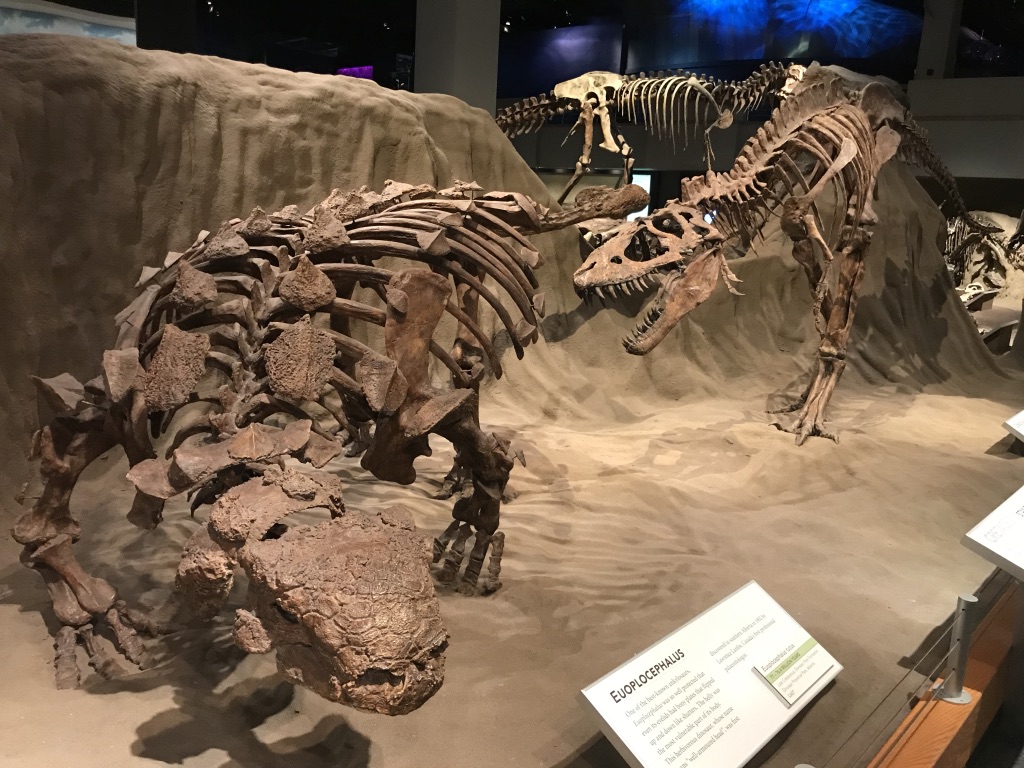
So, while Ankylosaur tail clubs may have evolved to fight for love, they could still be used as formidable weapons. Past studies have indicated that the tail clubs of Zuul-sized Ankylosaurines could easily smash through bone[v]. Plus, some Tyrannosaur fossils (such as an Albertosaurus on display at the Royal Ontario Museum) have curious leg injuries at the exact height of Ankylosaur tail clubs…
Ultimately, one thing is clear: whether you were a Tyrannosaur or another armoured dinosaur, the clubs of Ankylosaurs like Zuul crurivastator were rated E for everyone.
Thank you for reading this article! If you like armoured dinosaurs and want to know about their version of the holy grail, read about Borealopelta: The World’s Best Fossil, here at Max’s Blogosaurus!
I do not take credit for any images found in this article. Header image courtesy of Jack Mayer Wood, found here.
Works Cited
[i] Arbour, V. M., & Evans, D. C. (2017). A new ankylosaurine dinosaur from the Judith River Formation of Montana, USA, based on an exceptional skeleton with soft tissue preservation. Royal Society Open Science, 4(5), 161086. https://doi.org/10.1098/rsos.161086
[ii] Arbour, Victoria M., et al. “Palaeopathological Evidence for Intraspecific Combat in Ankylosaurid Dinosaurs.” Biology Letters, vol. 18, no. 12, 2022, https://doi.org/10.1098/rsbl.2022.0404.
[iii] Arbour, Victoria Megan, and David Evans. Zuul: Life of an Armoured Dinosaur. Royal Ontario Museum, 2018.
[iv] “White Rhino.” WWF, www.worldwildlife.org/species/white-rhino#:~:text=Groups%20of%20sometimes%2014%20rhinos,habitat%20quality%20and%20population%20density. Accessed 7 Aug. 2023.
[v] Arbour, Victoria M., and Eric Snively. “Finite Element Analyses of Ankylosaurid Dinosaur Tail Club Impacts.” The Anatomical Record: Advances in Integrative Anatomy and Evolutionary Biology, vol. 292, no. 9, 2009, pp. 1412–1426, https://doi.org/10.1002/ar.20987.
 Max's Blogo-Saurus

3 replies on “Zuul crurivastator & the True Origins of Ankylosaur Tail Clubs”
So the big question is did female ankylosaurs have clubs on the end of their tail? That would help to determine if it was only used for sexual fighting or also defense.
LikeLike
In theory that would be a good indicator. However, dinosaurs are a bit different than living animals. In modern species – particularly mammals like Deer and Moose – it is true that only males carry ornamentation, yet this doesn’t seem to be the case for dinosaurs. Triceratops is known from hundreds of fossil skulls, all of which feature the massive brow horns and frill that were likely used for sexual selection. While we can’t know for sure what gender the specimens are, it’s highly improbable that they were all one sex!
Ankylosaurs have a much weaker sample size, but it does appear as though females would have possessed tail clubs too. This doesn’t mean they weren’t used for sexual selection, as males still very well could have used their tails to joust for mates. It may also suggest a third potential use for the tail clubs: species identification. Some habitats (such as the Nemegt Formation in Mongolia) featured multiple Ankylosaurs living together, meaning differentiated tail clubs would go a long way for members of each species to identify each other. In this scenario, reproductive females possessing distinct tail clubs would be of the utmost importance!
LikeLike
So the big question is whether female ankylosaurus also had a club on the end of their tail. This would help to determine if the club was only for sexual dominance or also for defense.
LikeLike