
Keeping up with the latest paleontology news is a challenge, even for the most dedicated of followers. So, why not make it a bit easier?
In this series of periodic articles, I will recap some of the biggest storylines from around the world of paleontology. Now, not every story can be covered in these articles; otherwise, you might be subjected to 10,000 words of me rambling! Instead, 8-10 of the most interesting, important, or relevant studies and headlines (as judged by yours truly) will be discussed. Some large discoveries will warrant their own separate article but will be mentioned and linked within this article as well.
- The Big News: First Glimpses of Walking with Dinosaurs
- The United Kingdom’s Largest Dinosaur Trackway
- Archaeopteryx Specimen #14
- North America’s Oldest Dinosaur: Ahvaytum
- The New (Old) Carcharodontosaurid, Tameryraptor
- Fossil Snow Leopards…in Portugal?
- Giant Ground Sloths: Shaggy or Bald?
- The Bissekty Ornithomimid, Dzharacursor
- Insects in the Brain: Trace Fossils in Dinosaur Bones
The Big News: First Glimpses of Walking with Dinosaurs
6 months after the BBC announced that their legendary documentary series Walking with Dinosaurs would be receiving a long-awaited sequel, we finally have our first glimpse of what is to come. On January 22nd, the BBC’s social media accounts posted three preview images of the dinosaurs that will be featured in the series, namely the Tyrannosaur Albertosaurus and the Ceratopsian Pachyrhinosaurus. Both species look great, and while Pachyrhinosaurus has become a bit overused in mainstream paleomedia, the grizzled muzzle and stunning blue eyes of the Albertosaurus are truly refreshing:

The photographs have confirmed my suspicion that one episode of the series will focus on Canadian dinosaurs from the Campanian Cretaceous. Other confirmed episodes will feature dinosaurs such as Lusotitan in Jurassic Portugal, Tyrannosaurus rex, Utahraptor, and Gastonia in two seperate Cretaceous episodes, and Spinosaurus in Cretaceous Africa. The contents of the sixth episode remain unknown; here’s hoping that we get some Triassic content! Regardless, the first images of Walking with Dinosaurs 2025 are an encouraging sign of things to come for the series.
The United Kingdom’s Largest Dinosaur Trackway
Ichnofossils – trace remains of prehistoric animals such as burrows and tracks – rarely get media coverage, but sometimes there are exceptions. The discovery of a massive dinosaur track site in an Oxfordshire quarry sent Western media outlets into a frenzy, and for good reason. The 150-meter-long site is the largest recorded in the United Kingdom and amongst the largest in the world[i]. Five trackways from two dinosaur species – a large sauropod in the vein of Cetiosaurus, and a theropod like Megalosaurus – are present at the site. The individual tracks are so large that they are easily visible from an aerial perspective:

While we can’t say for certain that the carnivorous theropod was hunting the sauropods, some of the footprints do overlap, meaning the theropod couldn’t have been too far behind. Nonetheless, the site has provided paleontologists with a terrific snapshot into life during the Middle Jurassic, with more footprints potentially awaiting as excavations continue at the quarry.
Archaeopteryx Specimen #14
On January 3rd, European paleontologists led by Christian Foth of the University of Fribourg published a study describing the 14th known specimen of Archaeopteryx known to science[i]. Discovered years prior in the Late Jurassic Mörnsheim Formation of southern Germany, the specimen consists primarily of the right forelimb and shoulder, with fragmentary elements of other limbs also present on the small slab of limestone. While not the most complete or well-preserved fossil, the specimen may still be able to provide important information about Archaeopteryx and its transition to the skies of the Late Jurassic. Plus, the significance of Archaeopteryx in the context of bird evolution and evolutionary theory makes every new specimen noteworthy – regardless of its condition.
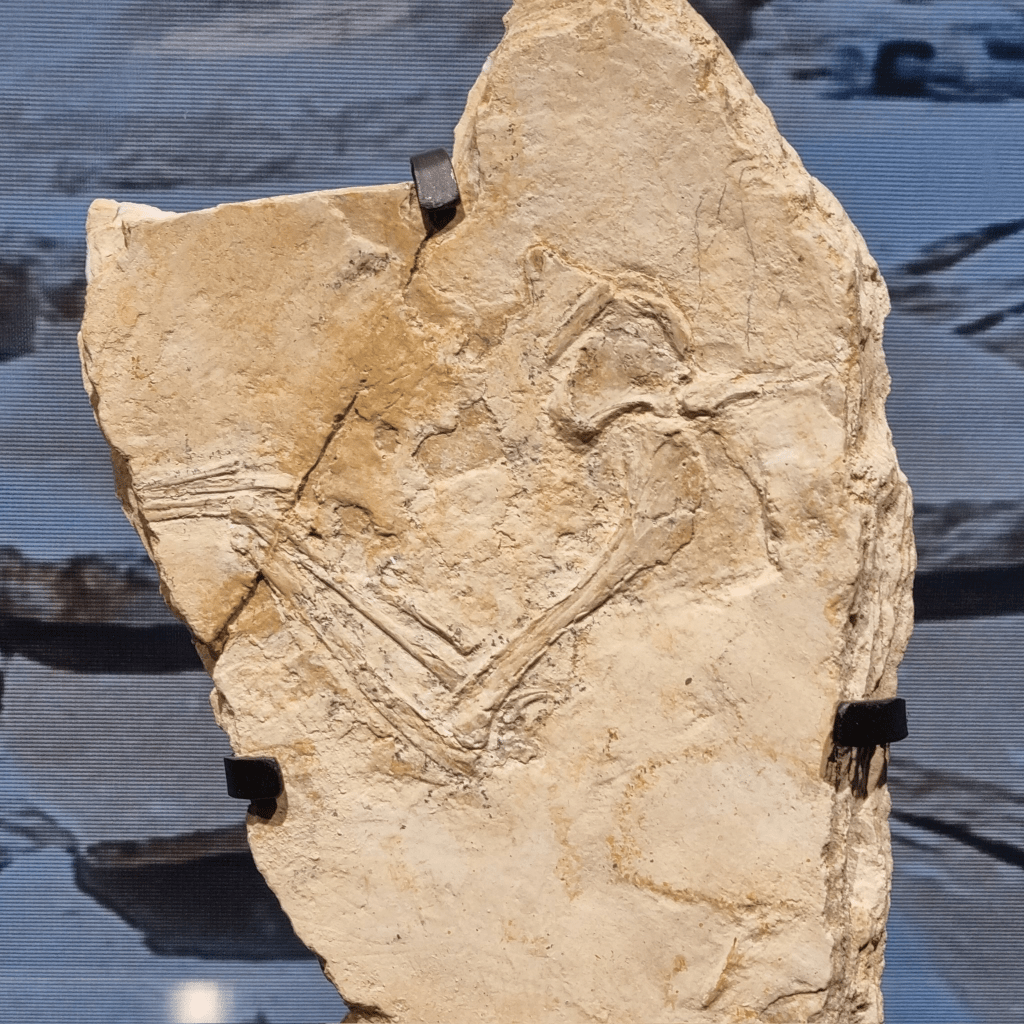
A cast of the specimen is on display at the Oertijdmuseum in Boxtel, Netherlands.
North America’s Oldest Dinosaur: Ahvaytum
Us North Americans can finally say we have our very own Eoraptor!Named Ahvaytum bahndooiveche, fossils of this 229-million-year-old dinosauromorph were discovered in the Triassic Popo Agie Formation of Wyoming, USA[i]. Morphological analyses have suggested that Ahvaytum was an early sauropodomorph, the dinosaur lineage that would become the largest animals to ever walk the earth. Yet Ahvaytum was only the size of a chicken, a far cry from the 40-plus tonne giants its ancestors would later become. The presence of Ahvaytum in North America has raised several questions regarding biogeography during the Mid-Triassic, as the closest cousins of Ahvaytum lived on the opposite side of a supposedly inhospitable equatorial region of Triassic Pangea.

For a more complete description of Ahvaytum, including the awesome story behind its name, take a look at this article: https://maxs-blogo-saurus.com/2025/01/08/ahvaytum-bahndooiveche-north-americas-oldest-dinosaur/
The New (Old) Carcharodontosaurid, Tameryraptor
Easily the most surprising news of January was the redescription of Ernst Stromer’s lost Carcharodontosaurus fossils. Discovered in Egypt during the 1910’s, the skeleton previously assigned to Carcharodontosaurus – which included parts of the skull, hips, and limbs – was destroyed during an Allied bombing raid of Munich in April 1944. However, recent analysis of Stromer’s written descriptions and a newfound photograph of the specimen has revealed that it belonged to a new genus of dinosaur, named Tameryraptor markgrafi[i]. While the bones of this large predator may still be lost to history, we do know a few interesting things about it, including the presence of a small horn-like structure on its face and triangular shark-like teeth inside its mouth.

This article includes a more complete description of Tameryraptor: https://maxs-blogo-saurus.com/2025/01/15/examination-of-lost-carcharodontosaurus-bones-reveal-new-horned-genus-tameryraptor/
Fossil Snow Leopards…in Portugal?
Snow Leopards are one of the most unique big cats alive today, a powerful predator adapted to navigating the high-altitude regions of central Asia in pursuit of prey. Their current distribution makes the recent identification of Snow Leopard fossils in the Iberian Peninsula of Portugal quite the story, confirming that several dispersal events occurred in the species Panthera uncia during the Pleistocene Epoch[i]. The analyses of the Portuguese material also included a description of several anatomical traits designed for aiding Snow Leopard’s high-altitude lifestyle, including a large nasal cavity designed to aid warming frigid mountainous air and strong jaws for tackling strong prey like Ibex, Sheep, and Tahr. One thing is for sure: between the Cave Lions, Lynxes, Homotherium, and now Snow Leopards, Pleistocene Europe would have been teaming with big cats!
Giant Ground Sloths: Shaggy or Bald?
Did the largest family of ground sloths – the appropriately titled Megatheriids – have full body hair? While it may seem a bizarre question to ask given that fossilized hair has been found on several smaller ground sloth species, the immense size of Megatheriids like Megatherium and Eremotherium (both estimated to weigh around 4 tonnes) makes thermodynamics difficult. Larger animals have more trouble dissipating heat, which would make a full body covering on the elephant sized animals extremely costly – in theory.

Luckily for the Megatheriids, their crappy metabolisms made up for their size! A study undertaken by Michael Deak of Youngstown State University found that ground sloths possessed slow metabolic rates like their living cousins, meaning they could get away with possessing a coat of fur[i]. In fact, the relatively cold habitats of several of Megatheriids would have required thick fur coats to survive, with Megatherium estimated to have required a 30mm coat in some parts of its range. Some species still would have remained hairless, particularly those living in tropical conditions such as Eremotherium. While we cannot fully kiss bald depictions of giant ground sloths goodbye, at least we know that some remained as shaggy as their cousins!
The Bissekty Ornithomimid, Dzharacursor
Ornithomimid fossils are reportedly the most abundant theropod remains in Uzbekistan’s Late Cretaceous (~90-million-year-old) Bissekty Formation, making a proper genus name overdue. On January 9th, paleontologists Alexander Averianov and Hans-Dieter Sues published a description of Dzharacursor bissektensis, a basal Ornithomimid known from fossils of the skull, vertebrae, and hindlimbs[i]. Once thought to belong to a subspecies of the Mongolian Archaeornithomimus, Averianov and Sues found several unique characteristics in the Uzbek dinosaur, establishing it as a new genus of Ostrich mimic. Its presence helps solidify the theory that Ornithomimids originated in Asia, later dispersing to North America during later stages of the Cretaceous.
Insects in the Brain: Trace Fossils in Dinosaur Bones
The last of my chosen paleontology headlines pertains to a few unique dinosaur bones from Canada and Uruguay. In Canada, close examination of a fragmentary Triceratops specimen has revealed the presence of trace fossils on the bones made by other organisms after the Triceratops died[i]. Several markings were made by plant roots that wrapped around the skeleton, while the presence of spherical holes suggests that prehistoric insects burrowed into the bones to create a temporary home for themselves.
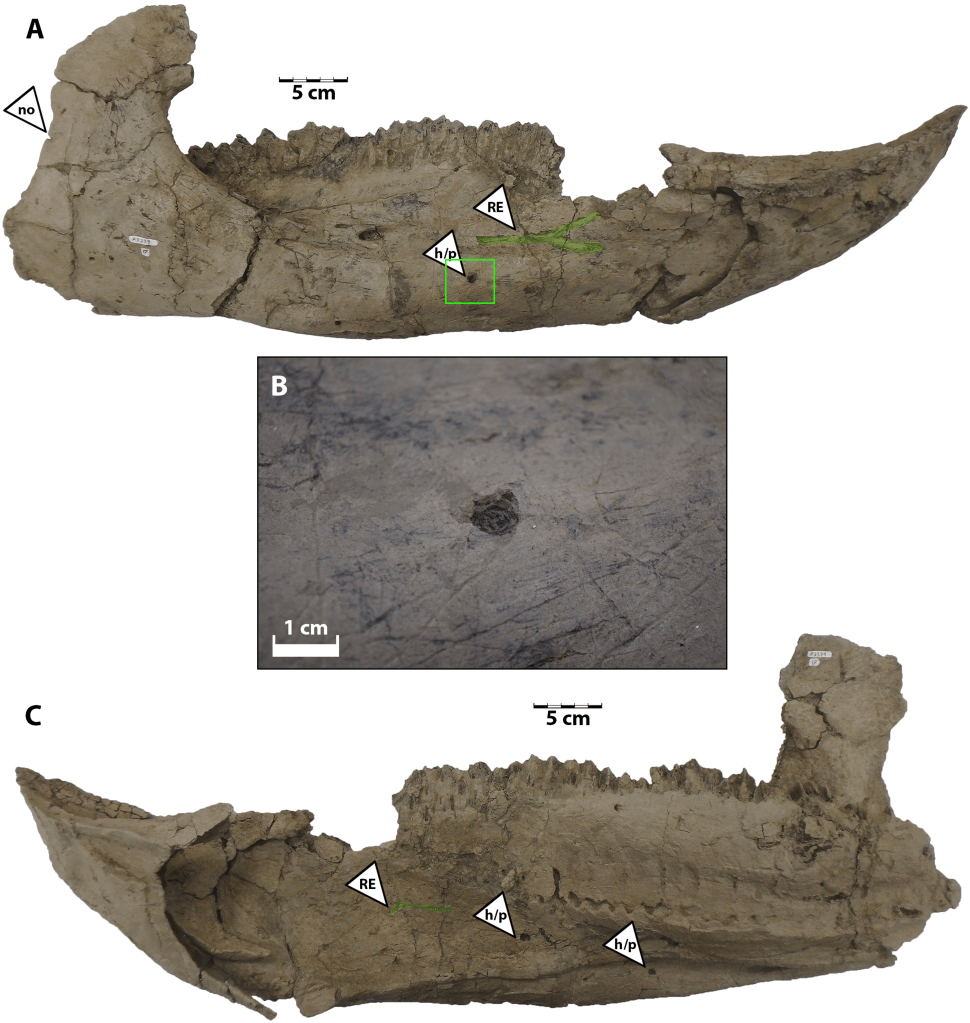
When thinking of trace fossils associated with Triceratops bones, you would normally expect to hear about a Tyrannosaurus bite mark or evidence of intraspecific combat. Yet this fossil shows a more complete picture of Triceratops’ importance to its ecosystem, as both plant roots and beetle larvae appear to have used the titanic herbivore’s bones for survival.
In Uruguay, trace fossils on the sauropod Udelartitan are believed to have been made by beetles and a multituberculate mammal, an extinct clade famous for their giant premolars[ii]. It is believed that several of the markings on the dinosaur bones were made when a small scavenger gnawed on the dinosaur’s bones, perhaps trying to scrape off small bits of flesh. Dinosaurs 0, mammals 1!
Finding trace fossils on dinosaur bones isn’t all that common, so to find such unique markings on not one, but two skeletons in January is truly incredible.
I do not take credit for any images found in this article. Header images from top to bottom come courtesy of University of Birmingham via the Associated Press; Kellerman et. al 2025; and, the BBC.
Works Cited:
[i] Milligan, J. R., Bamforth, E. L., Mángano, M. G., & Buatois, L. A. (2025). Taphonomic history of a dinosaur skeleton from the upper Cretaceous Frenchman Formation, Canada: insights from ancient rhizoetchings and invertebrate bioerosion trace fossils. Ichnos/Ichnos : An International Journal for Plant and Animal Traces, 1–20. https://doi.org/10.1080/10420940.2025.2449656
[ii] Perea, D., Verde, M., Mesa, V., Soto, M., & Montenegro, F. (2025). Bioerosion structures on dinosaur bones probably made by multituberculate mammals and dermestid beetles (Guichón formation, late Cretaceous of Uruguay). Fossil Studies, 3(1), 2. https://doi.org/10.3390/fossils3010002
[i] Averianov, A. O., & Sues, H. 2025. A new ornithomimid theropod from the Upper Cretaceous Bissekty Formation of Uzbekistan. Journal of Vertebrate Paleontology. https://doi.org/10.1080/02724634.2024.2433759
[i] Deak, M.D., Porter, W.P., Mathewson, P.D. et al. 2025. Metabolic skinflint or spendthrift? Insights into ground sloth integument and thermophysiology revealed by biophysical modeling and clumped isotope paleothermometry. Journal of Mammalian Evolution 32 (1). https://doi.org/10.1007/s10914-024-09743-2
[i] Jiangzuo, Q., Madurell-Malapeira, J., Li, X., Estraviz-López, D., Mateus, O., Testu, A., Wang, S., Li, S., and Deng, T. 2025. Insights on the evolution and adaptation toward high-altitude and cold environments in the snow leopard lineage. Science Advances 11(3): DOI: 10.1126/sciadv.adp5243
[i] Kellermann M, Cuesta E, Rauhut OWM (2025) Re-evaluation of the Bahariya Formation carcharodontosaurid (Dinosauria: Theropoda) and its implications for allosauroid phylogeny. PLoS ONE 20(1): e0311096. https://doi.org/10.1371/journal.pone.0311096
[i] Lovelace, D.M., Kufner, A.M., Fitch, A.J., Rogers, K.C., Schmitz, M., Schwartz, D.M., LeClair-Diaz, A., St. Clair, L., Mann, J., Teran, R. 2025. Rethinking dinosaur origins: oldest known equatorial dinosaur-bearing assemblage (mid-late Carnian Popo Agie FM, Wyoming, USA). Zoologocial Journal of the Linnean Society 203. https://doi.org/10.1093/zoolinnean/zlae153
[i] Foth, C., Van De Kamp, T., Tischlinger, H., Kantelis, T., Carney, R. M., Zuber, M., Hamann, E., Wallaard, J. J. W., Lenz, N., Rauhut, O. W. M., & Frey, E. (2025). A new Archaeopteryx from the lower Tithonian Mörnsheim Formation at Mühlheim (Late Jurassic). Fossil Record, 28(1), 17–43. https://doi.org/10.3897/fr.28.e131671
[i] Morelle, R. (2025, January 2). UK’s biggest ever dinosaur footprint trackways unearthed. https://www.bbc.com/news/articles/c24nzeqq1l2o
 Max's Blogo-Saurus
One reply on “Paleontology News: January 2025”
[…] Thank you for reading this article! If you would like to catch up on paleontology news from January of 2025, read the previous installment of Paleontology News here at Max’s Blogosaurus at the following link: https://maxs-blogo-saurus.com/2025/02/01/paleontology-news-january-2025/#north-america-s-oldest-dino… […]
LikeLike