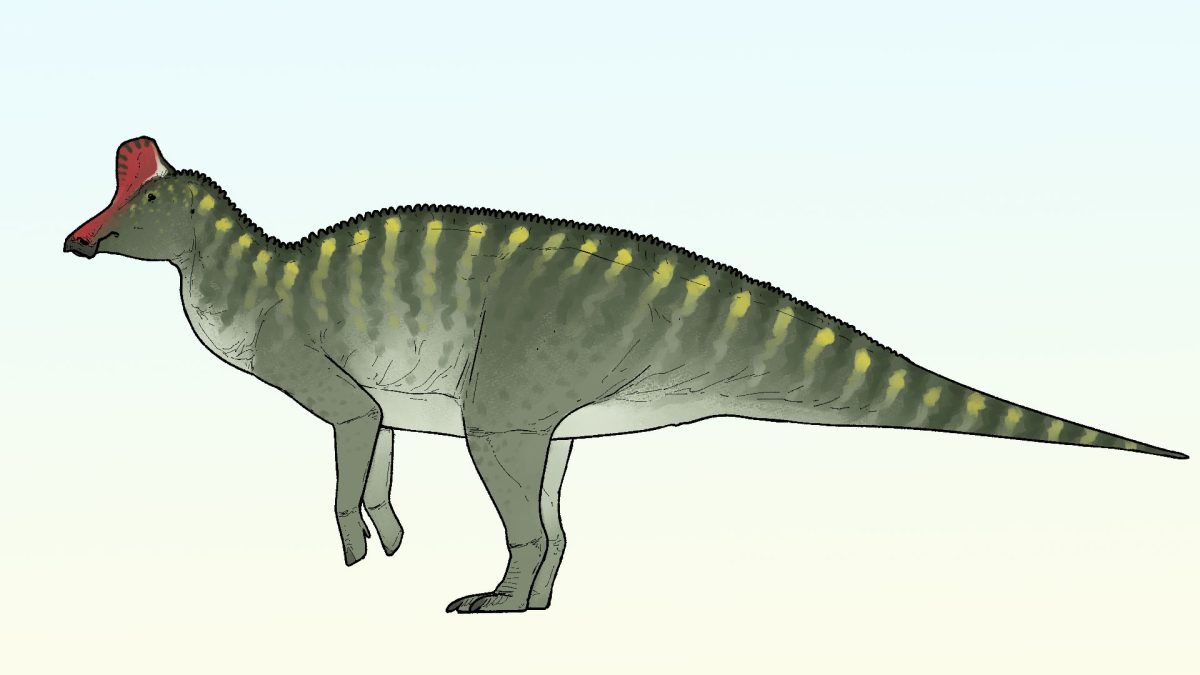
In 2024, the publication of a new genus of lambeosaurine hadrosaur, Minqaria bata, raised several questions in my mind. Known from only incomplete skull material, Minqaria is relatively small for a hadrosaur, with estimates only placing it at approximately 3.5 meters long[i]. Given that Minqaria lived in Morocco at the end of the Cretaceous period alongside another previously described lambeosaur, Ajnabia odysseus, I considered doing an article about whether the two should be considered synonymous.
At the time, I didn’t have enough confidence to do such an article. Besides, Minqaria was published around the same time as several key Tyrannosaur papers, so it fell somewhat into the background of my Max’s Blogosaurus periphery. But through all that comes with life and paleontology, I never forgot about those pesky Moroccan hadrosaurs and my questions surrounding them.
Now that a third genus of Moroccan lambeosaur has been described, this time from even more fragmentary remains, I think it’s time to revisit my quandary with North Africa’s duckbilled diversity.
On May 28th, a paper authored by Nicholas Longrich described Taleta taleta, a genus of lambeosaur from the Moroccan Phosphates[ii]. Yes, you read that right; Taleta is a name so nice they named it twice! In total, only two bones of Taleta2 are known: left and right maxillae from the skull. That’s right folks! A genus named from even less bones than the last two Moroccan lambeosaurines!

Fortunately, both Ajnabia and Minqaria are also represented in the fossil record by partial maxillae. The characters used to differentiate Taleta from Ajnabia and Minqaria are as follows. First, the ectopterygoid ridge of the maxilla is located higher along the skull. Second, the toothrow is straight in the maxilla. Third, differences in teeth condition are observed, including an enlarged primary ridge of the tooth and the orientation of the tooth crowns. Seems fine, right?
Sure, these characters may differ from Taleta’s Moroccan counterparts. But have these characters ever been examined within the context of a single genus? In other words, do these characters vary within individuals of the same species?
Of these four characters, the positioning of the ectopterygoid ridge is the safest for diagnosis. The development of the character has been used in phylogenetic analyses before, thus providing basis for diagnostic potential in previous studies[iii]. However, the positioning of the ectopterygoid ridge and its variation within individuals has never been examined within a phylogenetic context. As such, it is presently unclear how reliable the position of the ridge is for phylogenetic analyses and diagnosing a new genus. Further examination of the character in more well-sampled hadrosaurids would be beneficial.
The straightness of the toothrow is far less consistent in hadrosaurs. For example, let’s examine two specimens of Edmontosaurus, a well-sampled hadrosaurid from the Late Cretaceous of North America (Figure below). The first specimen, CMN 2289, is from an adult and possesses a nearly perfectly straight maxillary tooth row[iv]. The second is from UALVP 60425, a juvenile, in which the maxillary tooth row is curved[v]. If we went by Taleta’s definition, this could be diagnostic; however, the reality is this character can vary both between individuals. There’s also the matter of physical deformation from the fossilization process which could have led to differences in toothrow curvature demonstrated by the Moroccan hadrosaurs.
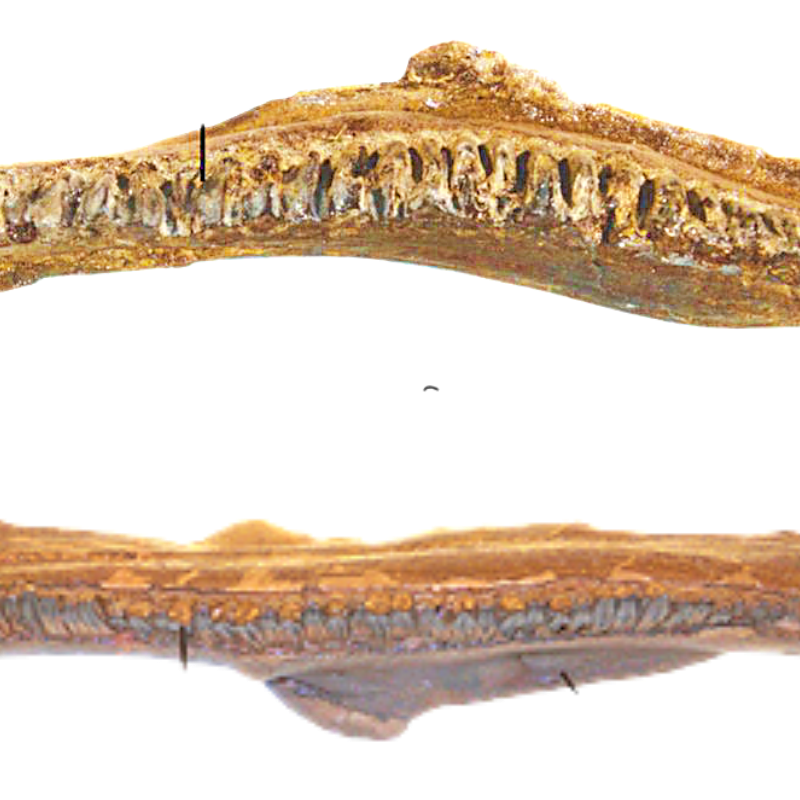
Tooth morphology has also been found to be variable. In 2024, Dudgeon et al. noted that the morphology of primary tooth ridge is variable in the dental battery of hadrosaurids and thus has been omitted from recent phylogenetic research[vi]. As such, use of this character as diagnostic for Taleta is dubious. As for the orientation of the tooth crown, the “curl” described as more pronounced in Ajnabia and Minqaria could just be the result of taphonomy, as the figured teeth of Ajnabia appear to be more weathered than those of Taleta. As such, I question how reliable this character is for diagnosis.
This leaves us with only two potentially autapomorphic traits in Taleta, of which neither has been thoroughly examined outside of the Moroccan lambeosaurines. As such, it is far to wonder whether Taleta should be considered a valid genus.
It’s fair to question whether Taleta is even diagnosable as a lambeosaurine. Sure, it comes from a formation in which multiple lambeosaurines are currently known, but that doesn’t really mean much. Non-lambeosaurine hadrosaurids coexisted with their crested cousins in many locations during the late Cretaceous, and basal hadrosauromorphs like Telmatosaurus are known from nearby locations in Europe. Traits diagnosable to lambeosaurinae are typically focused on the unique morphology of their premaxillary-nasal crests, though some traits of the maxilla can be diagnostic. However, the fragmentary nature of Taleta’s holotype MHNM.KHG.222 makes identifying many of these traits near-impossible[vii].
The existence of three fragmentary, similar-sized lambeosaurines from the same location is, in my mind, a bit of a stretch. It’s bad enough to name a new genus from a single bone. But to do so when two close relatives have already been described from the same locality without providing enough evidence for what differentiates your new dinosaur is not ideal. The assertion that these fragmentary bones all represent different taxa which were part of a Galapagos-finch style island diversification of dinosaurs is hard to take seriously when the differences between broken, weathered maxillae are minute. It is still possible that such a radiation occurred, but the research justifying this conclusion is presently lacking.
The fact that the possibility for individual and ontogenetic variation within the lambeosaurines is not even discussed in the Taleta paper says all you really need to know. Taleta may be an accepted genus at present, but I would ask for lambeosaurine or hadrosaur experts outside of those presently involved with the material to give these bones a look. I would especially ask this since one figure in Taleta’s description implies the existence of two more undescribed Moroccan lambeosaurines:

If you do, make sure that you have the right angle for your research!
One last thing to note. Shortly after Taleta’s publication, paleontologist Henry Sharpe inputted the characters of a watermelon – yes you read that right – into the phylogenetic matrix utilized to describe Taleta. When ran, the watermelon was found to be a distinct genus of Moroccan hadrosaur due to the emphasis of biogeography in Taleta’s matrix. If a melon can be misidentified as a distinct duck-billed dinosaur because of the research design, it’s probably best to revise your character matrixes.
Also, if the prophecy of two more Moroccan lambeosaurines comes to pass, can we get a better name than Taletataleta, which translates to “three three” in Arabic? Or will the next two be named four four and five five because they are the fourth and fifth lambeosaurines from Morocco?
All thoughts and opinions expressed in this article are solely my own and not reflective of any institutions I am associated with. All images come courtesy of the artists and sources noted alongside each piece. Header image courtesy of Connor Ashbridge.
Works Cited:
[i] Longrich, N. R., Pereda-Suberbiola, X., Bardet, N., & Jalil, N. 2024. A new small duckbilled dinosaur (Hadrosauridae: Lambeosaurinae) from Morocco and dinosaur diversity in the late Maastrichtian of North Africa. Scientific Reports, 14(1). https://doi.org/10.1038/s41598-024-53447-9
[ii] Longrich, N.R., Pereda-Suberbiola, X., Bardet, N., Nour-Eddine, J. 2025. A new hadrosaurid dinosaur from the late Maastrichtian Phosphates of Morocco provides evidence for an African radiation of lambeosaurines. Gondwana Research. https://doi.org/10.1016/j.gr.2025.05.006
[iii] Evans, D. C., & Reisz, R. R. 2007. Anatomy and Relationships of Lambeosaurus magnicristatus, a crested hadrosaurid dinosaur (Ornithischia) from the Dinosaur Park Formation, Alberta. Journal of Vertebrate Paleontology 27(2), 373–393. https://doi.org/10.1671/0272-4634(2007)27
[iv] Xing, H., Mallon, J. C., & Currie, M. L. 2017. Supplementary cranial description of the types of Edmontosaurus regalis (Ornithischia: Hadrosauridae), with comments on the phylogenetics and biogeography of Hadrosaurinae. PLoS ONE 12(4), e0175253. https://doi.org/10.1371/journal.pone.0175253
[v] Sharpe, H.S., Powers, M.J., Dyer, A.D., Rhodes, M.M., Mcintosh, A.P., Garros, C.W., Currie, P.J., & Funston, G.F. 2024. Craniomandibular Anatomy of a Juvenile Specimen of Edmontosaurus regalis Lambe, 1917 Clarifies Issues in Ontogeny and Biogeography. Journal of Vertebrate Paleontology 43(5): e2326644. https://doi.org/10.1080/02724634.2024.2326644
[vi] Dudgeon, T. W., Gallimore, G., & Evans, D. C. 2024. Individual, ontogenetic, and phylogenetic variation in the dentition of hadrosaurids (Iguanodontia: Ornithischia). Journal of Systematic Palaeontology 22(1). https://doi.org/10.1080/14772019.2024.2419422
[vii] Prieto-Márquez, A., Vecchia, F. M. D., Gaete, R., & Galobart, À. 2013. Diversity, Relationships, and Biogeography of the Lambeosaurine Dinosaurs from the European Archipelago, with Description of the New Aralosaurin Canardia garonnensis. PLoS ONE 8(7), e69835. https://doi.org/10.1371/journal.pone.0069835
 Max's Blogo-Saurus
2 replies on “Moroccan Lambeosaurs: Darwin’s Finches, or Fragmentary Messes?”
This reminds me of the trials and tribulations of attempting to write my first-ever professional scientific article. Posting in-depth articles on my blog is one thing, but publishing in a scientific journal is a whole other beast. It’s a headache that I don’t care to repeat.
LikeLike
My first research study has absolutely had its fair share of trials. Especially given the complexities of phylogenetics, I would love for more restraint to be exercised in studies such as this given my experiences.
LikeLike