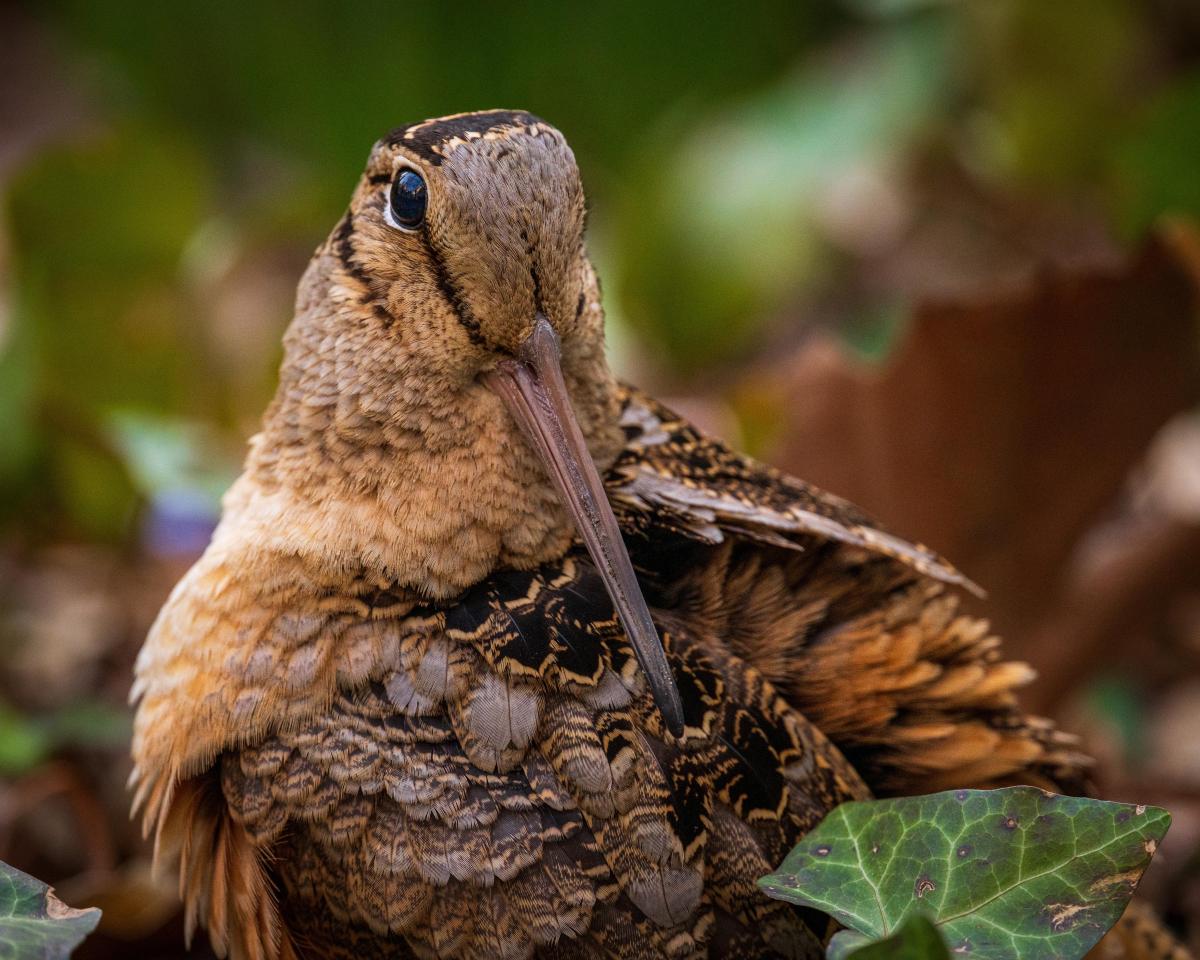
I have a confession to make. Paleontology is no longer my only passion.
Somewhere along the way, I fell in love with birding.
My affair with the avian world did not come early or even naturally. After my third year at the University of Toronto, I decided to take a summer course for extra credits. While plenty of biology and geology courses were available, one topic stood out above the rest: EEB386, Diversity of Birds with Professor Michael Dennison. I assumed it would be a lab-focused course learning about bird morphology, evolution, and diversity that would provide the class with hands-on specimens.
What I didn’t know at the time was that a significant portion of the grade was from birdwatching. Yes, you read that correctly!
From the very first birding trip, I knew I was in trouble. I could go on for hours about the thrill of memorizing duck plumage, or the pure peace that comes from connecting with nature searching for birds, but that’s not what this article is about. The bottom line is something clicked, and I’ve spent the last two years roaming Toronto’s parks searching for fleeting glimpses of the last living dinosaurs.

And let me tell you, I’ve had plenty of adventures in that time. Got stuck in the mud wading after a sandpiper. Climbed up Mount Royale in Montreal on a belly full of poutine in search of a Barred Owl. Tripped over a very much alive coyote while staring at the sky. Nearly drove into a corn field after glimpsing a Horned Lark in the rearview mirrors. Came down with something awful after searching for a duck at a sewage treatment plant…then went back there two months later to see more ducks. So worth it.
You get the idea.
Through every muddy step, the winter duck hunts and fall hawk watches, the triumphs and failures, one bird has haunted my imagination – a creature so elusive, so outlandish, so weird that I spent an entire year chasing it in vain. One may even say that it became my nemesis bird – the dreaded adversary for every birder.
Meet the American Woodcock:
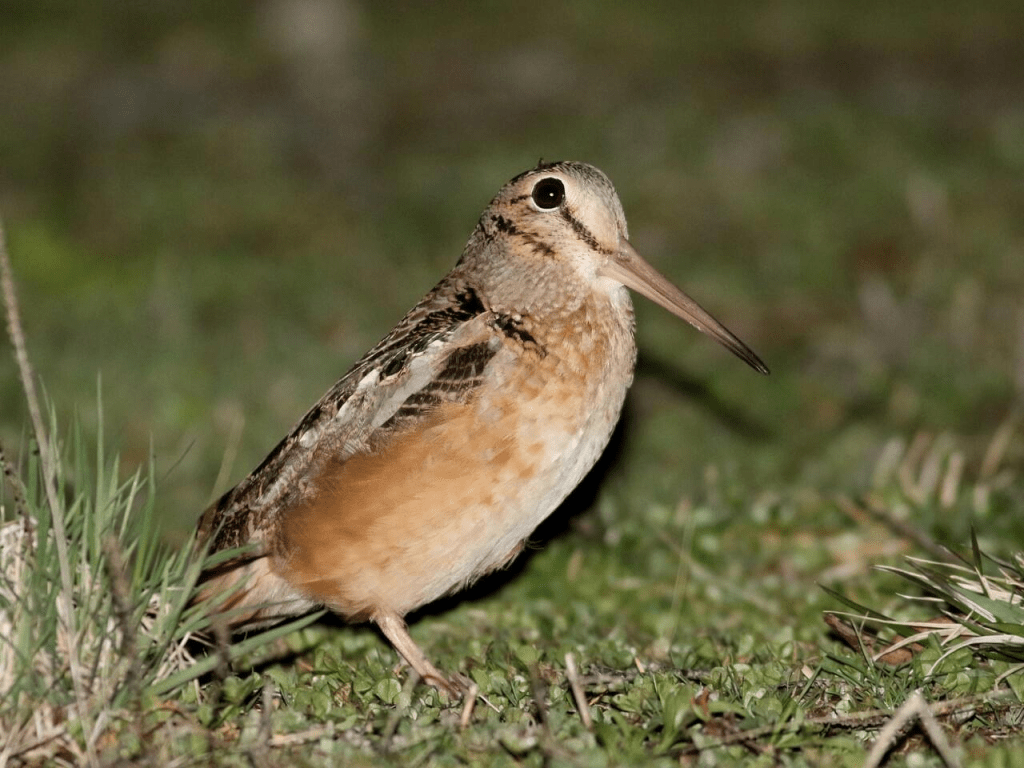
Scolopax minor goes by many names. For starters, there’s the American Woodcock, the common name which suggests that some ornithologists are not-so-secretly “odd”. Another commonly used name is the timberdoodle, which reflects the habitat of the Woodcock – forest floors and shrubby fields – and a behaviour I’ll dive into later. There’s also the labrador twister (cute), the night partridge (fair), the mudbat (weird), the bogsucker (that’s just mean), and, as I like to call them, “those meepy bastards.”
Truly, the Woodcock is a bird of many names. However, it is a bird of only one sound:
Meep. Meep. Meep.
Yes folks, the American Woodcock really sounds like that. Generally described as a nasally “peent” sound, the majestic call of the American Woodcock is instantly recognizable amongst North American birds. Though I cannot recall when I first heard recordings of these calls, I was instantly enraptured. Why on earth was this sound being made? Was this real, or is the timberdoodle simply a mass hallucination? And, are we sure that the Roadrunner of Looney Tunes fame wasn’t based on a Woodcock?
While the last two questions were more rhetorical, the first is genuine: why do Woodcocks meep?
The answer is simple: mating. Every spring, from late February to about mid-May, Woodcocks migrate north to their breeding grounds across eastern North America. Along the way, males claim small areas of open shrublands where they remain mostly cryptic throughout the day. But when night falls, they arise. At sunset, just after the last songs of daytime birds like Red-Winged Blackbirds and American Robins, the male Woodcocks begin their performance. A single meep. Followed by another. And another. And another.
The chorus of meeps is only the opening act in this symphony of love. After a few rounds of meeping, the male Woodcock takes off into the air to perform the far more dramatic act of his mating ritual: the “sky dance.” As he ascends, two fascinating things can be observed. First, his upwards trajectory is not a straight line up, nor is it a more gradual arc; instead, he flies in a spiral, continuously moving higher in the sky. As this occurs, the male produces a series of chirps accompanied by the loud fluttering of his wings. The combined effect sounds less like a bird and more like something mechanical, as if a UFO were descending from the sky!
After the Woodcock’s upwards spiral has taken him between 60 and 105 meters (200-350 feet) high, he adjusts his pattern to fly in a circle. After a few laps he plunges back towards the ground wherein he resumes his familiar meeping calls in hopes of attracting a female. When I say plunging down, I am not exaggerating: the speed at which a Woodcocks fly is astounding for a bird with such compact proportions.
All these maneuvers are performed with one goal in mind: impressing females that happen to be passing by. Sometimes, males will display together in large “singing grounds,” where several birds display in the same area, trying to outperform each other. Both sexes have been observed visiting multiple singing grounds over the course of the breeding season; for males, this is crucial for increasing their chances to have multiple mates. Once mating has occurred however, the males role in reproduction ends abruptly, as only female Woodcocks raise their chicks. I suppose this makes them deadmeeps, but when you think about it, it’s probably better to keep the loud meeping sounds that surely attract predators away from little babies!
The complex mating dance is far from the only quirk observed in the American Woodcock. Oftentimes, Woodcocks are seen “dancing” on the ground, planting their feet forward before rocking their body in a back-and-forth motion:
Although several theories exist, the purpose of this dance is currently unclear. The most accepted theory is that the behaviour is designed to lure worms from the ground, as the combination of rocking and probing mimics the effect of raindrops on soil. Given that earthworms make up a significant portion of a Woodcock’s diet, it seems logical that they would employ some mechanism to lure their buried meals to the surface.
Another way to interpret this behaviour is through the lens of camouflage. Swaying behaviours have been observed in several species of stick insects, where the motion attempts to mimic the natural movement of tree branches in the wind. Although Woodcocks live on the ground, the principle may be similar, with the rocking used as an attempt to blend into the flickering sunlight filtered through the canopies above. Though the colours and patterning of Woodcock feathers lend themselves extremely well for blending into the forest canopy, it never hurts to triple down on camouflage!
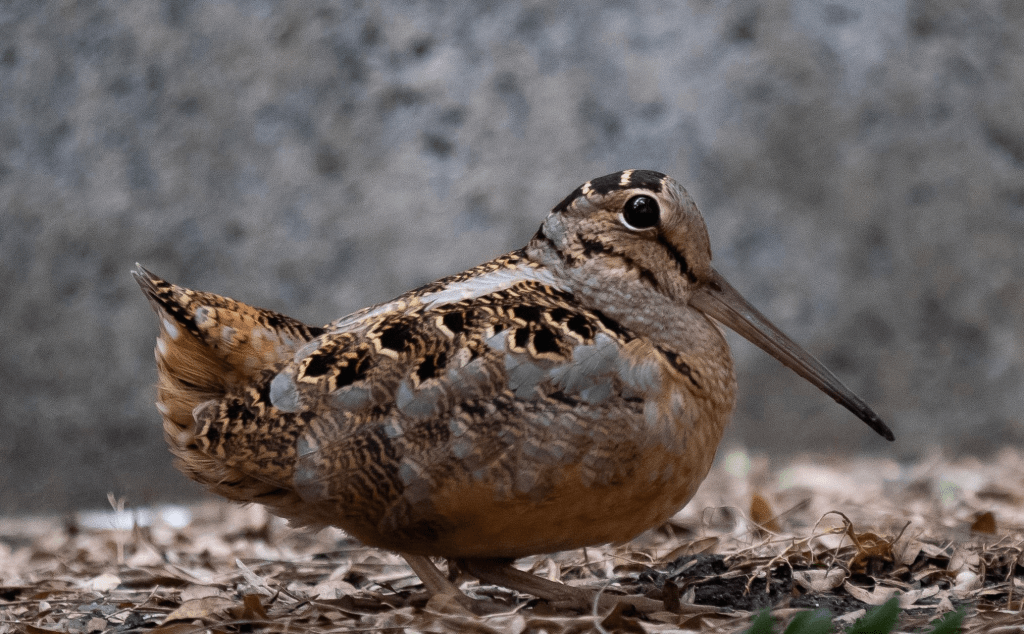
The last weird thing about the Woodcock is the most basic thing: its anatomy. Woodcocks are a species of sandpiper, characterized by an extremely long and narrow beak. Yet even for a sandpiper the Woodcock’s beak is exceptionally long and slender relative to the rest of the skull, as can be seen in the following comparison between an American Woodcock (bottom) and a Common Sandpiper (top):

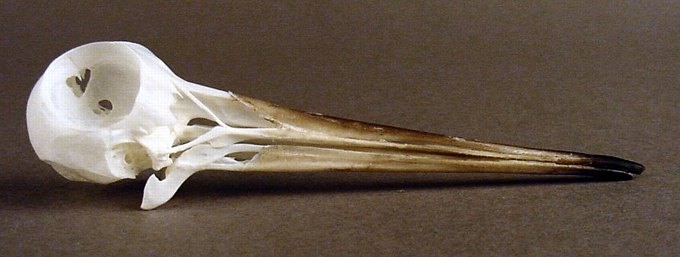
Adding to the Woodcock’s weirdness are its eyes. Not only are they massive, but they also face to the side instead of forwards. While this feature likely restricts the Woodcock’s ability to track quick movements of their prey – not much of a drawback when your main target is earthworms – it offers a clear advantage: a wide view for spotting danger. Living on the ground exposes Woodcocks to both terrestrial predators, like wild cats, foxes, coyotes, and raccoons, and aerial predators, such as hawks and owls. In this way, combining camouflage with visual acuity is essential for survival.
On the topic of survival, the conservation status of the American Woodcock is a complex one. While they are listed as a ‘least concern’ species by the International Union for Conservation of Nature (IUCN), their populations have plummeted in recent years as the habitats they rely on have become increasingly altered or lost to human activity. Historically, overhunting posed a significant challenge for Woodcock survival, but the implementation of seasonal and quota restrictions has alleviated some of this pressure. Even so, a quick google search shows that woodcock hunting is still a thriving sport in parts of North America.
Fortunately, recent estimates suggest that approximately 3.5 million Woodcocks still roam eastern North America. While that number may seem reassuring, the fragility of nature can never be taken for granted. The Passenger Pigeon, once the most abundant bird on the continent with over 3 billion individuals, was driven to extinction in just a century. While such a collapse may seem unlikely for Woodcocks, it highlights the importance of protecting these birds so that future generations may experience the thrill of observing the wonderful animals around us.
Speaking of thrill, let’s get back to my experiences with the king of the meeps.
My journey to find the American Woodcock began in April of 2025. Following a successful yet extremely busy and stressful semester at school, I took it upon myself to track down the legendary and surprisingly elusive timberdoodle. In theory, there are several locations where Woodcock’s can theoretically be spotted in Toronto, yet only one was truly reliable: Tommy Thompson Park (TTP).
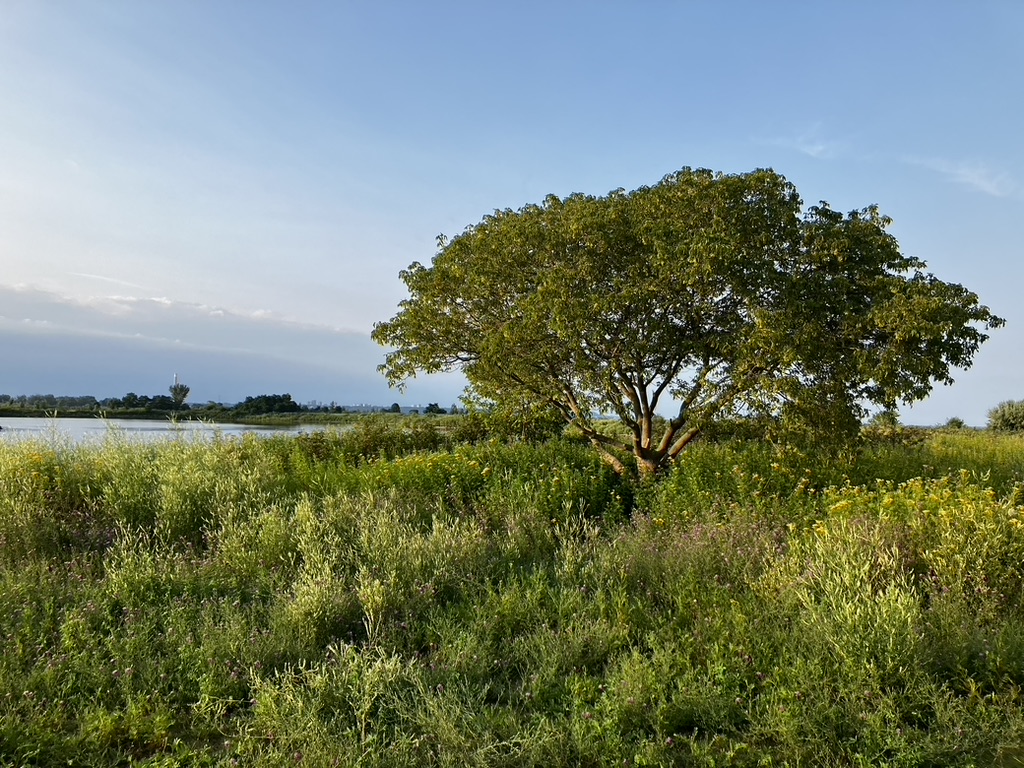
TTP is an internationally recognized bird sanctuary for good reason. Once an urban landfill site, the diverse ecosystems contained within the massive park host several hundred bird species on an annual basis, ranging from summer residents like cormorants and swallows to seasonal passers-by like whimbrel and Tundra Swans. The spring also sees the migration of the Woodcocks, who host their singing grounds in several of the lowland areas within the park.
Yet there is a challenge. Not only do I live on the opposite end of the city from TTP – getting there takes 2 hours by public transit – but the window to see Woodcocks is often fleeting. Since their mating displays revolve around the setting sun, catching a glimpse means arriving late and staying well into the twilight hours.
As you can imagine, this wasn’t a challenge I was initially prepared for. My first few attempts at Woodcock hunts went awry, namely because I wasn’t ready to spend late evenings tracking the bird – remember my encounter with a coyote? As I would later learn, the times I did stay later were misguided since I didn’t yet have the right location for a Woodcock watch.
My failures could have led to frustration, desperation or…a new sense of determination. I started looking for them at Humber Bay Park East, a much closer location to home but one without the ideal habitat for Woodcock displays. I tried High Park, but as was the case with TTP, my timing wasn’t there. In August, months after the mating rituals of the Woodcock had concluded, I chased a reported Woodcock on Toronto Island’s busy Centre Island to no avail.
I was discouraged.Yet I paused, regrouped, and vowed that I would find them in 2026. I did more research on their behaviours and the best time to see them. I consulted my birding friends and finally learned which part of TTP usually hosts their singing grounds. Most importantly, I waited patiently for the Woodcocks to return.
As March finally arrived, reports of Woodcocks began flooding EBird. As classes and work consumed my time, finding a time to see them seemed almost impossible. The opportunity to strike finally came on Wednesday the 10th as heavy rains forecasted for the day were projected to clear by 5pm.
In other words, the perfect conditions to find a Woodcock.
Not only would the rains have cleared by the time of their display, but the rainy conditions could draw plenty of earthworms to the surface for the Woodcocks to feast upon. Though I was dealing with back pain and had a class earlier in the day, it was finally time to see the timberdoodle.
After a few hours walking around TTP with two fellow bird-loving friends, we finally found ourselves in position, waiting for a Woodcock to appear. As the Red-Winged Blackbirds and Robins made their final calls for the day, we became alarmed when a Cooper’s Hawk landed in the bushes right where we anticipated the Woodcocks would be. Would they hide now? Fortunately, we didn’t have to wait long for the unmistakable sounds of destiny to call from the abyss.
Meep. Meep. Meep.
Not long after the first meeps, the calls of several other Woodcocks erupted from the thicket. At first, it seemed like three different Woodcocks had chosen to display themselves on that fateful evening. Yet it soon became clear that there were more as the telltale fluttering sound of a Woodcock’s sky dance roared from behind us. While we were unable to see the spiral flight on that cloudy night, the descent was impossible to miss – one individual came remarkably close to hitting us in the head!
After about 45 minutes of listening, the calls finally started to trail off. In total, we saw 5 Woodcocks that night, with two engaging in the full sky dance behaviour.
I’ve been on birding trips where I saw more birds, and others where I have seen rarer birds. Yet nothing will ever compare to the satisfaction I felt seeing the American Woodcock. There may be over 11,000 species of birds on Earth, but in this birder’s eyes, none are quite as special as the Woodcock.
Oh, and one last note. As is the case with all birds, if you do elect to chase the thrill and find a Woodcock in your local habitats, please be respectful. Never try to flush the birds. If you can’t find one at first, be patient. Trust me; failure makes it even better when you actually find one!
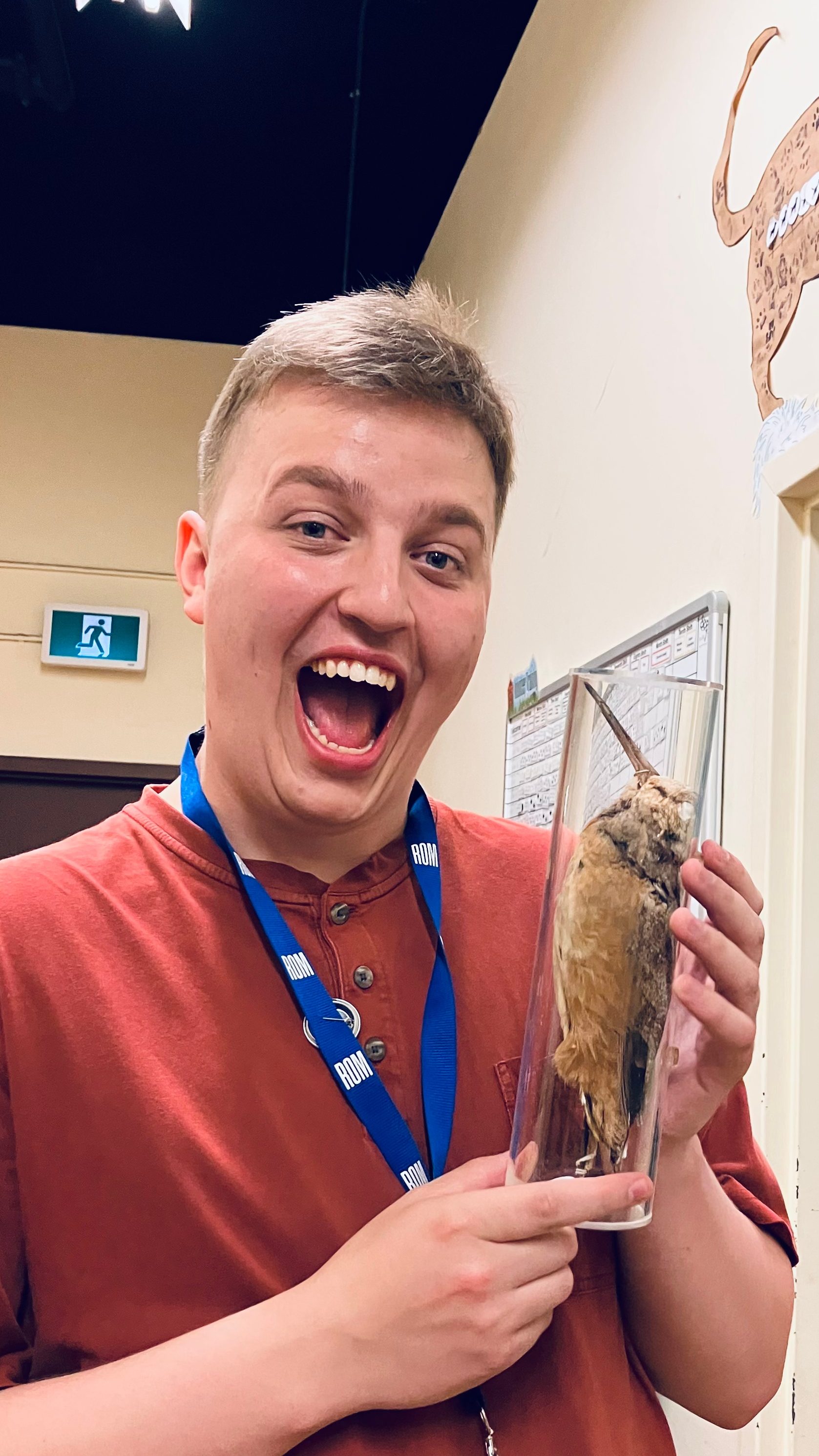
Thank you for reading this (very long) article! Kind of crazy that this is my first article that focuses on living species, but what an article it was to write. As you can tell, Woodcocks are my favourite bird and finally getting the chance to see several living individuals inspired me to write this piece. Next up on the docket is an overdue review of Netflix’s The Dinosaurs. Spoiler alert: surprisingly enjoyable!
Header image courtesy of SeanK789 on Reddit.
Works Cited:
Grimaldi, D. (2026, January 28). Why do stick insects sway? Entomology Blog. https://blog.entomologist.net/why-do-stick-insects-sway.html
Avian Conservation Assessment Database Scores – partners in flight databases. https://pif.birdconservancy.org/ACAD/Database.aspx
American Woodcock Life History, All about Birds, Cornell Lab of Ornithology. https://www.allaboutbirds.org/guide/American_Woodcock/lifehistory#conservation
Villanueva, N. (2025, October 28). How the American Woodcock Performs Its Sky Dance. bird-life.com. https://bird-life.com/how-the-american-woodcock-performs-its-sky-dance-1-17382/
The Many Nicknames of the American Woodcock – Project Upland
 Max's Blogo-Saurus