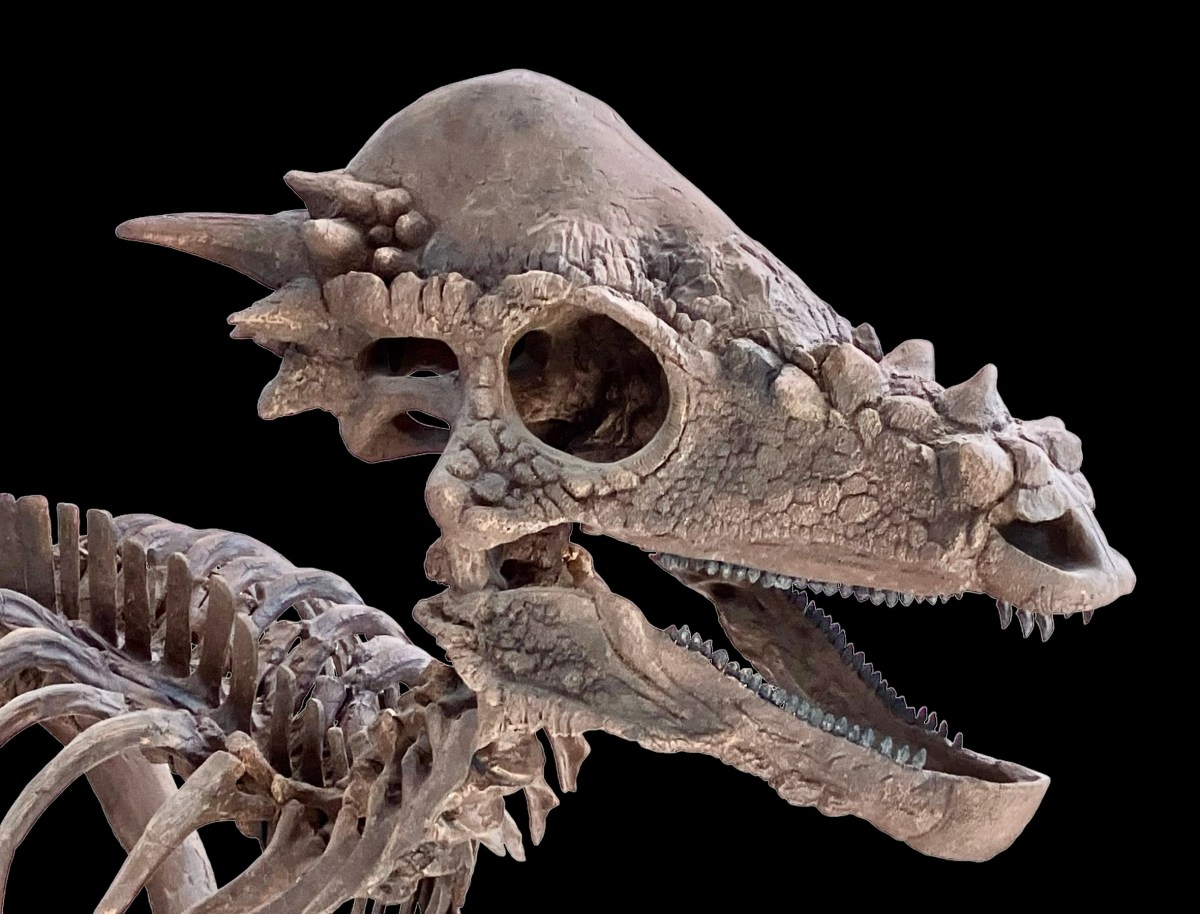
In a shocking turn of events, Pachycephalosaurus wyomingensis – the largest and most recognizable of the dome-headed dinosaurs – has been reclassified as a junior synonym, thus making it an invalid name.
Welcome back, Tylosteus ornatus?
Before your brains explode in confusion and anger at your thirtieth favourite dinosaur getting a name change, allow me to explain.
Sometime between 1853 and 1867, American geologist Ferdinand Vandeveer Hayden collected a handful of bones from “Black Foot Country at the head of the Missouri River” on his expeditions as part of the US Geological Survey to the central United States[i][ii] Fast forward to 1872 when several of these fossils were described by paleontologist Joseph Leidy, who believed they represented the armoured plate of an extinct reptile which he dubbed Tylosteus ornatus.
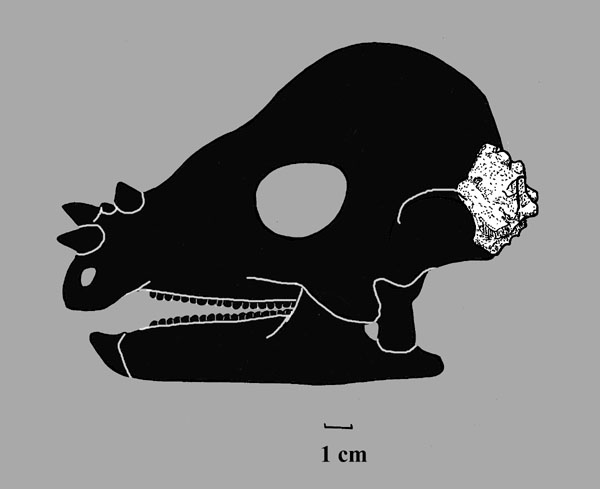
Tylosteus was relatively anonymous for several years following Leidy’s description. In 1902 and 1928, the bones were identified as belonging to a dinosaur – first by Oliver Perry Hay, then by Charles Gilmore – but neither could identify which family they belonged to.[iii][iv] It wouldn’t be until 1979 that the identity of Tylosteus became apparent when Donald Baird examined the holotype specimen and determined it to be a squamosal, or rear skull bone, of Pachycephalosaurus – the legendary dome headed dinosaur.[v] This assessment was supported by both the anatomy of the specimen and its location of discovery, as Baird connected Hayden’s listed location to the states of Montana, the Dakotas, and Wyoming – all locations where Pachycephalosaurus fossils have been documented.
Ok, cool. But why does a centuries old fossil misidentification present a problem for your beloved Pachycephalosaurus?
The answer lies in the strict naming conventions of zoology. When two names are assigned to the same animal, one must take precedence to avoid confusion. Typically, the first name assigned gets priority as the “senior synonym,” while the younger name is considered the “junior synonym.” Since Tylosteus was named in 1872 and Pachycephalosaurus was named in 1943, the name Tylosteus should take precedence. Otherwise, us paleontologists would be nothing more than lawless hypocrites who make exceptions for dinosaurs we like!
As such, a titanic scientific movement has begun to restore Tylosteus to its rightful place and retire the name Pachycephalosaurus entirely. As the masses calling for the restoration of the Tylosteus dynasty begin to grow, it’s become clearer that Pachycephalosaurus may, fittingly, go the way of the dinosaur and fade into the distant past.
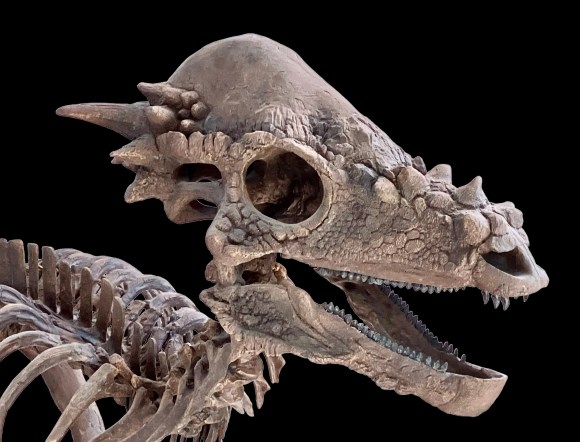
As you can imagine, this would have massive implications for dinosaur paleontology. First, every movie, show, documentary, museum display, children’s book, field guide, research publication, toy, encyclopedia, and offhand reference about Pachycephalosaurus would need fixing. Perhaps we can get mass quantities of white out for every book, and hire a voice actor to redub every mention of Pachycephalosaurus? How much would it cost to employ Morgan Freeman’s services? At least we won’t have to remove any mustaches in post-production!
Second, the entire Pachycephalosaur family just got a lot more confusing. Because Tylosteus was never used to describe a dinosaur family, dome-headed dinosaurs should still be classified under the clade name Pachycephalosauria, family name Pachycephalosauridae, and tribe name Pachycephalosaurini. None of those names have senior synonyms, so for now, they stay until someone digs up an even older paper that contains another senior synonym.
To the Pachycephalosaurus fans reading this article – all 9 of you – hang in there. It might feel tough right now, what with your favourite dinosaur being invalidated because of people reading old papers, but don’t fret. It’s still a real dinosaur that would’ve been the same animal it was during life; it’s just stuck with a different name that is a lot less cool and a lot less distinctive.
It could always be worse. Your dinosaur could be a turtle.
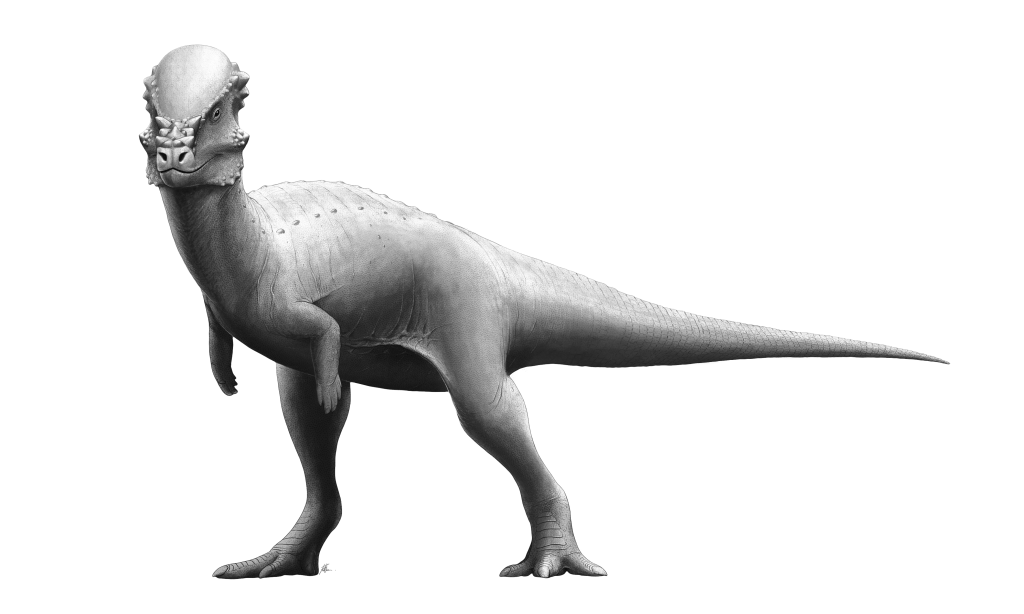
Thank you for reading folks! If it wasn’t obvious already, HAPPY APRIL FOOLS DAY! While Tylosteus is a very real name and in theory should be a senior synonym of Pachycephalosaurus, there’s good reason for it to be considered a junior synonym. After today, I’ll update this article to tell the real story of Tylosteus and why it isn’t the prevailing name for the legendary dome-headed dinosaurs.
All images come courtesy of the source listed alongside each image. Header image from yours truly.
Works Cited:
[i] Baird, D. (1979). “The dome-headed dinosaur Tylosteus ornatus Leidy 1872 (Reptilia: Ornithischia: Pachycephalosauridae)”. Notulae Naturae. 456: 1–11. Dome-Headed Dinosaur Tylosteus Ornatus Leidy 1872 (Reptilia: Ornithischia … – Google Books
[ii] Leidy, J. (1873). “Contributions to the extinct vertebrate fauna of the Western Territories”. Report of the United States Geological Survey of the Territories. 1: 1–358. Contributions to the Extinct Vertebrate Fauna of the Western Territories – Joseph Leidy – Google Books
[iii] Gilmore, C.W. (1928). “Fossil lizards of North America”. National Academy of Sciences Memoirs. 22 (3): 1–201. Fossil lizards of North America : Gilmore, Charles W. (Charles Whitney), 1874-1945 : Free Download, Borrow, and Streaming : Internet Archive
[iv] Hay, O.P. (1902). “Bibliography and catalogue of the fossil Vertebrata of North America”. United States Geological Survey Bulletin. 179: 1–868.
[v] Baird, D. (1979). “The dome-headed dinosaur Tylosteus ornatus Leidy 1872 (Reptilia: Ornithischia: Pachycephalosauridae)”. Notulae Naturae. 456: 1–11. Dome-Headed Dinosaur Tylosteus Ornatus Leidy 1872 (Reptilia: Ornithischia … – Google Books
 Max's Blogo-Saurus