
Like the dinosaurs, the second season of Apple TV’s megalith series Prehistoric Planet has came and went. And, just like the dinosaurs, it was a triumphant success that ended with a bang.
Prehistoric Planet 2 is a brilliant glimpse into the world of dinosaurs. Presented in a documentary style reminiscent of Planet Earth, Prehistoric Planet 2 travels across the Late Cretaceous to explore dinosaurs and the majestic animals that lived alongside them. Though the season’s five stunning episodes may be a tad more compressed than season 1, the overall quality of the series has remained consistent. New species, biomes, and scenarios amplify the action, making for an informative and entertaining viewing experience. While it may be too soon to say, Prehistoric Planet 2 feels like an improvement from season 1. In fact, while purchasing an Apple TV subscription is annoying, I would say that Prehistoric Planet 2 is well worth it!
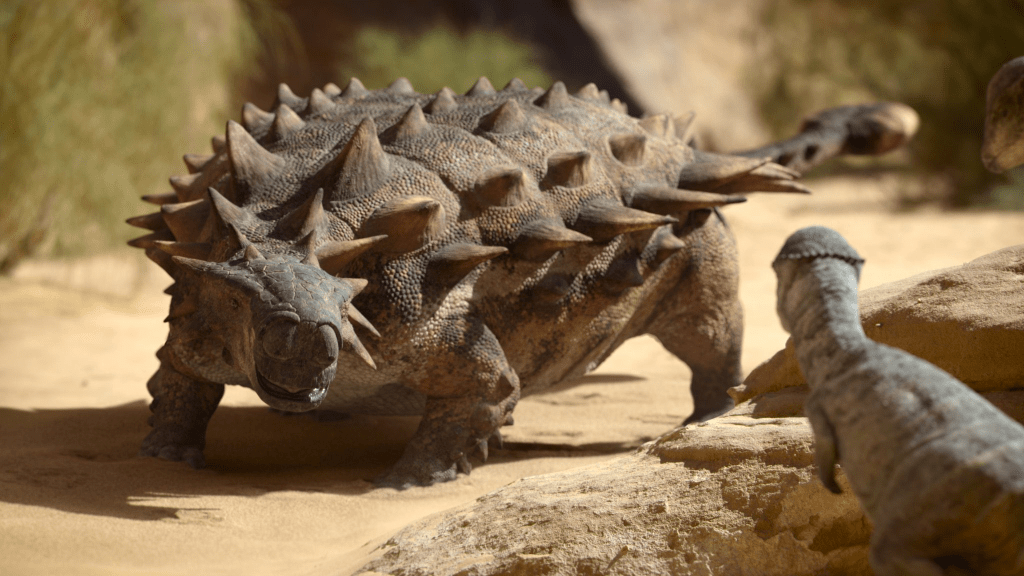
Today’s article breaks down the season’s highlights, (some) lowlights, and the future of Prehistoric Planet. This article contains several spoilers so please be mindful. With that out of the way, let’s dive in!
Quick Episode Recaps
In keeping with season 1, each episode focuses on a different biome of prehistoric earth. Episode 1, Islands, takes audiences to Europe, Madagascar, and Antarctica to present some of the most bizarre fauna of the Late Cretaceous. Episode 2, Badlands, brings the series to the dry heartlands of Mesozoic Earth, demonstrating how dinosaurs were able to cope in even the most hostile conditions. Episode 3, Swamps, is an ambitious episode that seamlessly blends both obscure and famous species to create unique stories. Episode 4, Oceans, may be the weakest of the season, but it still provides viewers with exhilarating scenes featuring mosasaurs and ammonites. Finally, the season ends on a high note with North America, portraying famous dinosaurs like Tyrannosaurus and Triceratops at the height of their powers.
Still Beautiful, Still Scientific
The main draw of Prehistoric Planet are the beautiful and scientifically accurate dinosaurs. The CGI is brilliant, bringing enough depth and accuracy to convince viewers that the dinosaurs on screen are truly alive. Every scene has a scientific basis, with the show runners going so far as to commission a study on mosasaur swimming speed for Oceans. I find it hard to believe that some people criticized the CGI of the series, as most scenes are truly vibrant. One nameless reviewer even said the series “lacks scientific insight”, as though the series doesn’t feature some of the most prominent paleontologists in the globe as advisors. It just goes to show you that some people can’t be bothered to do any background research but are quick to complain!

Best Episode: Swamps
Swamps is Prehistoric Planet at its very best. First, the diversity of species is breathtaking, with famous taxa like Tyrannosaurus, Triceratops, and Pachycephalosaurus featured alongside unique taxa like Beelzebufo, Austroraptor, and Rapetosaurus. Second, the landscapes are beautiful, with the representations of prehistoric Montana and Madagascar being the most accurate depictions on camera. Lastly, Swamps features two of the best sequences of the series, featuring a grumpy Beelzebufo and a nocturnal Tyrannosaurus hunt. Seeing T. rex hunting at night almost three years after I discussed its plausibility was incredibly validating!
Honourable mention: Badlands (well-balanced episode with brilliant segments featuring India and Mongolia)
Best Sequence: The King is Humbled
Nothing could ever challenge Tyrannosaurus rex, right? Nope! In North America, audiences are treated to a clash between titans over the carcass of a dead sauropod. In one corner was Tyrannosaurus rex, the “tyrant lizard king” of all dinosaurs. In the other? Two Quetzalcoatlus pterosaurs, giraffe-sized animals that weighed less than some domestic pigs. There’s no way T. rex could ever blow that, right?

Well, Prehistoric Planet 2 shows otherwise. Using a combination of honks, squawks, flaps from their 10-meter wingspan, and pecks from their titanic beaks, the giant pterosaurs scare off the Tyrannosaurus. Like seagulls 66 million years later, Quetzalcoatlus proved that stealing food from larger predators at the beach isn’t as difficult as one would assume.
Honourable mentions: Beelzebufo’s best Shrek impersonation; T. rex’s nocturnal hunt; The voyage of the ammonite babies; Isisaurus dangerous journey.
The Tuarangisaurus Award for Inspired Scene: Intruder in the Burrow
It’s no secret that Prehistoric Planet has been inspired by other documentaries and various paleoart. Walking with Dinosaurs, the ground-breaking 1999 docuseries, has been referenced multiple times throughout the series. In Islands, the shot of a Masiakasaurus peeking into a mammal burrow in search of a baby mammal looked just a little familiar:
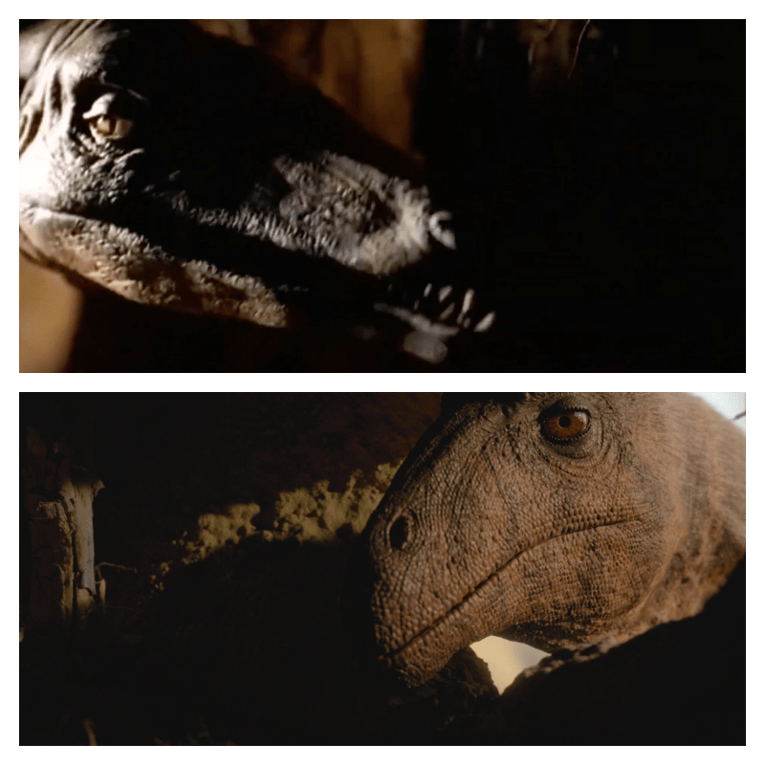
Unfortunately for the Masiakasaurus, its hunt isn’t nearly as successful as the Coelophysis in Walking with Dinosaurs. Not only does it miss out on the baby mammals, but it also ends up getting eaten by a giant snake. Talk about a turn of events!
Honourable Mentions: Rapetosaurus mud bath (inspired by John Conway); Hatzegopteryx hunt (inspired by Mark Witton); Pachycephalosaurus mimicking the colours of Jurassic Park; Beelzebufo using sauropod footprints (inspired by Joschua Knüppe); Simosuchus running through bushes (this may be a stretch, but this reminded me of a scene from The Truth About Killer Dinosaurs).
The Dinosaur Revolution T. Rex Award for Best Design: Isisaurus
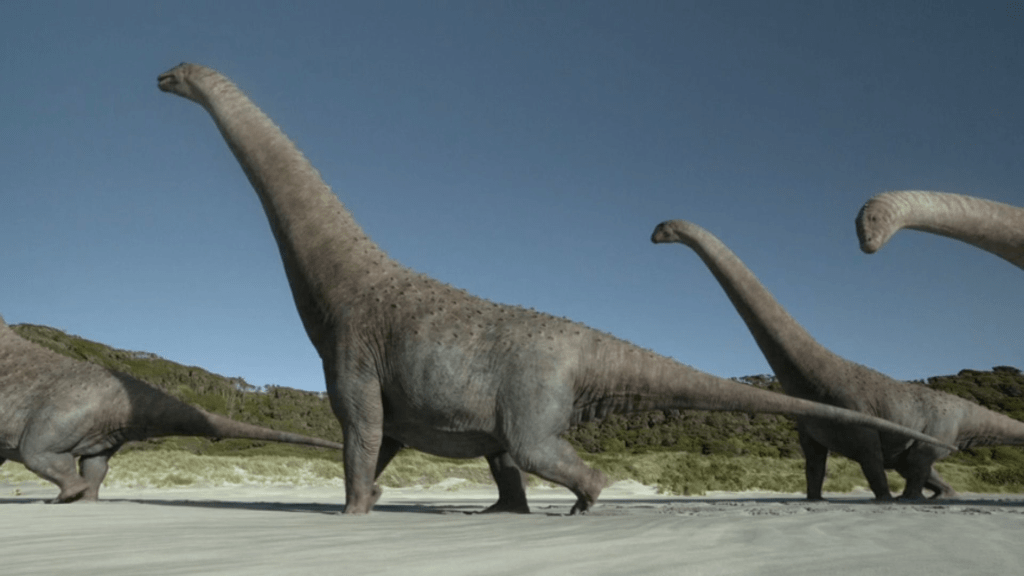
I’ve loved paleontology since my mother bought me a dinosaur onesie when I was 2 months old. During that time, I’ve seen dozens of dinosaur films, numerous documentaries, and thousands of art pieces. A lot of those art pieces were created by paleontologist Mark Witton, one of the greatest paleoartists of our time who was featured in this series! Yet nothing trumps the design of Isisaurus from Badlands. Initially designed by series creator Darren Naish, everything about this dinosaur is perfect. The stumpy neck, the spines atop their backs, the scale diversity and patterns, the orange-colour scheme with white areas on its neck and face, all of it works so well together. While they may not be the signature species of season two, these giant ladies are the most beautiful dinosaurs ever put to screen.

Honourable mentions: Rapetosaurus; Alamosaurus (good season for sauropods!); Majungasaurus; Rajasaurus; Simosuchus.
The Carnotaurus Award for Most Creative Behaviour: Simosuchus
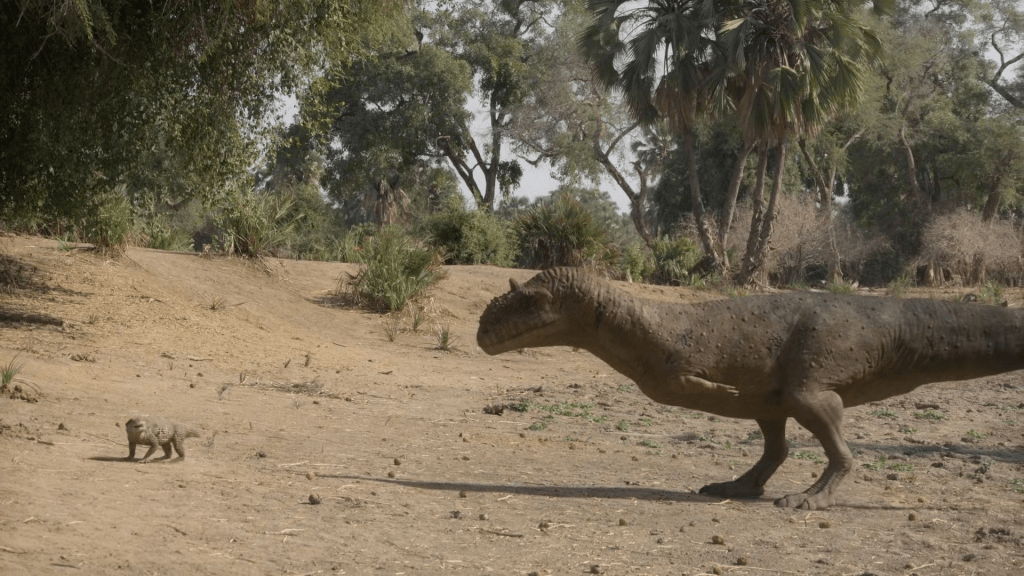
Prehistoric Madagascar was a weird place, something that Prehistoric Planet 2 fully capitalizes on. Nowhere is this demonstrated better than in the vegan crocodile Simosuchus, portrayed as an armoured burrower. More intriguing was its response to danger, that being to thrash around, stick out its stubby tail, and make a giant, chaotic scene. While its methods may be questionable, the fact that it got away proves that ungodly aggression is a foolproof strategy to confuse predators. Just ask honey badgers, whose anger and aggression scares off predators like lions and hyenas.
Honourable mentions: Globidens’ ammonite feast; Ammonite babies using tidal pods for sanctuary; insect eating Pachycephalosaurus; rafting Zalmoxes.
Best Moment: Breaching Mosasaurus
There’s a reason why the shot below has been featured in a lot of promotional material. Enough said.

Honourable mentions: Hatzegopteryx’s hunt; Night-vision Majungasaurus; Masiakasaurus gets annihilated.
The Marvel Award for Worst CGI: Shamosuchus
Look, I need to be honest. The creature designs and CGI of this series may be brilliant, but they’re not perfect. Take for instance the opening sequence of Swamps, which features a group of infant Azhdarchid pterosaurs trying to escape the Asian crocodile Shamosuchus. While the pterosaurs look awesome, their crocodilian counterparts are another story. Look for yourself:
What makes this clip even more confounding is its setting. Paleontologists know that Azhdarchids nested in swamps… and they know this based on fossils found in North America. So, why did the series choose Asia instead? It’s even more surprising when considering that there isn’t anything special about Shamosuchus, making the exclusion of a unique North American croc like Champsosaurus unfortunate. (No, I am not just saying this because Champsosaurus was on my list of desired species. Nice try though!)
Honourable mentions: Tarchia and Pachycephalosaurus skulls (both not perfect representations in my eyes).
Where Does the Series go From Here?
This isn’t meant to be negative, but the Maastrichtian Age of the Cretaceous has run its course. Across two seasons, Prehistoric Planet has milked the very end of the Cretaceous for all its worth. To be honest, it’s amazing they managed to get two seasons out of one period, given that most dinosaur series don’t feature two episodes from the same time. However, the condensed episodes and repeated species from season 1 signal that it’s time to move on from the Late Cretaceous.
Season 3, while not confirmed, has been hinted at by creators Tim Walker and Mike Gunton. Walker and Gunton also hinted that a potential season 3 would be moving on from the Late Cretaceous. Where the series could head is a matter of debate, though my preferred setting – the Aptian Age of the early Cretaceous – can be found in the article linked here. Alternatively, the series could also head forward in time and portray animals such as sabretooth cats and Woolly Mammoths from the Cenozoic Epoch. Whatever period is portrayed, it’s a safe bet that Prehistoric Planet will make the most of it.
So, when season 3 arrives, I – and the legions of paleonerds who love this series for what it is – will be ready.
Thank you for reading today’s article! If you want to read more about Prehistoric Planet, here is a page compiling all articles about it here at Max’s Blogosaurus!
I do not take credit for any images found in this article. All images are credited to Apple TV+
 Max's Blogo-Saurus
5 replies on “Prehistoric Planet Season 2: Recap and Review”
The Hatzegopteryx hunt in Islands reminded me not just of Mark Witton’s artwork, but a similar scene in Planet Dinosaur (2011) with Hatzegopteryx hunting young sauropods. Though at the time we didn’t know as much about what the animal looked like as we do now.
LikeLiked by 1 person
I honestly forgot about this scene! It seems as though the idea of giant pterosaurs terrorizing small dinosaurs in horsetail forests is a favourite of paleontologists
LikeLike
Yeah, though technically the horsetails in that Tethyshadros segment were actually young pine trees
LikeLiked by 1 person
Phosphorosaurus reminded me heavily on Cruel Seas from WWD.
And my pick for Season 3 would probably be the Cenomanian (Spinosaurus for Marketing). Albian and Aptian would be cool too, we need some Ichthyosaurs.
LikeLiked by 1 person
I’m not sure my sanity could withstand a Spinosaurus segment (or episode), but Cenomanian would be awesome. Going to any time period that moves away from some of the most featured families so far (Mosasaurs, Azhdarchids, Tyrannosaurs) would be welcome!
LikeLike