
Over the Labour Day weekend, the Max’s Blogosaurus team travelled to Canada’s capital, Ottawa, to visit the Canadian Museum of Nature (CMN). While we had visited the museum before, revisiting institutions is always fun to see if anything has changed. Plus, we wouldn’t be real paleonerds if we turned down a trip to a museum with dinosaurs in it!
First opened in 1912, the CMN has long had ties with Canada’s natural sciences. The building initially served as the residence for the Geological Survey of Canada and displayed the first dinosaur fossils in the country (the hadrosaur Edmontosaurus regalis). The CMN continues this tradition in the present, featuring exhibits focusing on Canadian wildlife and biodiversity, geological sciences, and (of course) dinosaurs and other prehistoric animals.
The fossil gallery is a moderately sized area that features a good combination of fossils alongside dioramas and models. Upon entering, visitors encounter the skeleton of the Tyrannosaur Daspletosaurus, which looms over the entrance of the exhibit hall. Being able to walk under fossils is something I enjoy, as it allows us to truly immerse ourselves in the exhibit and get a true sense of scale. (Also, it makes for goofy photos like the one you’ll see below!)

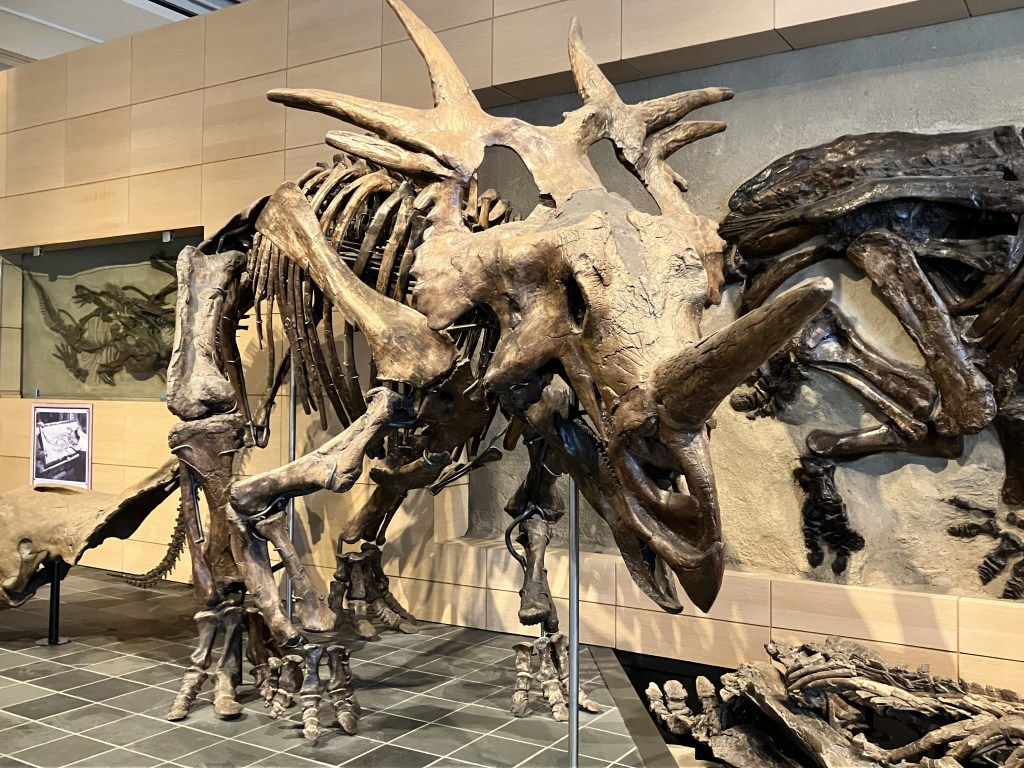
Following the Daspletosaurus, the CMN’s fossil gallery features numerous Canadian dinosaurs. Most of the gallery is dedicated to Canadian Ceratopsians, ranging from the newly discovered Spiclypeus to the legendary Triceratops and the spiky-frilled Styracosaurus. The Ceratopsian selection depicts their diversity well, with individuals from the three main North American Ceratopsian lineages – Chasmosaurines, Centrosaurines, and Leptoceratopsids – all present.
Other dinosaurs found in the exhibit hall include the Ornithomimid Dromiceiomimus, the Hadrosaurs Edmontosaurus and Corythosaurus, and a handful of skeletal remains from the Ankylosaur Panoplosaurus. One odd fossil is the skeleton of a Dromaeosaurus with its lower jaw missing, which I like to think got stolen by a member of the public. While most fossils are Canadian species from the last 15 million years of the Cretaceous, one notable outlier exists. Meet the Argentinian Abelisaurid Carnotaurus:

Why a South American dinosaur is present in a Canadian-centric exhibit was confusing. Was it a leftover from an old travelling exhibit, like the Futalognkosaurus in the Royal Ontario Museum? Did it result from a strange collaboration with an Argentinian institution? Or did the fossil gallery need another predatory dinosaur besides Daspletosaurus? I’d be willing on the third, but I’d love to hear the origin story of the specimen!
One interesting thing to note is the completion of the fossils preserved. According to the museum, over 80% of the displayed fossils are actual specimens, which is an incredible rate for museums. Even more impressive is the importance of some of these fossils, as the holotypes (the specimen used to describe the species) of Daspletosaurus, Chasmosaurus, Styracosaurus, Edmontosaurus, Panoplosaurus, and Spiclypeus are all present in the gallery. That’s a pretty good collection!
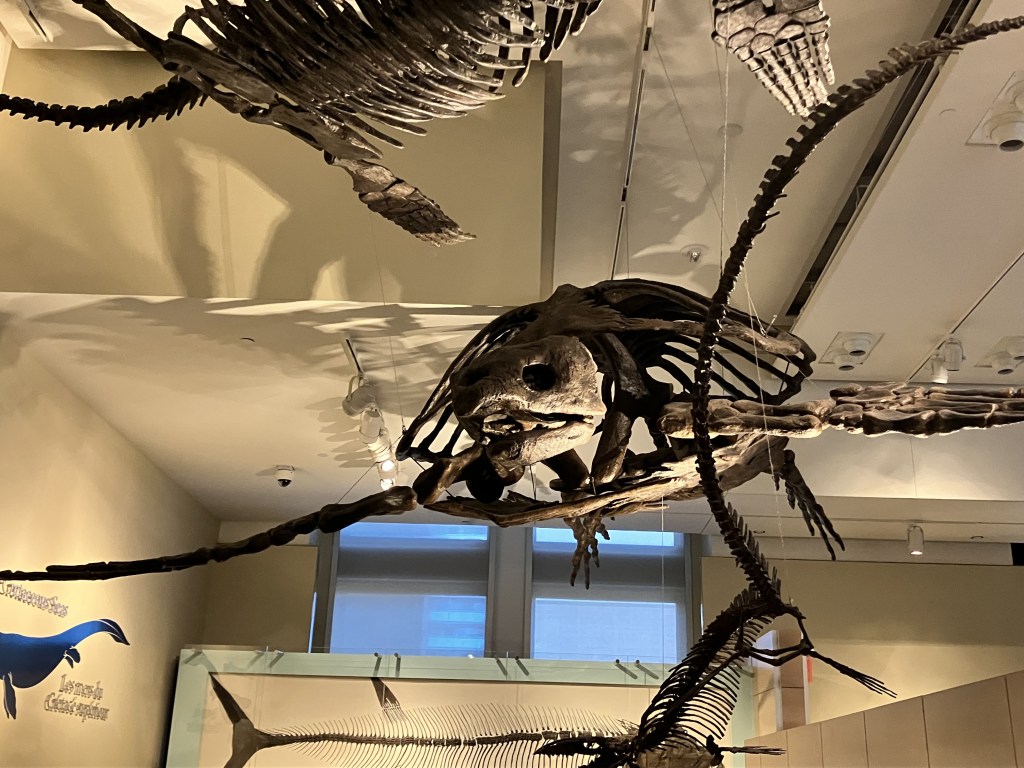
Towards the back of the gallery lies an assortment of animals that lived alongside the dinosaurs. This includes a specimen of the crocodile mimic Champsosaurus, the Mosasaur Platecarpus, the marine bird Hesperornis, the long-necked reptile Elasmosaurus, and a rather fascinating Cretaceous sawfish specimen. The most notable display is of the giant turtle Archelon, whose presentation is greatly enhanced by rather ominous lighting (for a museum, at least!):
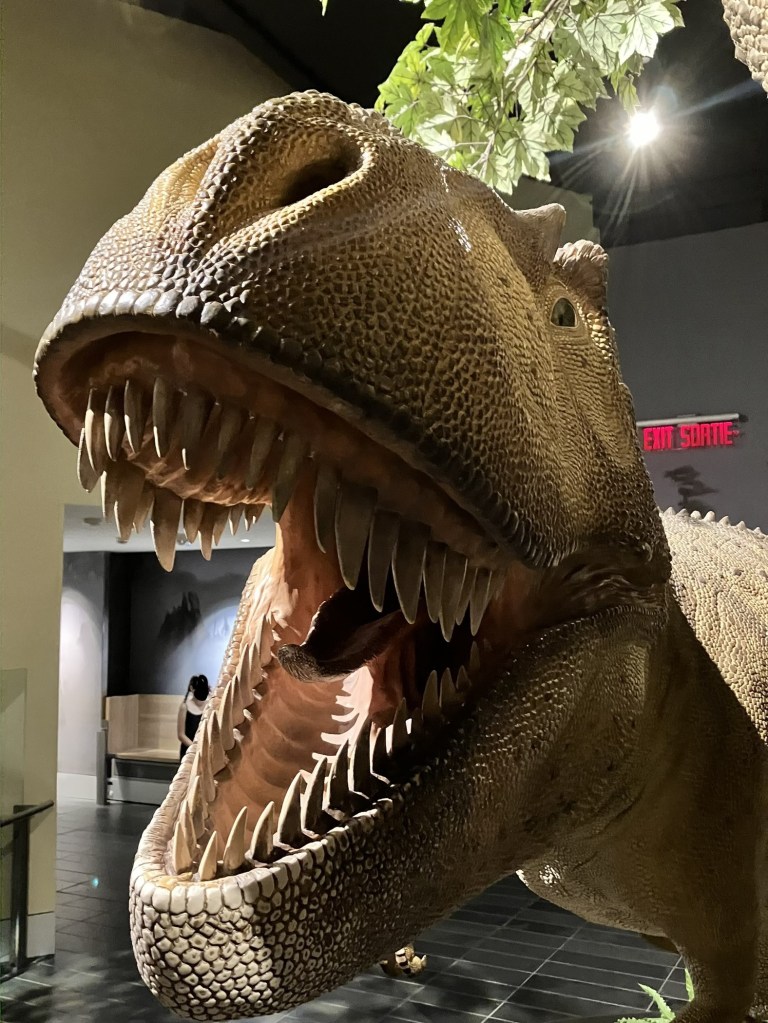
Tucked away at the end of the exhibit is a scene from a Cretaceous forest that features life-sized dinosaur dioramas. The landscape features a duel between a pack of Daspletosaurus and a herd of the ceratopsian Vagaceratops as a nesting pair of Troodontids look on. The models have their strengths (injuries to the Daspletosaurus, colouration of the Vagaceratops) but have a big issue with shrink wrapping (the dinosaurs being under-fleshed). This issue is most apparent in the face of Daspletosaurus, where you can see the skeletal outline of the animal.
Another issue with the model dinosaurs – and the fossil gallery in general – is a noticeable lack of labels. Nowhere in the dinosaur forest are the names of the species displayed, requiring viewers to listen to audio recordings on headsets to understand the scene. Another diorama in the mammal hall has the same reliance on audio recordings, and some other fossils lack sufficient labelling. Audio recordings are a good resource but insufficient as the crux which the audience’s understanding of the exhibit relies upon. It should be noted that the audio format provides a serious accessibility issue for some visitors too. Additionally, the existing labels are the exhibit’s only source of traditional paleoart. While some art pieces still hold up, others could use an update.
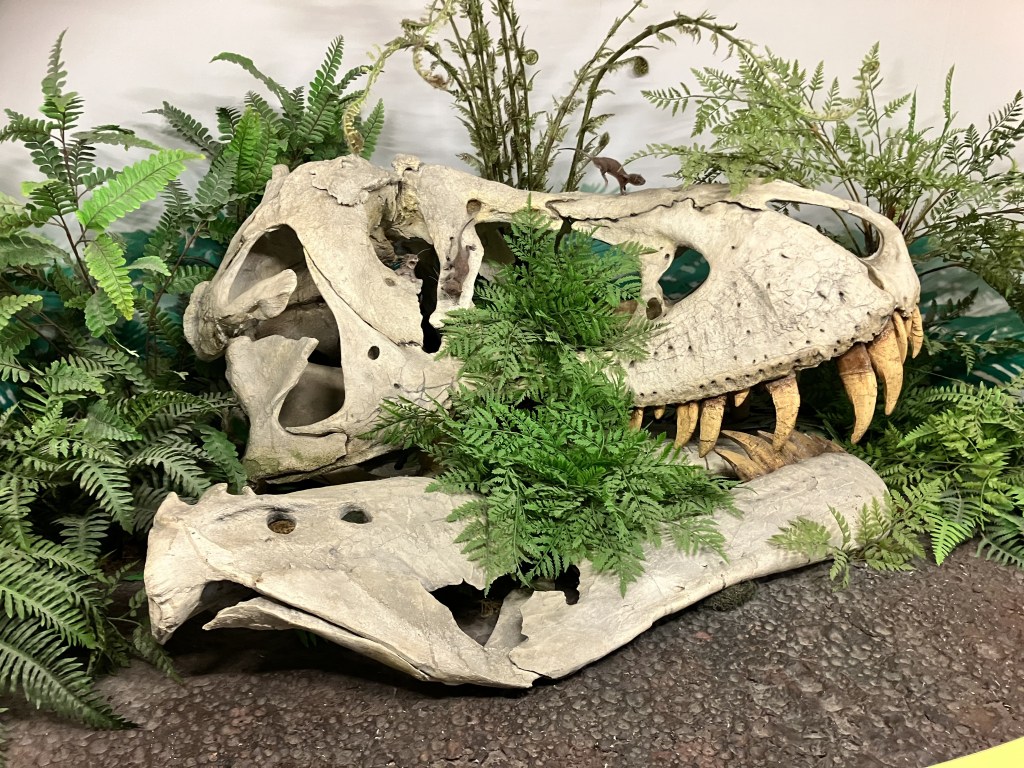
The last section of the exhibit, entitled “Rise of the Mammals,” focuses on precisely what you’d think: how mammals came to dominate Earth following the dinosaur’s extinction. My favourite portion of this area was the display of mice crawling out of a Tyrannosaurus skull, but the chart of mammal phylogeny was interesting as well. This dedication to explaining the phylogeny – or evolutionary relationships between animals – is present throughout the exhibit, with large signs explaining the different clades of dinosaurs and other prehistoric animals found throughout the gallery.
Other elements of the mammal exhibit include various stages of whale and horse evolution, another diorama which features the Eocene species Megacerops and an Entelodont, and fossils from the legendary Green River Formation of the midwestern US. The mammal hall only contains specimens from the Eocene epoch, which is surprising given that fossils of mammals from the rest of the Cenozoic are known from across Canada. Ultimately, it comes down to a spacing issue, as the space used for the fossil gallery ends with the rise of the mammals.
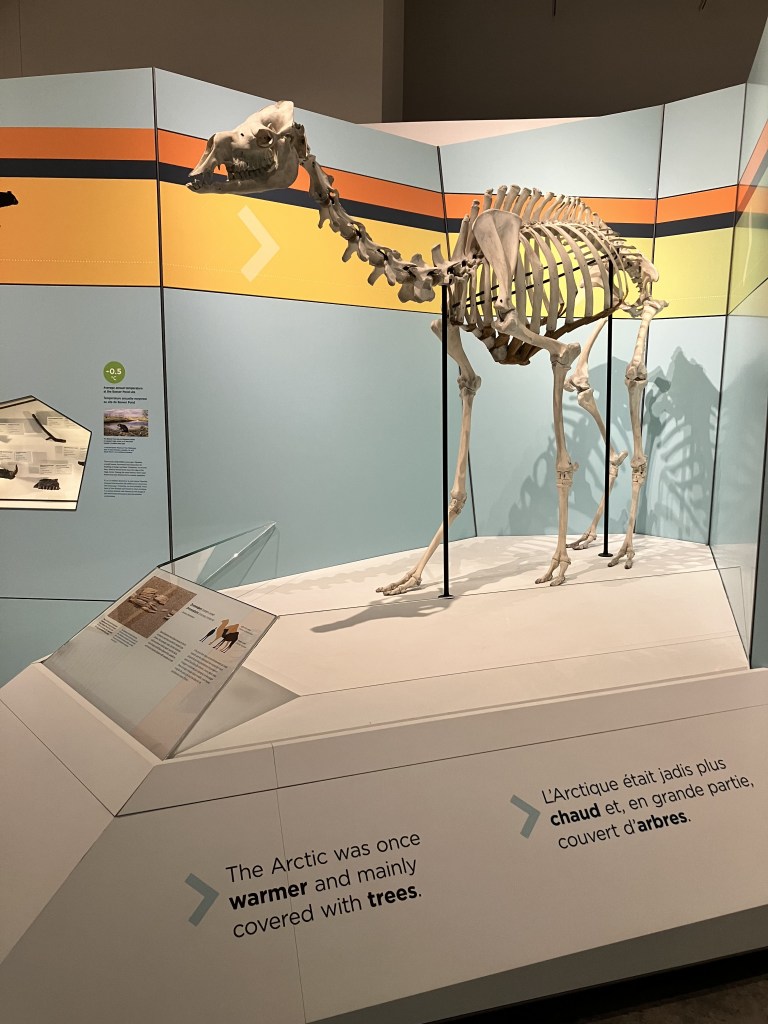
There are other fossils displayed elsewhere in the museum, however. On the CMN’s fourth floor lies an exhibit dedicated to the Canadian Arctic, which contains fossils from both the Late Cretaceous period and the Pleistocene epoch. The Cretaceous fossils consist primarily of Hadrosaur bone fragments from the Canadian high Arctic, including those found on Ellesmere Island (~80° North: crazy to think about!). Yet the mammal fossils steal the show, with the jawbone of the Pleistocene Beaver Castoroides, the skull of a Woolly Mammoth, and a camel skeleton from the Arctic making for quite the sight!
Overall, the Canadian Museum of Nature boasts an exciting fossil hall. With many different fossils, immersive models and displays, and multiple scientifically important specimens, it is well worth your time to check it out. While minor updates to the gallery are probably in order, the CMN nonetheless does an excellent job of presenting Canada’s natural history in a way that makes it fascinating to audiences.
Thank you for reading this article! If you want to know more about the Canadian Museum of Nature, check out their official website, linked below:
If you’d like to visit another Canadian museum, the Dawn of Life gallery at the Royal Ontario Museum in Toronto is well worth your time. The exhibit was installed during the pandemic and has wowed audiences with its beautiful combination of fossils, artwork, and interactive displays. To read more about it, check out my review here at Max’s Blogosaurus!
All images were taken at the Canadian Museum of Nature and were photographed by Max’s Blogosaurus.
 Max's Blogo-Saurus
3 replies on “The Canadian Museum of Nature: Canada’s Natural History Come to Life”
The museum of nature (aka the Castle) is pretty much my favourite museum in the National Capital Region. It used to be only half the building, with the other half being the Museum of Man, which moved to the Quebec side of the river and was renamed the Canadian Museum of History.
Come to think of it, I have been to the Nature museum in a while. I need to get out again.
LikeLike
Embarking on a cultural expedition through Canada’s museums was nothing short of enchanting! The National Gallery’s artistry, the Canadian Museum of History’s immersive narratives, and the poignant exhibits at the Canadian Museum for Human Rights left me in awe. If you’re a fellow wanderer seeking an unforgettable odyssey, these museums are a must-visit.
LikeLike
[…] fossil gallery houses Canada’s first displayed dinosaur, the Edmontosaurus regalis hadrosaur, which debuted in 1915. This specimen anchors a collection […]
LikeLike