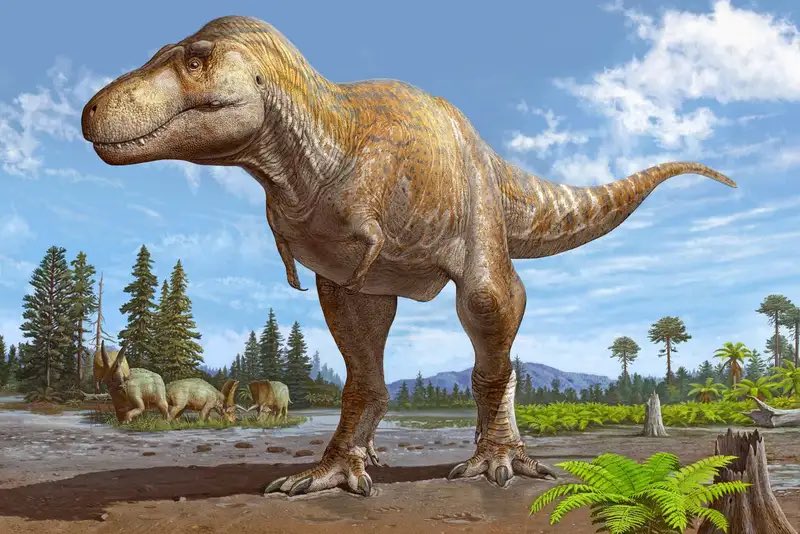
Tyrannosaurus has kicked off the new year with an absolute bang! Perhaps it was very dedicated to its resolutions?
Just over a week ago, on January 3rd, paleontologists Nicholas Longrich and Evan Saitta published an examination of the Tyrannosaurid Nanotyrannus and its taxonomic status. To summarize, they believed that the teenage tyrant was a valid genus and not a teenage Tyrannosaurus rex, the prevailing view in paleontology. While their study presented interesting arguments, including a new specimen of a juvenile Tyrannosaur, many individuals – including myself – considered the publication more of a review and insufficient to settle the debate. (For more information, read “The Pipe Dream of Nanotyrannus Reaches New Heights: Comments on Longrich & Saitta 2024”).
It appears that Longrich is not very patient because it only took him 8 days to publish another study related to Tyrannosaurus! This time, Longrich (and a larger team of researchers, including lead author Sebastian Dalman and legendary paleontologist Phil Currie) have introduced a new controversy to Tyrannosaurus: a potential second species.
In 1983, a massive jawbone assigned to Tyrannosaurus rex emerged from the Hall Lake Formation of New Mexico. In subsequent years, additional dinosaur fossils – including skull fragments from the same Tyrannosaurus, Ceratopsian skeletons, and leg bones of both a sauropod and a large hadrosaur – would be found in Hall Lake deposits. The jaw of Tyrannosaurus, specimen NMMNH P-3698, would be displayed at the New Mexico Museum of Natural History and Science for all to see, believed to be an inconsequential fossil for the taxonomy of its genus…

Until Dalman came along, that is. A thorough re-examination of NMMNH P-3698 led Dalman to conclude that it represented a distinct species from Tyrannosaurus rex, known as Tyrannosaurus mcraeensis[i]. The name mcraeensis is surprisingly not dedicated to any individual involved in the study, instead stemming from the McRae Formation, which contains the Hall Lake subgroup. Many subtle anatomical differences between T. mcraeensis and other T. rex fossils were noted, though variation between individuals may explain many of these features away (why does that sound familiar?). Some paleontologists, including Tyrannosaur expert Thomas Carr[ii], have already noted that NMMNH P-3698 doesn’t exhibit any features that vary drastically from T. rex, so these traits may not be suitable for diagnosing a new species.
The age of T. mcraeensis is however far more interesting. T. rex was believed to have appeared in the later portion of the Maastrichtian Stage during the Late Cretaceous, approximately 68 million years ago. Hall Lake fossils, once thought to have fallen within this time range, were recently found to be approximately 73.2 million years old[iii]. Using the distance of T. mcraeensis’ fossils relative to the sediments used to calculate this date, Dalman’s paper concludes that the site containing T. mcraeensis was likely between 72.7 and 70.9 million years old.
If true, this discovery may rewrite our knowledge of Tyrannosaurus evolution. Paleontologists have theorized that the Tyrannosaur subfamily Tyrannosaurini – which includes massive, late-stage genera like Tyrannosaurus and the Asian Tarbosaurus and Zhuchengtyrannus – originated in Asia and later dispersed to North America[iv]. This theory is rooted in the age of the respective Tyrannosaurines, with Zhuchengtyrannus and Tarbosaurus appearing earlier in the fossil record than their close relative Tyrannosaurus. As the Tyrannosaurines moved to North America during the Maastrichtian stage of the Late Cretaceous approximately 69-68 million years ago, they replaced endemic Tyrannosaurids like Albertosaurus, paving the way for Tyrannosaurus rex to evolve.

The discovery of an older Tyrannosaurus species in New Mexico could refute this notion. If Tyrannosaurus evolved simultaneously with the Asian Tyrannosaurines, the genus probably originated from North America instead of Asia. This scenario raises many questions regarding the dispersal patterns of Tyrannosaurini. Were other Tyrannosauids from North America, like Lythronax and Daspletosaurus, also part of the lineage? If there were large Tyrannosaurines in Asia and North America 72 million years ago, when and where did the lineage first appear? If they originated in southern North America, why don’t we find their fossils in northern areas like Montana and Alberta until the Late Maastrichtian? If Tyrannosaurus mcraeensis – or something like it – dispersed into Asia during the Campanian and diversified into Zhuchengtyrannus and Tarbosaurus, why did it not spread to the rest of North America at this time?
For now, these questions remain unanswered.
The idea that a second Tyrannosaurus species may have existed isn’t new. In 2022, Paleontologist Greg Paul famously published a theory proposing a split of Tyrannosaurus rex into three separate species: T. rex, T. imperator, and T. regina. The general perception of this theory at the time was that, while these were very cool names to give the species, the proposed anatomical evidence to justify this divide was insufficient.
While most paleontologists agree that more species of Tyrannosaurus may have existed, no study has created a solid case for one – until now. While the study isn’t perfect (I’d love supplementary radiometric dating from the specific site where the fossils of T. mcraeensis come from), the proposed age of the newest Tyrannosaur is perhaps the best evidence presented to justify a new species. I’m sure a counter argument will be published soon. For now, we can enjoy a second species of Tyrannosaurus with a real case to be valid!

A few other things to note:
- Some online sources have connected T. mcraeensis to “Alamotyrannus,” a dubious genus of Tyrannosaur known from fossils found in New Mexico. This information is incorrect, as the proposed fossils of Alamotyrannus are separate from the ones used to describe T. mcraeensis.
- While the remains of T. mcraeensis are fragmentary, the size of the dentary indicates that it may have been longer than Scotty, the largest known specimen of Tyrannosaurus rex!
- Mcraeensis is spelt with two e’s.
- The name Mcraeensis is admittedly terrible. Most hostility from paleo-twitter has stemmed from the name itself instead of the notion of a second Tyrannosaurus species. If the research team wanted a better name, they should have used the advice given by Max’s Blogosaurus!
Thank you for reading this article! 2024 has been a crazy year for Tyrannosaurid research, and we haven’t even cracked January 15th yet! For more Tyrannosaurid content, I suggest reading “The Gorgon’s Last Meal: Fossilized Stomach Contents of a Teenage Tyrannosaur” here at Max’s Blogosaurus!
I do not take credit for any images found in this article. All images come courtesy of the artists/sources tagged.
Header image courtesy of Sergey Krasovskiy, found at his twitter here.
Works Cited:
[i] Dalman, Sebastian G., et al. “A Giant Tyrannosaur From the Campanian–Maastrichtian of Southern North America and the Evolution of Tyrannosaurid Gigantism.” Scientific Reports, vol. 13, no. 1, Springer Science and Business Media LLC, Jan. 2024. Crossref, https://doi.org/10.1038/s41598-023-47011-0.
[ii] Dunham, Will. “Scientists Conclude New Mexico Fossil Is New Tyrannosaurus Species.” Reuters, 11 Jan. 2024, http://www.reuters.com/science/scientists-conclude-new-mexico-fossil-is-new-tyrannosaurus-species-2024-01-11.
[iii] Amato, Jeffrey M., et al. “Onset of the Laramide Orogeny and Associated Magmatism in Southern New Mexico Based on U-Pb Geochronology.” Geological Society of America Bulletin, Geological Society of America, May 2017, p. B31629.1. Crossref, https://doi.org/10.1130/b31629.1.
[iv] Brusatte, Stephen L., and Thomas D. Carr. “The Phylogeny and Evolutionary History of Tyrannosauroid Dinosaurs.” Scientific Reports, vol. 6, no. 1, Springer Science and Business Media LLC, Feb. 2016. Crossref, https://doi.org/10.1038/srep20252.
 Max's Blogo-Saurus
6 replies on “Meet Tyrannosaurus mcraeensis: the Newest Species of Giant Tyrannosaur”
This is so cool!!!
Can’t wait for the next article.
It’s funny… I read a lot of other blogs about palaeontology etc. but the authors are way too biased a lot of the time and say people are stupid when they claim something that they don’t think is true. Whereas you are very respectful of the ‘other sides’ opinion and you may disagree with it but you do so in a way that shows your own opinion but also leaves room for you to be convinced by their opinion as well.
In other words you don’t just shut down their theory straight away!!!
I think that’s such an awesome ability to have!!!
Anyway… I hope you had a great new year and am looking forward to reading some more very interesting articles throughout the year!
LikeLiked by 1 person
Thank you so much! I take great pride in being able to communicate both stances of given scientific debates, so to hear I am doing so effectively is extremely validating.
I’m glad you’re enjoying my website! I promise 2024 has plenty left in store – it is the 200th year anniversary of the first named dinosaur, after all!
LikeLike
It sure is…
Can’t wait to find out what new discoveries we have in store!
LikeLike
Hi, I did the original U-Pb dating of the tuff below the dinosaur. While I would also “…love supplementary radiometric dating from the specific site where the fossils of T. mcraeensis come from”, the best dates come from tuff (volcanic ash layers) and there aren’t any known tuffs between the one we dated and the dinosaur locality. We are continuing work in the area though.
LikeLiked by 1 person
The imperfections of the fossil and geological records strike yet again. Would love to hear more about the research you’re currently undertaking!
LikeLike
[…] enough confidence to do such an article. Besides, Minqaria was published around the same time as several key Tyrannosaur papers, so it fell somewhat into the background of my Max’s Blogosaurus periphery. But through all that […]
LikeLike