If you haven’t heard of Jurassic Fight Club, I will apologize in advance for the mania that I am about to introduce you to.
For those who have heard of it – or even seen it – welcome back! I suppose you will soon find out if things are better or worse the second time around.
In 2004, Animal Planet created a 12-part series entitled “Animal Face-off” which saw two animal species battle it out in a series of hypothetical fights. The matchups featured in the series were, for the most part, one of two possible conflicts: realistic encounters, like that between a sperm whale and a colossal squid; or complete fantasy, like a Hippo battling it out against a Bull Shark. I may question its appeal, but ultimately, the decent ratings and audience of the series seemed to negate my initial opinions. While Animal Face-off died after a single season, The History Channel looked to capitalize on the notion that “imitation is the sincerest form of flattery”.
Enter Jurassic Fight Club (JFC). To ride the momentum of its spiritual predecessor, the History Channel commissioned a new series that featured prehistoric battles to the death between long extinct species. In its 12-episode run, Jurassic Fight Club turned what could have been a fascinating concept into a self-indulgent mess littered with grossly edited comments by paleontologists; some extremely dubious and/or false theories presented as facts; and, a fundamental misunderstanding of how animals behave and interact with each other and their environment. To put it bluntly, there’s a reason why this show has lived in infamy since its 2008 release…
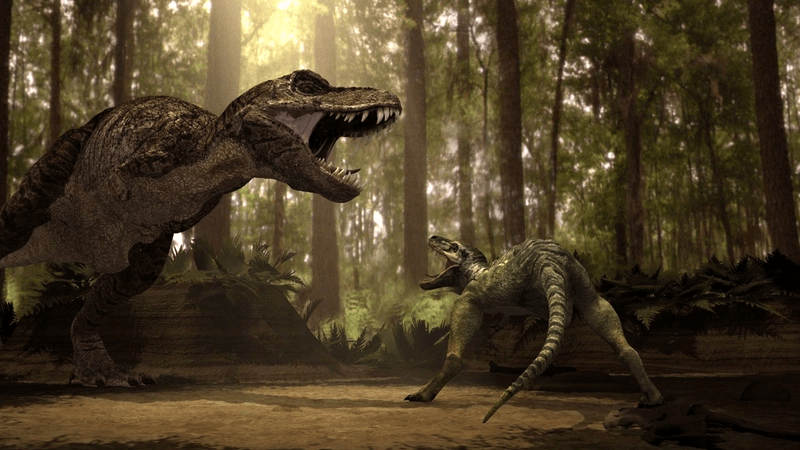
Often when reviewing a series such as this, I would re-watch every episode to get a greater sense of its strengths and weaknesses. However, in the case of JFC, I confess that I did not have the patience to watch 12 hours of this chaos again. One exhausting and borderline soul-crushing episode was hard enough!
Instead, I chose to watch the episode that I believe is the epitome of everything wrong with this series. Enter Bloodiest Battle, the 4th episode and “peak” of the series – in all the wrong ways. As should be expected, spoilers follow.
What’s it About?
Bloodiest Battle follows the fauna of the Cleveland-Llyod Dinosaur Quarry of Utah, a site from the Late Jurassic Morrison Formation. As you may guess, several of the site’s more enigmatic dinosaurs – the large predators Allosaurus and Ceratosaurus, the armored Stegosaurus, and the sauropod Camarasaurus – are combatants in the episode.
That’s right, folks. We’ve got ourselves a fatal four-way match!
The first half of the episode introduces the audience to the competitors, providing a brief description of their size and appearance before delving into why each animal was so deadly. The introduction to each dinosaur builds to the second half of the episode, which primarily focuses on a CGI dinosaur fight revolving around a ridiculous scenario. The “graphic depiction of a prehistoric battle,” as stated at the end of each commercial break, is primarily narrated by series co-creator and self-taught paleontologist “dinosaur” George Blasing. Though other paleontologists offer insights earlier in the episode, they are mostly spared from the end battle – more on that later. Once the battle concludes, the extinction at the end of the Jurassic is touched upon, wrapping up the story of the dinosaurs featured in the episode.
Let Them Fight!
Since Bloodiest Battle and other Jurassic Fight Club episodes are built around fictitious battles between prehistoric animals, I feel that the fight is a good place to start my critique. Though I am no expert on fight choreography, I can say for certain that the sequence of the titular bloodiest battle is an absolute mess.
The fight starts when a female Stegosaurus and her offspring become stuck in mud at the edge of a prehistoric lakebed. The sounds of their cries attract a lone Ceratosaurus, who proceeds to eat the trapped juvenile as the helpless mother attempts to free herself. Now, you may wonder: why didn’t the Ceratosaurus get stuck too? Well, the narrator explains that the splayed feet of the Ceratosaurus prevent it from sinking. This is the first major issue with the logic of the episode: why would the baby Stegosaurus, who presumably weighs less than (or at least equal to) the adult predator and is able to spread its weight on 4 feet instead of 2, get stuck while the predator doesn’t? This issue resurfaces later in the episode, but we’ll get to that in a minute.
Soon after the Ceratosaurus starts eating the baby Stegosaur, a pack of three Allosaurus arrive on the scene. While two distract the Ceratosaurus, a third individual circles behind and attacks the Ceratosaurus from the side, instantly killing it by ramming into its flank. While I love displays of dinosaur intelligence, even I must concede that it is unlikely that Allosaurus could engage in cooperative hunting strategies. Birds and Crocodilians, the closest living relatives to dinosaurs like Allosaurus, rarely engage in pack hunting. Though predatory dinosaurs (including Allosaurus) have been documented congregating together to scavenge food, the comparatively primitive brain of Allosaurus was incapable of using complex strategic maneuvers to outflank another predator[i]. Even if this did happen, Allosaurus wasn’t a “freight train” as described and couldn’t have killed the Ceratosaurus in one charge. You’d think that Bloodiest Battle would salivate at the chance to show an actual fight between the two theropods, but instead we get a very lopsided squash match. Guess the budget was going a little overboard!
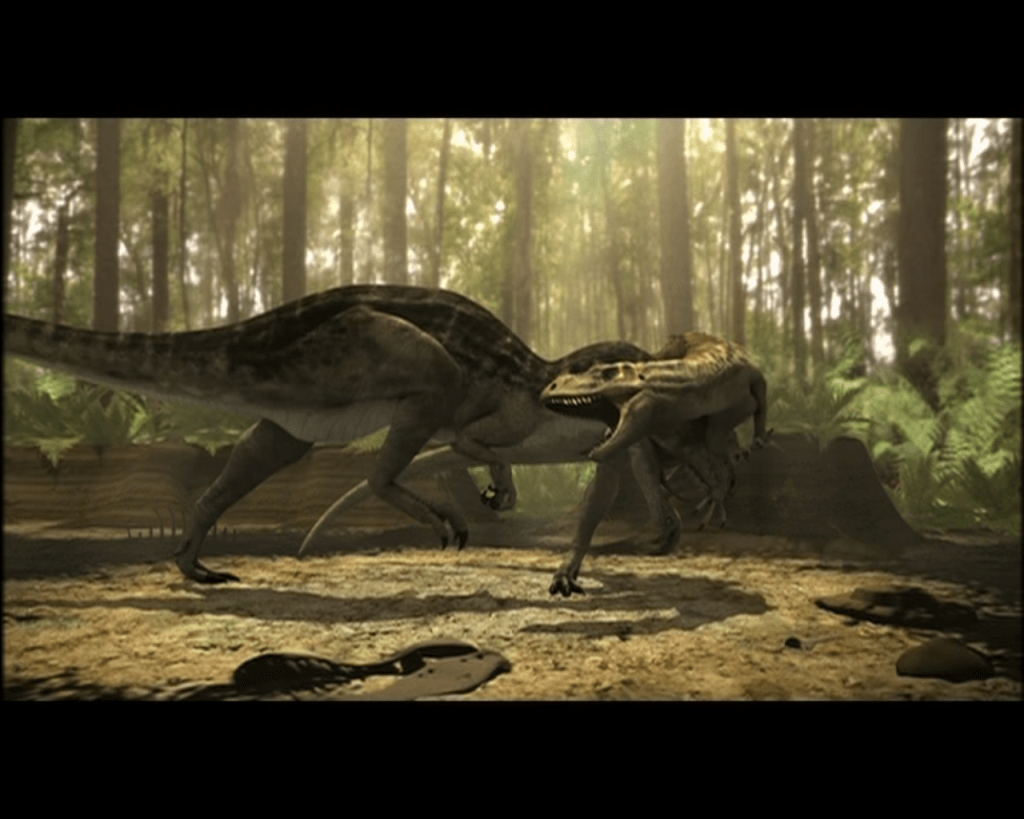
With two dead dinosaurs now sitting in front of them, do the Allosaurus start feasting? Of course not! While the Allosaurus trio mosey around their food, one of them wanders a little too close to the mother Stegosaurus’ tail. By a little too close, I mean that it sticks its face directly in the tail area and gets clubbed almost instantly. Do I even need to explain why this scene is devoid of logic? Perhaps if the Allosaurus avoided the fate of the late Thag Simmons, it may have lived.
Now, imagine that you’re the other two Allosaurus. Mere meters in front of you lies a dead Stegosaurus, Ceratosaurus, and now another Allosaurus. Do you start eating one of the dead dinosaurs? Nope. Do you kill the mother Stegosaurus so the danger she presents is eliminated? Nope. Do you, a species known to practice cannibalism when presented with dead Allosaurus[ii], eat your fallen companion? Of course not! No, you look over your shoulder and notice that a bull Camarasaurus has also gotten stuck in the mud at sometime during your fight and you leave the smorgasbord of dead dinosaurs to attack it. Why did the sauropod come to drink when a very bloody fight is happening less than 25 meters away? No clue!
It was at this point in the episode that the shark had officially been jumped, and I started looking for an escape route. While the remote to my DVD player (yes, I realize I am old!) was mere centimeters away from my hand, I came to my senses and struggled through the rest of the episode. It’s what the Ceratosaurus would have wanted.

The decision to make the Allosaurus leave their kill to attack a 20-ton dinosaur is completely nonsensical. Not a single predatory animal on this planet would abandon three perfectly fine meals to attack a larger, more dangerous prey item nearby. Allosaurus may not have been a brainiac, but it was intelligent enough to avoid putting itself in danger to take down a much larger dinosaur. If the Allosaurus were going to go after the Camarasaurus, they would have waited until it was either completely exhausted or outright dead, not while it was still able to take them out.
After turning to the Camarasaurus, the Allosaurus start biting and slashing at it. Both Allosaurus try jumping on the still upright Camarasaurus, a ridiculous visual and one ill-suited for multi-ton predatory dinosaurs. Maybe they accidentally used the raptor animations from other episodes? Rather predictably, the fight goes horribly wrong; one Allosaurus died while I stopped paying attention momentarily (oops!), and the other gets crushed after the Camarasaurus frees its front legs. Its death is quite funny; instead of just staying still, the Allosaurus sprints directly under the falling legs of the Camarasaurus.
For the first time in the 43-minute runtime, I wished I was that Allosaurus.
As you can tell, Bloodiest Battle puts its featured animals in ridiculous positions to make as graphic a confrontation as possible. Allosaurus are simultaneously transformed into strategic killing machines and Three Stooges-level idiots who somehow haven’t encountered a Stegosaurus and realized that its tail is a no-fly zone. Ceratosaurus is made into a weakling, while the herbivores are both non-entities. You could have replaced Camarasaurus with any Morrison sauropod and it wouldn’t have made a difference. At no point during the episode do any of the animals feel real. Instead, the whole episode feels like it came from the mind of Michael Bay: a senseless display of violence without a single consideration for animal behaviors and coherent logic. At least Bay can do explosions!
An Obituary for Ceratosaurus: 1884-2008
The lasting memory most people have of Jurassic Fight Club is its negative portrayal of Ceratosaurus. A burial, if you will. Before watching this episode, I honestly thought this criticism was overblown. My goodness was I wrong. The fact that the Ceratosaurus gets instantly killed by the Allosaurus is bad enough, but prior to this annihilation, Bloodiest Battle goes out of its way to disparage the dinosaur. At several points, the size, intelligence, and anatomy of Ceratosaurus are seemingly ridiculed by the paleontologists and narrator. Towards the middle of the episode, Thomas Holtz is taken out of context to state the following:
“Although it was pretty strong, it didn’t have the claws, it didn’t have the brains, and it also didn’t have the size of the other meat eaters of its environment”
Rough!
While it’s true that Allosaurus has a small size advantage on Ceratosaurus, it’s not as though Ceratosaurus was a pushover. Ceratosaurus was more heavily built than portrayed in Bloodiest Battle, and still had plenty of weapons beyond its claws. The massive teeth inside its mouth would have been quite effective in battle, making it a far more capable opponent for Allosaurus. The critique of its intelligence and claws is curious, given that Allosaurus wasn’t much smarter than Ceratosaurus, nor did it have larger claws. Claw size is especially redundant when you consider that most large theropods were using their jaws to fight instead of their claws anyways.

This episode isn’t even the pinnacle of Ceratosaurus bashing in Jurassic Fight Club. Episode six, “Hunter Becomes Hunted,” watches a lone Allosaurus kill a pair of Ceratosaurus as the episode declares that Allosaurus is responsible for the extinction of their horned rivals. Not only is the notion of a lone Allosaurus killing two other predators who are only marginally smaller than itself ridiculous, but the idea that a predator is solely responsible for another’s extinction is even more preposterous. Extinction isn’t a simple process, with environmental factors often playing a far greater role than other species. In declaring Allosaurus responsible, the series demonstrates a lack of understanding of how extinction works.
Plus, the idea that Allosaurus suddenly killed all the Ceratosaurus after living together for millions of years prior is just ridiculous. If it were that easy, every competing species would do it. Yet competition persists. The reason why both Ceratosaurus and Allosaurus went extinct is still unclear, but the reasons are more complex than labelling Ceratosaurus as an inferior dinosaur. All I can say now is Justice for Ceratosaurus.
How do Predator Traps Work?
On the topic of not understanding ecological concepts, I question whether the series creators of Jurassic Fight Club truly understand how a predator trap works.
To refresh, predator traps are locations where herbivores that have become trapped in mud, asphalt, or other sediments attract predators through either their cries or their smell after they die. The predators, attracted by the lure of a free meal, become stuck themselves and further the process. At these sites, the majority of fossils present belong to predators who couldn’t identify the trap before it was too late. The most famous example of this is the La Brea Tar Pits of downtown Los Angeles, USA, a location that preserves thousands of Dire Wolf and Sabretooth Cat specimens (amongst many others) who were attracted by Pleistocene megafauna like Mammoths and Ground Sloths stuck in the asphalt.

It has long been believed that the Cleveland-Llyod quarry was a predator trap based on the ratio of predator to herbivore fossils. Though some recent studies have suggested that more complex environmental factors led to the assemblage of dinosaurs,[iii] Bloodiest Battle presents Cleveland-Llyod as being a predator trap. The La Brea Tar Pits are even mentioned by name as an analogue for the site. So, if they call it a predator trap, I will treat it as such.
As you can probably guess, predator traps work nothing like what is shown. The whole theory of a predator trap revolves around the predators getting trapped. Just because predatory dinosaurs have splayed feet does not mean they could avoid getting stuck in the mud. In fact, their anatomy might make them more susceptible to entrapment; at least Stegosaurus had 4 feet to distribute its weight on. The reason that sites preserving predator traps have far more predator fossils is because they also get stuck. They aren’t killed by angry sauropods or swinging Stegosaurs; they get stuck and die. They might eat some of the prey before dying if they are lucky, but their fate remains the same. I wonder whether this came up in the pre-production of this series; maybe it did, but the producers decided to take artistic license. In either scenario, it’s plain embarrassing.
Harmless Fun? I think not!
There are plenty of other issues with the science and structure of Bloodiest Battle and the wider series. It seems that little effort was put into the set locations, with reuse of backgrounds and settings occuring frequently despite episodes being set in vastly different ecosystems. The exaggeration and hyperbole used in the narration doesn’t work for me; in this episode, the fatal four-way is referenced as a “prehistoric bloodbath unlike any other”. Spoiler alert: it wasn’t even the bloodiest site from the Morrison Formation (shoutout to the Mygatt-Moore Quarry). The anatomy of the dinosaur hands is wrong, because every mediocre-or-worse dinosaur documentary can’t help itself from making this error.
The feet of Camarasaurus are described as “elephant-like,” a common misconception. Camarasaurus is portrayed as a thoughtful parent when no evidence exists of parental behaviors in most sauropods and the genus itself. At one point, George Blasing says the Allosaurus lost to Camarasaurus because it wasn’t in “apex predator mode”. What does apex predator mode even mean? It’s not as though lions and tigers flip a switch and become unstoppable killing machines. Maybe Dinosaur George is referring to the mindset I have on Thanksgiving?
I found the scientific issues with this series troublesome. Some may believe it to be harmless, but I feel otherwise. Jurassic Fight Club is a show that’s primary audience is children and people outside the field of paleontology. In other words, groups that may view the show with a less critical lens. When I was younger, I watched this episode and latched onto the belief that the antorbital fenestra, the gap in the skull dinosaurs possess in front of their orbits, was utilized to help dissipate heat. I believed this for almost a decade before I learned this was false and had no scientific literature to support it. So, while Jurassic Fight Club may seem like a mindless series meant only for fun, it is important to remember that the documentary-style interviews and narration has an impact on younger and more impressionable audiences. It’s for this reason that I am critical of dinosaur programs getting information wrong, especially in the modern age of the internet. It takes about five minutes to find published and peer-reviewed articles about most paleontology topics; not doing so shows a laziness unbecoming of responsible programming.
Phil Currie? Is that you?
Now, about the paleontologists. Jurassic Fight Club features several renowned paleontologists as talking heads throughout its episodes. In Bloodiest Battle, Phil Currie, Thomas Holtz, Lawrence Witmer, James Madsen, and Jim Kirkland all feature at various points. The king of the skeletal diagrams, Scott Hartman, was featured too. In other episodes, Robert Gaston, John Foster, Mark Norell, and others make appearances. This begets the question: how did one of the most blatant exercises in scientific malpractice get all these respected figures to appear?
When asked about the production of the series, Jim Kirkland stated that the producers interviewed the paleontologists for several days and edited the footage to support their narrative. So, it appears that the producers deliberately interviewed the paleontologists on a wide range of topics before purposely altering their comments to fit the narrative seen within the series. Kind of scummy if you ask me!

Kirkland, a Utah state paleontologist with experience working at Cleveland-Llyod, hates Bloodiest Battle. What a surprise!
This mistreatment is likely one of the reasons why paleontologists hesitate to work for the History Channel, something that Luis Chiappe learned after offering his knowledge for an episode of Ancient Aliens. It’s one thing to put aside scientific findings in the name of artistry; it’s another to mislead interviewees to support your narrative. If it wasn’t already apparent that Jurassic Fight Club sucks, I hope this should clarify it.
The Better Jurassic Fight Club.
When I was a kid, I loved Jurassic Fight Club. How could I not? I got to see cool dinosaurs fighting in bloody, violent affairs. It’s not like I could watch R-rated movies. But watching an Allosaurus tear up a sauropod before getting crushed? Yes please! But, with age came the realization that this show is just a whole lot of nothing. The science is inaccurate, the dinosaur designs are just fine (at best -seeing my darling Majungasaurus portrayed as such hurts my soul), the narration is tedious, and the pacing is challenging. When preparing to watch Bloodiest Battle, I vowed to find something positive. The only thing I could muster was, “I kind of like the panting Allosaurus, at least”. What more is there to say?
Now, there is another series that uses the dinosaur death battle concept far better than Jurassic Fight Club. In 2005, the BBC created a 2-part series called The Truth About Killer Dinosaurs, which featured fights between a Tyrannosaurus and Triceratops, and Velociraptor against both Pinacosaurus and Protoceratops. I will concede that the UK version narrated by Bill Oddie is fine, but nothing special. The American version on the other hand is awesome. A well-paced, captivating series with brilliant use of practical models and props, TTAKD is one of my favorite dinosaur documentaries of all time. You may have seen the clip from the series where a metal T. rex crushes a car, a moment that is eternally better than anything featured in Jurassic Fight Club.

Now, perhaps there is a universe where Jurassic Fight Club could have taken the fantastical dinosaur death battle premise and turned it into something brilliant. Maybe if they were more upfront about the series just being an excuse to depict dinosaurs fighting each other, it would at least be digestible. Ultimately, the documentary-style presentation and overly dramatic premises ruin any chance of redemption.
Perhaps I will return to JFC for this website someday; lord knows that my paleo friends want to suffer through another episode with me. Regardless, the pain of watching is now in your hands dear reader!
I do not take credit for any image found in this article. All images come courtesy of the History Channel unless otherwise stated.
References:
[i] Rogers, S. W. “Exploring Dinosaur Neuropaleobiology.” Neuron, vol. 21, no. 4, Oct. 1998, pp. 673–79. https://doi.org/10.1016/s0896-6273(00)80585-1.
[ii] Drumheller, Stephanie K., et al. “High frequencies of theropod bite marks provide evidence for feeding, scavenging, and possible cannibalism in a stressed Late Jurassic ecosystem.” PLoS ONE, vol. 15, no. 5, May 2020, p. e0233115. https://doi.org/10.1371/journal.pone.0233115.
[iii] New data towards the development of a comprehensive taphonomic framework for the Late Jurassic Cleveland-Lloyd Dinosaur Quarry, Central Utah
 Max's Blogo-Saurus
6 replies on “Drama, Derangement, and Dead Dinosaurs: A Review of Jurassic Fight Club: Bloodiest Battle”
It’s certainly true that Jurassic Fight Club (a very cringy series title) was marketed towards children, and not in a good way. The entire series had a very strong “video game” vibe to it, like a bunch of 8 year olds playing a dinosaur version of Street Fighter or Mortal Combat. During my time as a museum volunteer, one of the most common questions that I’d get asked by the kids (I’d say 40-50% of the time) is “Who would win in a fight between species A and species B?” Jurassic Fight Club is an abomination which NEVER should have been produced.
LikeLiked by 1 person
It really is unfortunate how series like JFC can influence the younger generation. I laughed at your video game comment; in my planning for the article, I was going to talk about the Jurassic Fight Club online fighting game which, I believe, can still be found floating around. Guess a topic for a future article!
LikeLiked by 1 person
While I agree with most of the criticism, the idea dinosaurs were incapable of cooperative hunting because birds and crocs rarely do it is an argument based entirely on outdated ideas about modern animal behavior. Genuine cooperative hunting IS actually known in crocodilians (though only as necessary), and the entire idea of “primitive-brained” theropods not having the intelligence for cooperative hunting is based on disproven ideas about crocodilians being instinct-driven and stupid animals.
LikeLike
You raise a fair point. I do believe that while some kind of cooperative behaviour in even more “primitive” theropods is certainly possible, if not probable, JFC presents the Allosaurus trio as being capable of forming complex strategies to combat multiple opponents simultaneously, which is stretching those capabilities quite beyond what I would call plausible. It’s less about the notion of pack hunting itself and more about how it is presented within the series.
LikeLike
Honestly the cooperative attack behavior in this episode is the least implausible aspect of Allosaurus’s portrayal in this episode, as immediately afterwards they lose all intelligence and make boneheaded decisions like ignoring carcasses and an animal they’ve just killed to attack a live sauropod, walking into range of a stegosaur’s tail when said stegosaur is immobilized and they can just approach from in front of it, etc.
LikeLike
That and the idea of Allosaurus causing Ceratosaurus to go extinct when Ceratosaurus is actually the more recently evolved of the two and they went extinct at the same time…
(Ironically allosauroids are usually on the other end of such myths due to the persistent but equally ridiculous idea they were outcompeted by “more evolved” tyrannosaurs, which also doesn’t fit the actual timeline)
LikeLike