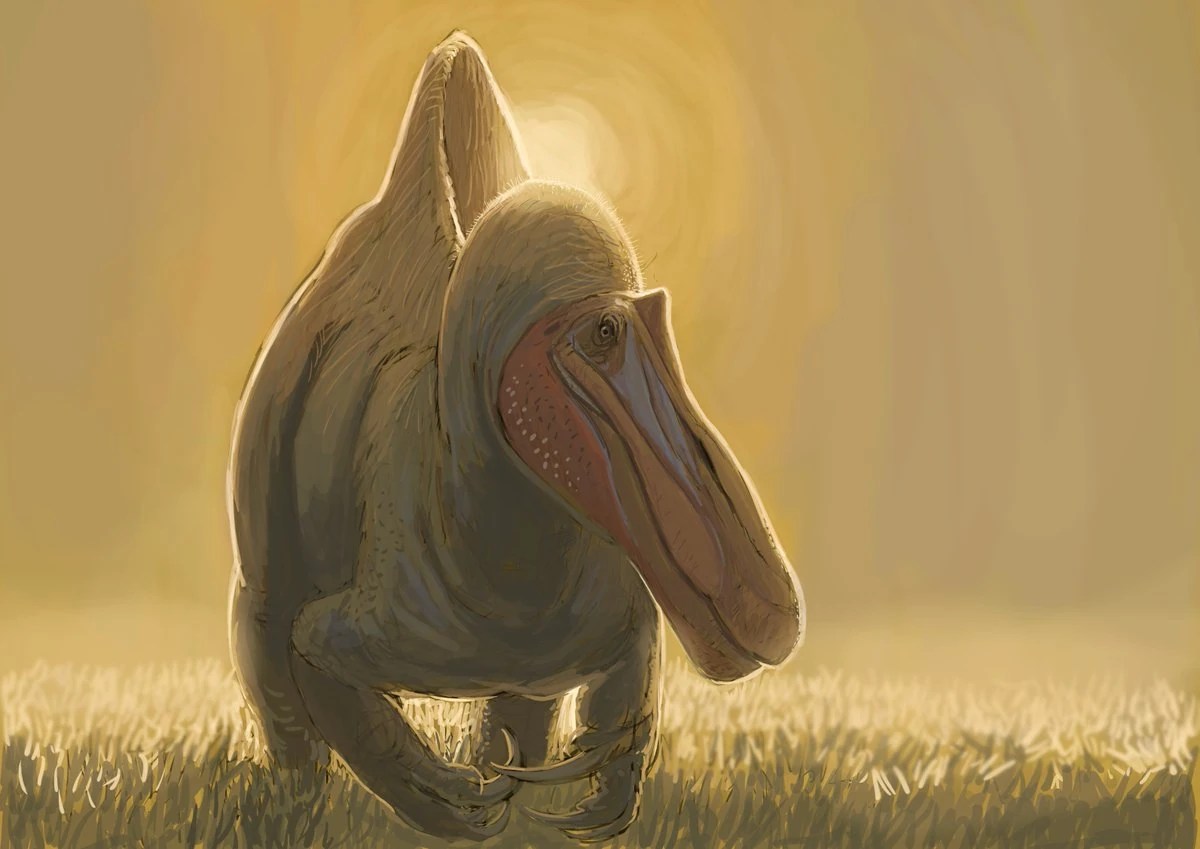
Has Suchomimus joined names such as Anatotitan and Dynamosaurus on the pantheon of dinosaur names lost to history?
The answer is complicated, as is typical for cases of dinosaur taxonomy.
On June 25th, 2026, paleontologist Frédéric Pittet of Switzerland’s Jurassica Museum published a study examining the neurovascular capabilities of Spinosaurid dinosaurs. Using detailed comparative descriptions and CT scanning of several specimens housed at the Muséum national d’Histoire naturelle, Paris, Pittet reconstructed the internal anatomy of Spinosaurid snouts. His research revealed a dense, complex network of neurovascular channels within the premaxilla, suggesting that the snout of Spinosaurids was a hypersensitive organ capable of detecting prey in aquatic ecosystems, amongst other potential functions.
Yet this discovery was not what caught the attention of many folks online. Instead, the biggest takeaway concerned the taxonomy of a dinosaur that barely featured in the paper: Suchomimus tenerensis.
In the discussion section of the paper, Pittet argues that Suchomimus, a well-known genus of Spinosaurid from Niger, is not valid, but rather a junior synonym of the species Cristatusaurus lapparenti. This conclusion is based on several anatomical similarities between known specimens of Cristatusaurus and Suchomimus, including the degree of curvature in snout specimens and the presence of a small ‘crest’ on the premaxilla. Since Cristatusaurus was described before Suchomimus – by a whopping two months, as both taxa were described in 1998 – it takes priority under established naming conventions, thus leaving the name ‘Suchomimus’ invalid.
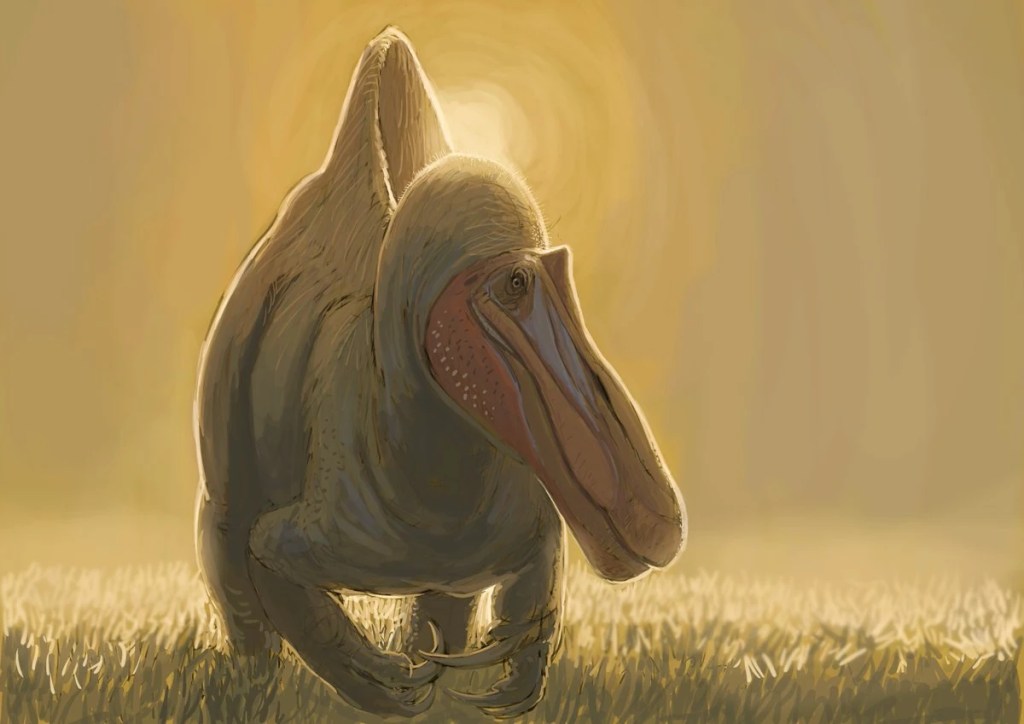
As you can imagine, the paleo community had a very calm and measured reaction to this study. Just kidding! As has become tradition, headlines proclaiming ‘Suchomimus invalid’ spread like wildfire, with many expressing surprise – and in some cases outright frustration – that their favourite dinosaur is no longer valid. While I understand this reaction, let’s take a deep breath and pause for a moment. The taxonomic relationship of Suchomimus and Cristatusaurus is a complicated affair that deserves more examination than the character limit on a social media post!
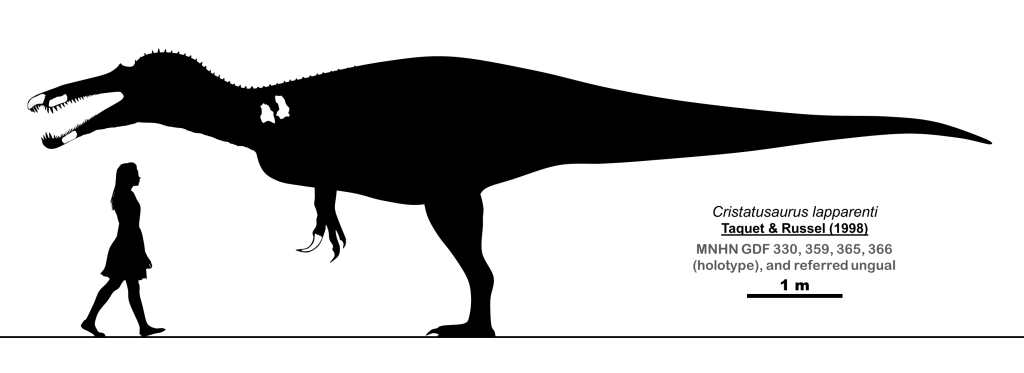
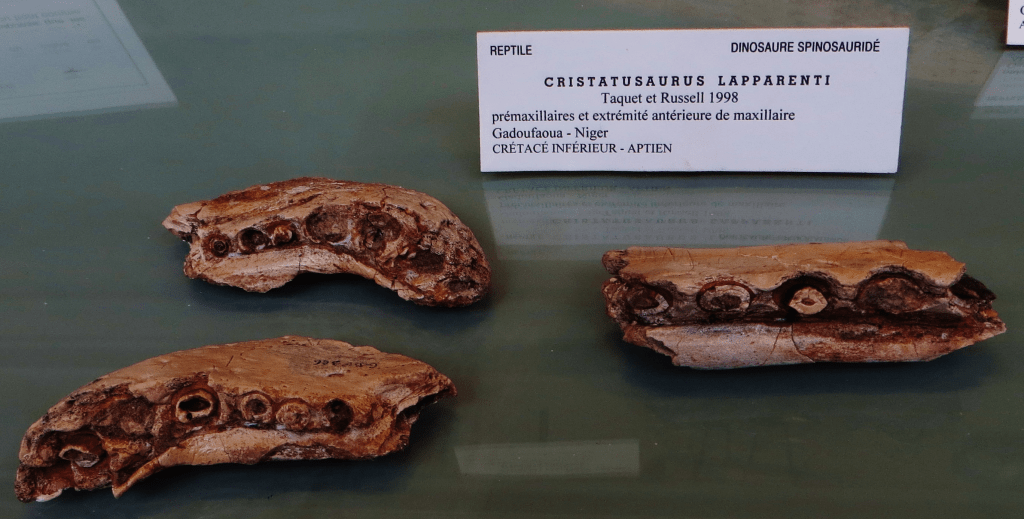
Let’s start by examining the known material of both taxa. At present, Cristatusaurus is represented in the fossil record by scarce remains from the skull and postcranial skeleton. Only two individuals have ever been discovered, with the only bones recognized comprising the snout (premaxilla and maxilla), lower jaw (dentary), and two vertebrae. The holotype, specimen MNHN.F.GDF366 housed at the Muséum national d’Histoire naturelle, represents a juvenile and preserves only the premaxilla, maxilla, and dentary.
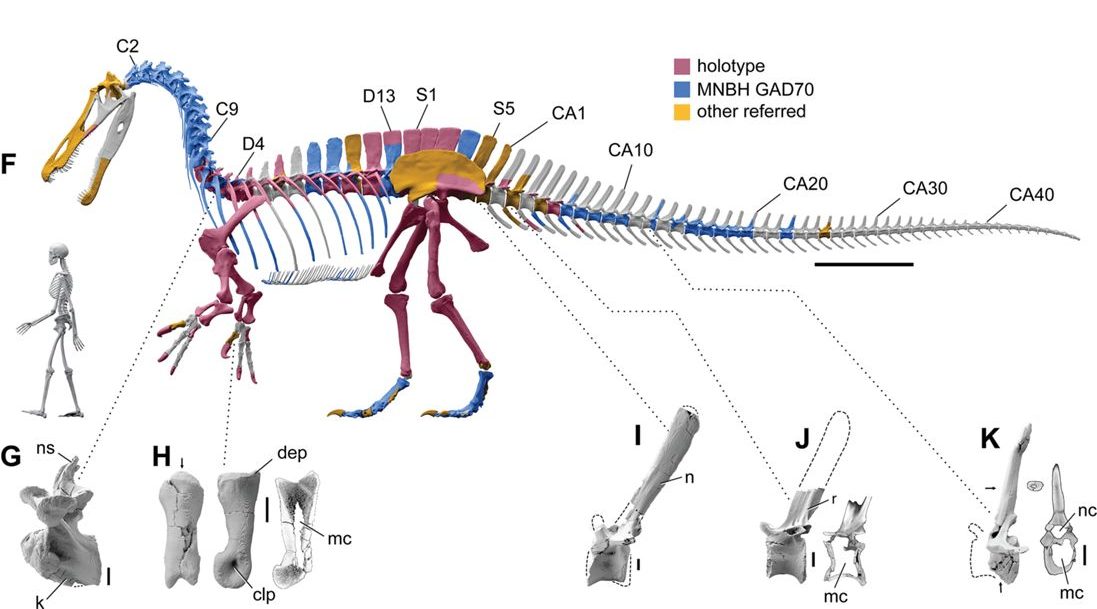
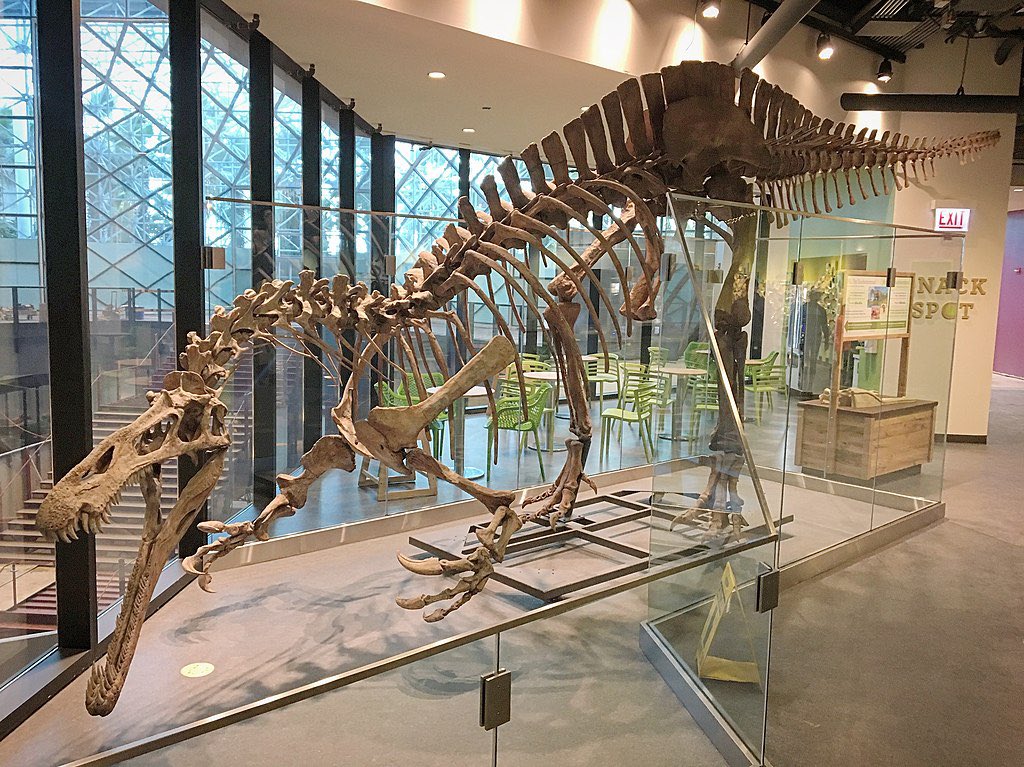
In contrast, Suchomimus is known from much more complete remains. The holotype of Suchomimus, MNN GDF500, consists of a well-preserved postcranial skeleton including portions of the vertebral column, pelvis, and fore and hind limbs. Several additional fossils have since been referred to the genus, including another partial skeleton (MNBH GAD70) and fragmentary remains which include well-preserved skulls. The relative completeness of Suchomimus material has made it cornerstone of spinosaurid research, serving as a key reference for studies despite the relative incompleteness of the clade’s other members.
So, we have one taxon represented by extensive, well-preserved remains from several individuals and another known from relative scraps. Seems cut and dry that Suchomimus should stay valid, right? Not quite. For Suchomimus to take priority over the older name Cristatusaurus, there needs to be a stronger justification than that. Luckily for Suchomimus, there is: the lack of a true autapomorphy in Cristatusaurus.
The main shared characteristic that Pittet uses to justify synonymizing Suchomimus with Cristatusaurus is the presence of a ridge along the top of the snout in both taxa, dubbed a premaxillary crest. However, this feature is not present on both Cristatusaurus specimens; in fact, such a feature is not visible on the holotype. While Pittet argues that “we can get an idea of it” by comparing it to the referred specimen, I find this methodology insufficient to treat the character as a diagnostic feature of the genus.
The other primary feature Pittet uses to synonymize Suchomimus with Cristatusaurus – the curvature of the anterior margin of the snout – also presents several problems. First, the feature itself was previously noted by Hendrickx et al (2016) to be highly variable, thus making it insufficient for diagnosis. Second, Hendrickx and colleagues note that the curvature seen in Cristatusaurus is almost identical to not just Suchomimus but also the European taxon Baryonyx, meaning it is not a true autapomorphy of the genus. Third, to explain around the second issue, Pittet did not quantify the degree of curvature through morphometrics; instead, a sketch of the Cristatusaurus referred specimen was superimposed over a photo of Suchomimus and Baryonyx. At the very least, this method is unusual in modern paleontology, especially in the context of the argument Pittet is making.
Put simply, the holotype of Cristatusaurus lacks diagnosable autapomorphies. As such, the genus should be considered Nomen Dubium at best, with a more likely outcome being that it is synonymized with Suchomimus as the junior synonym, with Suchomimus taking precedence.
Such a classification would not be unprecedented within dinosaur paleontology – far from it, in fact. My previous article was an April Fool’s post about a dinosaur named Tylosteus ornatus, a genus named in 1872 from a piece of squamosal found in deposits of the Hell Creek Formation. Years later, paleontologists recognized that Tylosteus was the first name given to Pachycephalosaurus, the iconic dome headed dinosaur known from multiple specimens in the same formation as Tylosteus. Luckily, the holotype of Tylosteus lacked diagnosable features, thus paving the way for Pachycephalosaurus to become the conserved name.
I can’t help but draw a comparison between this case and Suchomimus and Cristatusaurus. Like Tylosteus, Cristatusaurus is represented by isolated, fragmentary bones without any diagnostic features. Though to a lesser extent, Suchomimus is akin to Pachycephalosaurus in being a well researched, widely recognized genus known from far more extensive remains than its senior synonym. As alluded to above, this is not an isolated case in dinosaur paleontology. This is probably a subject for another article (or twenty), but some of my favourites include Tyrannosaurus rex (née Manospondylus gigas), Triceratops (née Bison alticornis), and Allosaurus (née Antrodemus valens).
To make a long story short, I don’t think anyone needs to get too worked up about Suchomimus’ taxonomic status. It’s not as though this is the first time Suchomimus’ validity has been questioned, as it has been suggested as synonymous with Baryonyx on several occasions. If it survived those controversies, I think it’ll do just fine with Cristatusaurus. It’s also worth noting that the International Code of Zoological Nomenclature (ICZN) has an active case pending to clarify the matter. Perhaps with the publication of this study, they will reach a conclusion to this matter.
There are a few additional points I believe should be addressed. First, I have been a little tough on Pittet’s methods of synonymizing Suchomimus with Cristatusaurus, but it’s important to note that this was not the primary focus of his paper. As mentioned previously, the study focuses on describing the internal anatomy of spinosaurid jaws using what he had available to him: the referred specimens of Cristatusaurus. Over 90% of the paper is dedicated to this description and its implications, with only two paragraphs dedicated to the taxonomy of Suchomimus and Cristatusaurus. In the ensuing controversy over the taxonomic repercussions, the main findings of the paper have been completely lost in the shuffle, which I find unfortunate. Pittet’s research is sound and contributes valuable new information surrounding into one of the most mysterious clades of dinosaurs known to science; unfortunately, what amounts to a brief taxonomic note has dominated the reception of his research.
The second point to mention is that dinosaur taxonomy is, for all intents and purposes, highly subjective. Different paleontologists have different opinions and methodologies for assessing dinosaur diversity, which means vastly different conclusions will be reached regarding dinosaur genera and species. Need an example? Open up any edition of Greg Paul’s The Princeton Field Guide to Dinosaurs and skim through the dinosaurs listed to see if they are a 1:1 match to conventional taxon identifications. I may be singling out Greg here, but the broader point remains: there will never be complete consensus in paleontology when it comes to taxonomy. Genera like Cristatusaurus will persist so long as there is at least one paleontologist willing to argue for their existence.
Plus, Cristatusaurus isn’t the only quirk of taxonomy in this paper; Spinosaurus maroccanus, a third species of Spinosaurus long considered invalid, is referred to casually. Haven’t seen any pushback against this yet!
Another thing to discuss is the overall reaction to the possibility that Suchomimus may be invalid. If the debates around Spinosaurus and Nanotyrannus haven’t already hadn’t made it apparent, there is something of an echo chamber effect amidst us paleonerds. Put simply, there is a tendency to hear news we don’t like, react strongly to that news, and then repeat those reactions without reading the papers proposing the hypothesis. In the process, much of the original context gets lost, thus creating incomplete narratives about certain topics in the field.
Additionally, I think we could all take a page from the Jedi rulebook and loosen our attachments to the dinosaurs we hold dear. I get it – if Majungasaurus or Coronosaurus were deemed invalid tomorrow, it would sting a bit. But at the end of the day, most of us are attached to certain dinosaurs not for their names, but for the animal behind them. Both Majungasaurus and Coronosaurus have undergone name changes, but nothing about the dinosaurs themselves have changed; the former is still a short, pug-faced unicorn-horned weirdo, and the latter is still the awkwardly named, ball-headed ceratopsian – regardless of what we call them.
The same goes for Suchomimus. Even if it were to become invalid, it would still be the same animal. If there is anything to be learned from this whole debacle, it’s that we should appreciate our favourite dinosaurs for what they are – not their names.
Especially when your favourite is part of a clade as volatile as Spinosauridae!
Thank you for reading!
I do not take credit for any images found in this article. All images come courtesy of the artists noted alongside each piece. Header image courtesy of (XXX)
Works Cited:
Hendrickx, C., Mateus, O., & Buffetaut, E. (2016). Morphofunctional analysis of the quadrate of Spinosauridae (dinosauria: Theropoda) and the presence of Spinosaurus and a second spinosaurine taxon in the Cenomanian of North Africa. PLOS ONE, 11(1). https://doi.org/10.1371/journal.pone.0144695
PITTET, F. (2026). Neurovascular system and dental renewal in the rostrum of Spinosauridae: new descriptions and implications on non-olfactive snout sensitivity of dinosaurs. Geodiversitas, 48 (12), 227-272. https://doi.org/10.5252/geodiversitas2026v48a12.
Sereno, P. C., Beck, A. L., Dutheil, D. B., Gado, B., Larsson, H. C., Lyon, G. H., Marcot, J. D., Rauhut, O. W., Sadleir, R. W., Sidor, C. A., Varricchio, D. D., Wilson, G. P., & Wilson, J. A. (1998). A long-snouted predatory dinosaur from Africa and the evolution of Spinosaurids. Science, 282(5392), 1298–1302. https://doi.org/10.1126/science.282.5392.1298
Sereno, P. C., Myhrvold, N., Henderson, D. M., Fish, F. E., Vidal, D., Baumgart, S. L., Keillor, T. M., Formoso, K. K., & Conroy, L. L. (2022). Spinosaurus is not an aquatic dinosaur. eLife, 11. https://doi.org/10.7554/elife.80092
Taquet, P., & Russell, D. A. (1998). New data on spinosaurid dinosaurs from the Early Cretaceous of the Sahara. Comptes Rendus de l’Académie Des Sciences – Series IIA – Earth and Planetary Science, 327(5), 347–353. https://doi.org/10.1016/s1251-8050(98)80054-2


One reply on “Suchomimus vs Cristatusaurus: The Subjective Intricacies of Dinosaur Taxonomy”
It’s all so intimidating because of the variety in fossils (how old? What part of this evolution (earlier or later?) Could whatever just be a known dinosaur with a weird nose??) ahhh
LikeLike