
The seemingly simple question of “what is the world’s largest dinosaur?” is a rabbit hole of uncertainty, speculation, and opportunity to market dinosaur bones.
In other words, it is not an easy question to answer.
All the way back to the origins of paleontology in the 1820s, scientists have known that dinosaurs were big. While estimations vary, the average dinosaur likely weighed a few hundred kilograms, dwarfing the average sizes of living mammals and reptiles. The true scope of dinosaur gigantism would not be revealed until the first sauropods, or long-neck dinosaurs, were described around 1870. The discovery of species like Diplodocus and Brachiosaurus stretched the limits of sizes that were believed to be possible for life on land.

In the century and a half since, paleontologists have turned finding the world’s largest sauropod into a painstaking competition. It has become something of an annual tradition for reports of a new “world’s largest dinosaur” to surface; some of these reports are credible, others not so much. The research paper that prompted this article, an estimation of body mass for the taxa Bruhathkayosaurus published on June 9, 2023, is the latter.
Let’s start with Bruhathkayosaurus. The first candidate for world’s largest dinosaur belongs to a group I like to call “The Dubious Brothers”, alongside the infamous diplodocid Amphicoelias fragillimus. Both dubious brothers were known from massive fossil remains, with Bruhathkayosaurus being known from a handful of skeletal remains while Amphicoelias was famously represented by a nearly 2-meter-tall vertebrae[i]. Sounds big, right?

Unfortunately, the remains of both species have been lost to time. The Bruhathkayosaurus fossils disintegrated in an Indian monsoon, while the Amphicoelias vertebrae disappeared in museum collections by 1900. Controversy has surrounded both species, with some claiming that Bruhathkayosaurus leg bones were actually tree stumps while others have called the validity of Amphicoelias into question. While photographic evidence has proved the authenticity of Bruhathkayosaurus, the lack of existing remains takes the dubious brothers out of the race for world’s largest dinosaur.
The June 9th study does little to put Bruhathkayosaurus back into the race. Published by infamous paleontological agitator Gregory Paul, the study claims that Bruhathkayosaurus could have weighed between 110-170 tonnes. Not only did Paul’s study heavily extrapolate data from other sauropods, but it uses extremely flawed methodology to come to its conclusions (estimating the entire body mass from an estimate of the dinosaur’s femur length. Estimate-ception, if you will). While Paul’s figures may be shocking, there is little validity to them and thus can be ignored.
The field gets extremely murky from here. The most accepted species to be the largest is the infamous Argentinosaurus, a behemoth titanosaur sauropod. While estimates vary, most place Argentinosaurus somewhere in the range of ~70 tonnes, ~35 meters long, and ~17 meters tall[ii]. Two new contenders, Patagotitan and Dreadnoughtus, also hail from Argentina and possessed similar dimensions, though both are projected to weigh less than Argentinosaurus. While many dinosaurs rival the length of Argentinosaurus, it is more-or-less the heavyweight (literally) of the sauropods.

Numerous other contenders exist. Three Brachiosaurids – Brachiosaurus, Giraffatitan, and Sauroposeidon – all exceeded 16 meters in height and weighed over 35 tonnes, but lack in the length department (at “meager” lengths between 20-30 meters). Perhaps the longest dinosaur in existence was a specimen of Barosaurus known as “Big Bar” or BYU 9024, projected to reach 45 meters. To put that in comparison, two Big Bars would equate to an American football field!
Other names to consider include Puertasaurus and Antarctosaurus, more Argentinian titanosaurs; Mamenchisaurus, the dinosaur known to have the longest neck of all; and Supersaurus, a giant of Jurassic North America. A few currently undescribed taxa may soon find their way onto this list too, but for now, are excluded. Though the topic is very opinionated amongst paleontologists, Argentinosaurus is the safest choice for world’s largest dinosaur in my opinion.

There is a massive problem, however. (See what I did there?)
Many of the species I just listed are known from virtually no fossil material. Puertasaurus is known from just 4 bones, only a handful of incomplete Brachiosaurus specimens exist, and even the champ Argentinosaurus has tantalizingly few remains preserved. Without adequate material, projections of size rely on utilizing body dimensions of different species. This can be problematic as different species can have different body proportions, number of vertebrae, and many more differences that can create inaccurate results.
Additionally, paleontologists use different methods to project dinosaur size and weight. Generally, paleontologists have either scaled up dinosaur body mass from their limb circumference or created models to simulate size and mass[iii]. These two methods can produce drastically different results, resulting in discrepancies of size estimations. Research teams using the same method can also use different software or models, leading to dissimilarities in estimations between teams. The uncertainty of these projections often results in massive ranges for mass and length, resulting in unclear answers as to what dinosaur is the largest.
It should be noted that accepted dinosaur mass has been reduced in recent years. While dinosaurs were once thought to exceed 100 tonnes, it is now accepted that 70-80 tonnes is around the maximum potential. This change has been due to a refinement of methods in the field, projecting more accurate potential sizes, though not perfect ones.
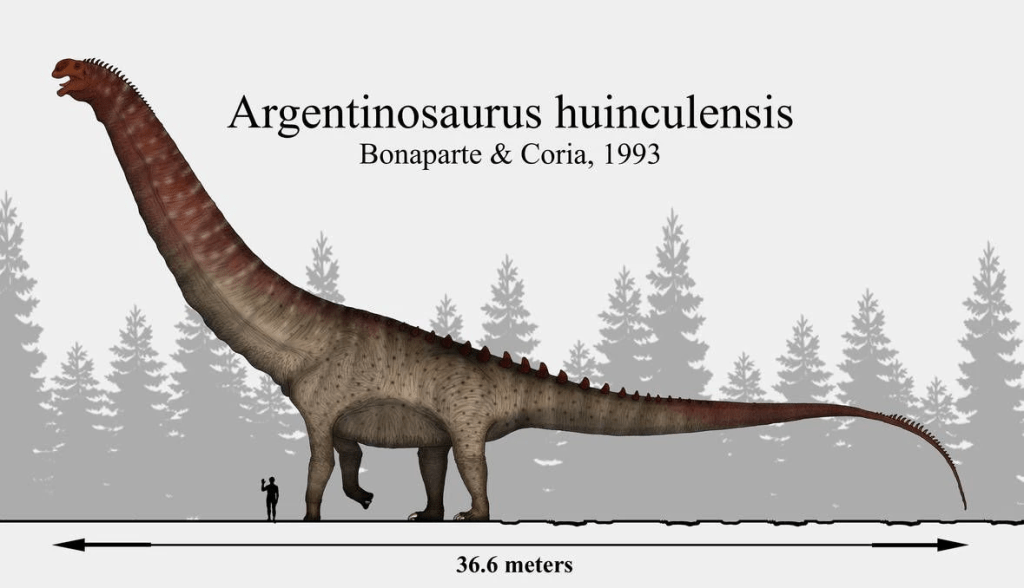
At the end of the day, the title of world’s largest dinosaur is a great tool for marketing and PR. There are many dinosaurs that might be the world’s largest dinosaur, but none of them stand above the others. When new fossils are found and promoted as a candidate for largest ever, it undoubtedly attracts media attention to the specimen (and therefore, the paleontologists research). What’s more interesting: “giant miscellaneous titanosaur”, or “Largest dinosaur EVER???”. Plus, paleontologists have egos like any other people. If I found a massive sauropod, you can be assured that I would be hyping up my dinosaur to be bigger than Argentinosaurus for as long as I possibly could!
The world’s largest dinosaur may be somewhat subjective, but it’s still fun to discuss. Whichever giant sauropod holds the crown was the largest animal to ever walk the earth, an animal of unimaginable proportions only surpassed by the largest whales. Whether it’s Argentinosaurus, Patagotitan, or some other sauropod, we would have looked like ants compared to these titanic giants.
Thank you for reading this article! If you want to know more about giant sauropods, I suggest you read about how a dozen giants could live alongside each other in the Morrison Formation here at Max’s Blogosaurus!
I do not take credit for any images found in this article. Header image courtesy of Rudolph Hima, found here
Works Cited:
[i] Lucas, Spencer G. Dinosaurs: The Textbook. 6th ed., Columbia University Press, 2016.
[ii] Molina-Pérez, Rubén, et al. Dinosaur Facts and Figures: The Sauropods and Other Sauropodomorphs. Princeton University Press, 2020.
[iii] Campione, Nicolás E., and David C. Evans. “The Accuracy and Precision of Body Mass Estimation in Non‐avian Dinosaurs.” Biological Reviews, vol. 95, no. 6, 2020, pp. 1759–1797, https://doi.org/10.1111/brv.12638.
 Max's Blogo-Saurus
One reply on “My Dinosaur is Bigger Than Yours: The Quest for the World’s Largest Dinosaur”
What about the Australian Titanosaur? Only cms in it!!!
LikeLike