
The sauropod dinosaurs will forever be famous for their titanic necks. Beginning in the Late Triassic period, the earliest sauropods began experimenting with long necks to exploit high-reaching vegetation inaccessible to contemporary herbivores. By the Late Jurassic period, their experimentation had reached (literal!) new heights, with necks of some genera like the Chinese Mamenchisaurus reaching over 14 meters in length[i]. Though animals like Giraffes may resemble sauropods, even they pale in comparison.
Yet not all sauropods possessed such elongated appendages. Some were quite the opposite!
Enter Brachytrachelopan (brack-e-track-ah-low-pan) mesai, a sauropod that was the antithesis of its relatives. Instead of a massive extremity designed for browsing on tree canopies, the neck of Brachytrachelopan was tiny, measuring only a meter long – the shortest sauropod neck recorded![ii] Despite being small for a sauropod, Brachytrachelopan was still 11 meters long and weighed 5 tonnes, which is comparable to an African Elephant[iii]. The tiny neck of Brachytrachelopan compared to the rest of its body resulted in quite an awkward appearance, as you will see below:
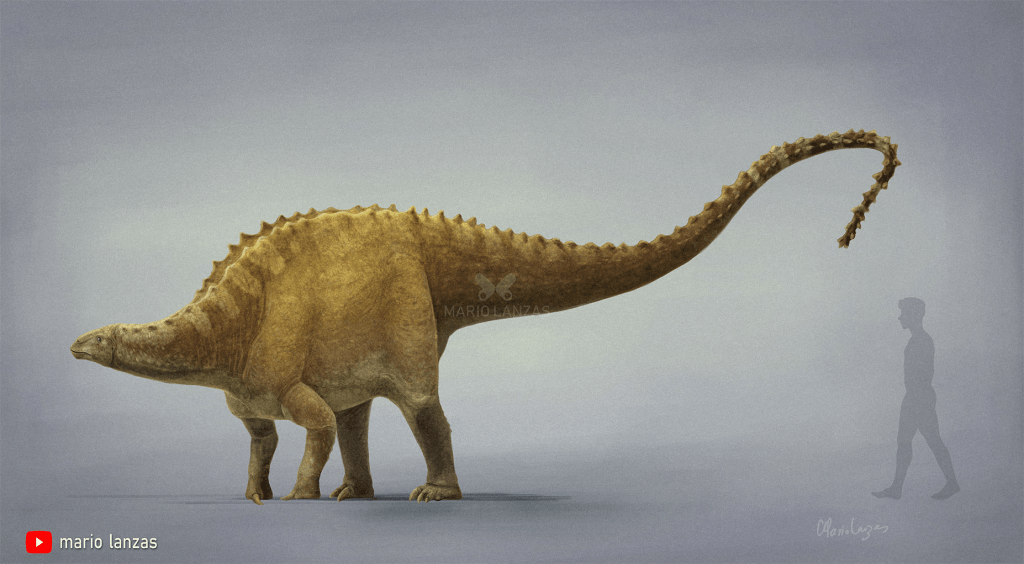
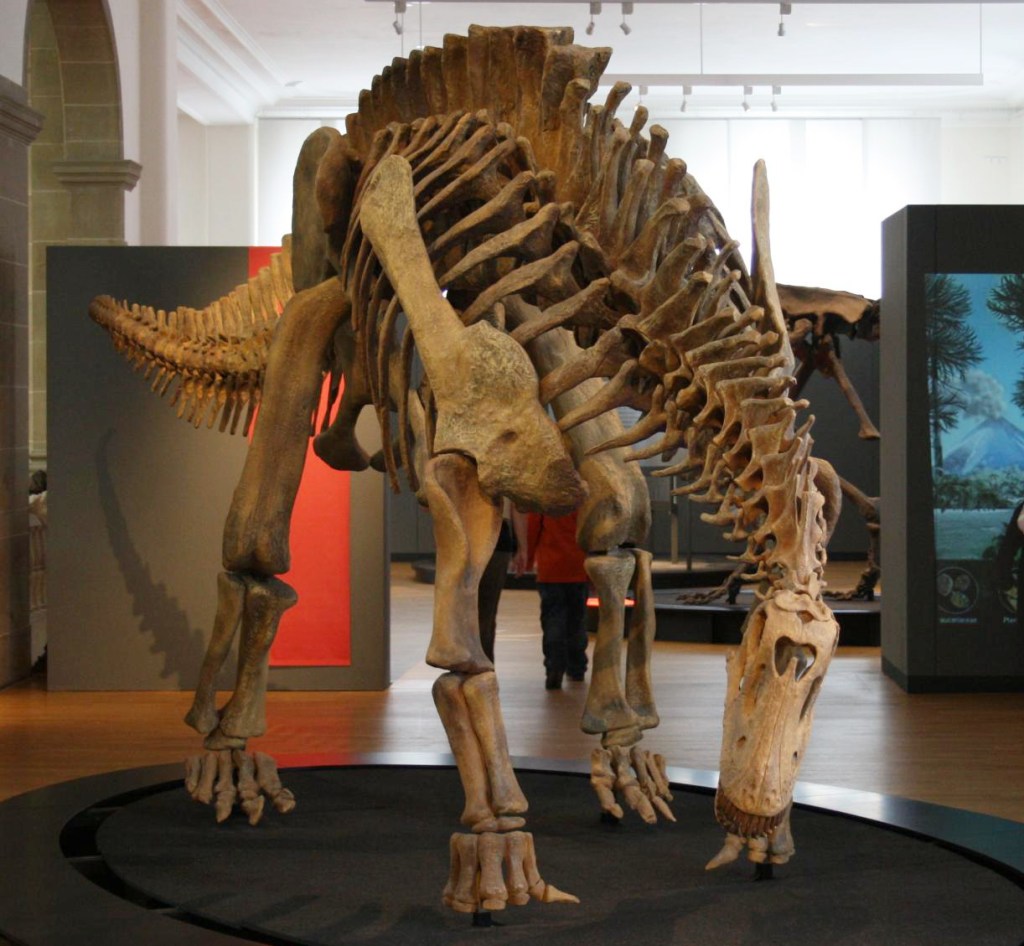
While Brachytrachelopan was the most extreme tiny-necked sauropod, it wasn’t the only one. The sauropod subfamily that Brachytrachelopan is part of – the Dicraeosaurids – are distinguished by their short necks, with species like Amargasaurus and Dicraeosaurus also featuring proportionately small necks. Some members of another sauropod lineage, known as the Rebbachisaurids, also experimented with this adaptation, most evident in species like Nigersaurus. Clearly, the short necks of these sauropods must have evolved for a purpose, but what was it?
The answer lies in their diet. The short necks of sauropods like Brachytrachelopan position their skulls very close to the ground, enabling them to browse on mid and low-lying vegetation. The structure of Dicraeosaurid vertebrae supports the notion that the family ate vegetation close to the ground, as the increased height of their neural spines suggests they could eat low-set vegetation in an effective vertical motion[iv]. While contemporary sauropods went high, the Dicraeosaurids went low!
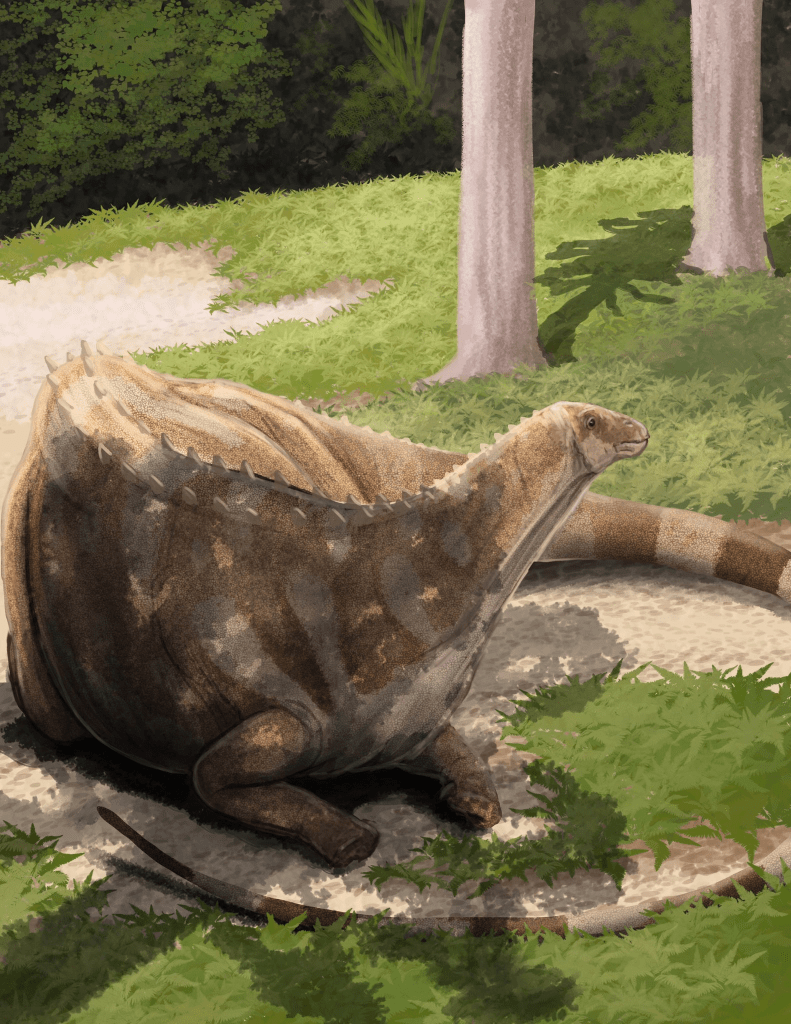
Why did the Dicraeosaurids favour these plants? In short, they wanted to avoid competition with their larger cousins. During the Late Jurassic and Early Cretaceous heydays of the Dicraeosaurids, sauropods were present on all continents and dominated their ecosystems. In places like the Morrison Formation of Jurassic North America, numerous species of sauropods lived alongside each other, putting tremendous strain on the plant populations of their ecosystems. In turn, sauropods adapted different diets to accommodate each other’s presence, a concept known in ecology as niche partitioning. While some species stuck to treetops, others became more generalist browsers, and some may have even specialized in eating material like twigs and bark.
Dicraeosaurids like Brachytrachelopan were no exception. While their giant cousins browsed vegetation higher in canopies, Dicraeosaurids stuck close to the ground and feasted on mid-to-low-lying plants. Brachytrachelopan lived alongside the Camarasaurid sauropod Tehuelchesaurus, a 15-meter giant better suited for vertical browsing. To better coexist with Tehuelchesaurus, Brachytrachelopan evolved the short neck necessary to browse vegetation close to the ground and thus partition the food resources available at the time.
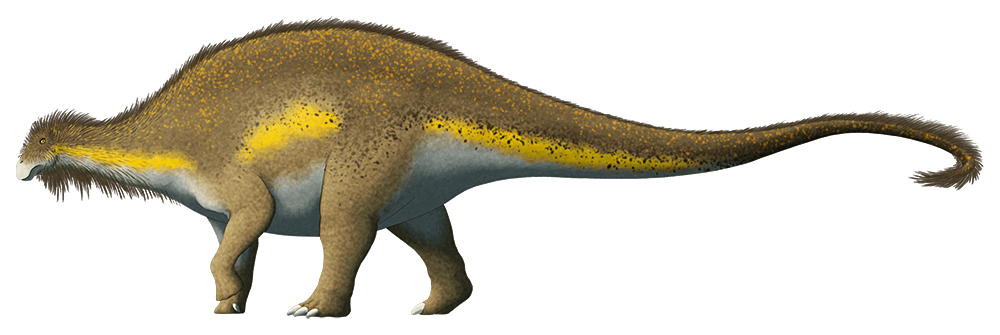
Despite the presence of Dicraeosaurids and Rebbachisaurids, short necks were rare amongst sauropods. This was due to competition from other dinosaurs that occupied the same ecological niche as these sauropods. In the Jurassic, Stegosaurs dominated mid-to-low-lying vegetation throughout the northern hemisphere and parts of Africa and South America. At the end of the Jurassic, the first Iguanodontids appeared and quickly dispersed in the Early Cretaceous. In the Late Cretaceous, Hadrosaurs, Ceratopsians, and Ankylosaurs all browsed on the preferred vegetation of short-neck sauropods, preventing their evolution.
In fact, the Jurassic-aged Cañadón Calcáreo Formation of Argentina – which Brachytrachelopan hails from – seemed to lack most of these competitors. While Stegosaurs did live in Cañadón Calcáreo, they are exceedingly rare[v], while Iguanodontids did not appear in South America until the Cretaceous. Without these competitors, South America became a haven for the Dicraeosaurids. While the lineage had gone extinct on most continents at the end of the Jurassic, they managed to survive into the Cretaceous in the environments of South America.
While short-neck sauropods may not be too common in the fossil record, they were nonetheless some of the most spectacular species known to science. Nigersaurus famously possessed a downright bizarre square-shaped skull, while the Cretaceous Dicraeosaurid Amargasaurus had a dual row of spines on top of its back. Yet even amongst all these strange sauropods, the tiny neck of Brachytrachelopan stands out like a sore thumb. Or, should I say, like the opposite of a sore thumb?
Thank you for reading this article! As it turns out, the Dicraeosaurids aren’t the only example of sauropods niche partitioning in the fossil record. At one point, almost a dozen giant sauropods lived in the same geological formation in the Jurassic of North America! If you want to know how they coexisted, I suggest you read “As Hungry as a Sauropod: The Morrison’s Giant Conundrum” here at Max’s Blogosaurus!
I do not take credit for any images found in this article. The header image comes courtesy of Emily Stepp, whose work can be found here.
Works Cited:
[i] Moore, Andrew J., et al. “Re-assessment of the late jurassic eusauropod mamenchisaurus sinocanadorum russell and Zheng, 1993, and the evolution of exceptionally long necks in mamenchisaurids.” Journal of Systematic Palaeontology, vol. 21, no. 1, 2023, https://doi.org/10.1080/14772019.2023.2171818.
[ii] Hallett, Mark, and Mathew J. Wedel. The Sauropod Dinosaurs: Life in the Age of Giants. Johns Hopkins University Press, 2016.
[iii] Paul, Gregory S. The Princeton Field Guide to Dinosaurs. 2nd ed., Princeton University Press, 2016.
[iv] Hallett, Mark, and Mathew J. Wedel. The Sauropod Dinosaurs: Life in the Age of Giants. Johns Hopkins University Press, 2016.
[v] Rauhut, Oliver W., et al. “First osteological record of a stegosaur (Dinosauria, ornithischia) from the Upper Jurassic of South America.” Journal of Vertebrate Paleontology, 2021, https://doi.org/10.1080/02724634.2020.1862133.

