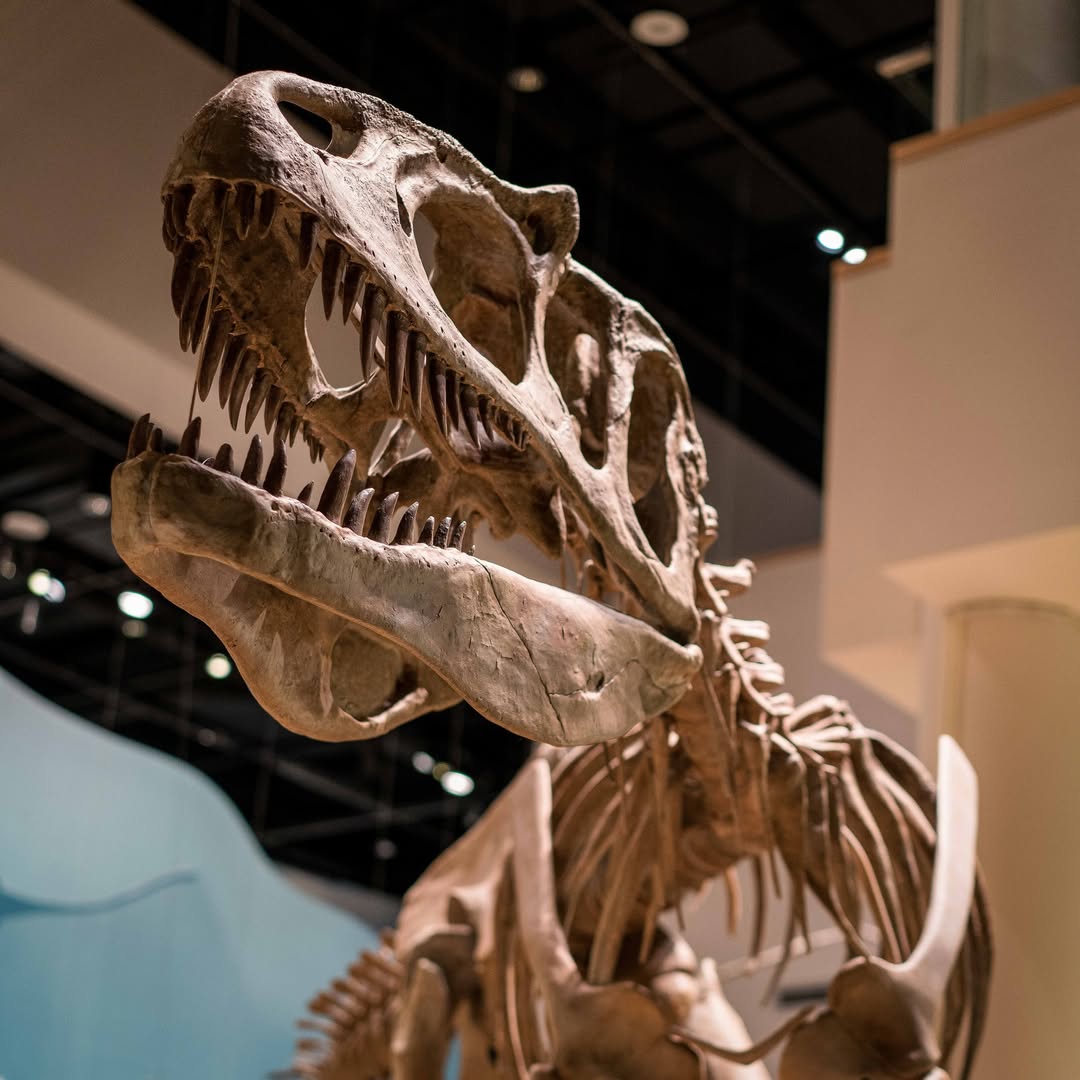
The holidays are usually a time for peace and quiet, making the identity crisis suffered by a longstanding dubious dinosaur even more dramatic.
That’s right folks, today’s article is going to dive into Saurophaganax maximus’ baffling taxonomic status. On December 21st, paleontologists led by Andy Danison of the Oklahoma State University Center for Health Sciences (yes, you read that right) published a review of specimens assigned to the dinosaur Saurophaganax, a large Allosaur from the Late Jurassic Morrison Formation of Oklahoma. First described in 1995, the massive size (~12.5 meters long[i]) and extravagant name (which translates to “lord of the lizard eaters”) of Saurophaganax has captured the attention of both paleonerds and the public alike, with Oklahoma designating Saurophaganax to be its official state fossil in 2000[ii].
Yet for all its fame and recognition, one question has always loomed large: is Saurophaganax just a large individual of Allosaurus?

It’s a question that has been present since shortly after Saurophaganax’s initial description[iii]. The overall appearance and anatomy of the two dinosaurs are quite similar, with key differences being present throughout the vertebrae in addition to smaller modifications of the postorbital and tibia[iv][v]. The vertebrae are of particular importance, with unique projections on the base of its neural arches being crucial in its designation as a unique taxon.
So, what happens when those vertebrae are removed from the picture?
In their study, Danison’s team found that several of the Saurophaganax vertebrae have been misassigned[vi]. After comparing the bones to other dinosaurs found at the site of Saurophaganax’s discovery, Stovall’s Quarry 1, most vertebrae were determined to be consistent with Sauropods like Camarasaurus and Apatosaurus instead of theropods. Vertebrae from Apatosaurine sauropods were found to be especially similar, leading the authors to conclude that Saurophaganax maximus is a dubious taxon whose unique anatomical features are attributable to the sauropod bones wrongly assigned to the genus. These bones were not confidently assigned to an existing genus of Morrison sauropod, opening the possibility for a new genus to be present within these skeletal remains.

Not all the bones assigned to Saurophaganax belonged to sauropods, however. Several bones from the skull and limbs were found to be consistent with Allosaurids, including a crestless postorbital which distinguished the specimen from previously described species of Allosaurus. Given the questionable nature of the Saurophaganax moniker, Danison determined this material should belong to a new species of Allosaurus, dubbed Allosaurus anax. While the possibility of Saurophaganax being a distinct genus of Allosaur was discussed by the authors, it appears for now that the lord of the lizard eaters has entered taxonomic purgatory.
So, Saurophaganax has now been split into two different taxa: Allosaurus anax, a new Allosaurus species known from only a handful of fragmentary bones; and “Saurophaganax,” a nomen dubium dinosaur that might be a new Apatosaurine sauropod, or still a theropod. Pretty messy, right?
While it may seem unusual for the name Saurophaganax to be kept in some capacity, there is merit for this decision. First, if any of the vertebrae that have been reclassified turn out to belong to a theropod –mentioned as a possibility for one neural arch – it would make Saurophaganax valid again. Given this possibility, keeping the door open to Saurophaganax makes sense. Second, I don’t think the state of Oklahoma would be too happy if they had to change their state fossil on the 25th anniversary of its designation!
Maybe they should start looking for backups, however; may I nominate Acrocanthosaurus for consideration?
The response to Danison’s research has been mixed. While many were disappointed that their favourite Allosaur has been lumped into the Allosaurus wastebasket, I was not surprised. Sure, the whole sauropod-vertebrae subplot was a bit weird, but Saurophaganax being a sub-species of Allosaurus? That was something I had assumed for years. Truthfully, I was a little confused at the strong community reaction to this news, but I suppose that when you become emotionally attached to a dinosaur, it can be a bit hard to see it go. If someone told me Majungasaurus was a second Carnotaurus species I would riot…

Although the way it happened may have been surprising, Saurophaganax has finally been lumped into Allosaurus under the name A. anax. Despite the name change, A. anax still would have been a terrifying top predator in its ecosystem, with multiple weight estimates all exceeding 3,700 kg (3.7 tonnes). As is the case with Nanotyrannus and its own taxonomic purgatory, the appearance, behaviour, and ecological niche of Saurophaganax/Allosaurus anax would have been the same regardless of its name.
Plus, it’s not as though Saurophaganax hasn’t had issues with taxonomy before. When the fossils of Saurophaganax were first unearthed in the early 1930’s, Oklahoma paleontologist J. Willis Stoval dubbed the Allosaur fossils “Saurophagus maximus” – the eater of lizards. Though this name would be included in a non-scientific 1941 article, it wouldn’t be until 1995 that paleontologist Dan Chure officially published the fossils under the name Saurophaganax[vii]. Why the change? Well, the name Saurophagus was already taken by a species of Kingfisher bird from southern Asia. I suppose this means that we should expect Saurophaganax to be deemed valid again sometime around 2069!
In the meantime, we can enjoy a fourth Allosaurus species that has been bestowed upon us. Three cheers for Allosaurus anax! And salutations to Saurophaganax! Your name will certainly be missed.
Happy new year everyone! I hope everyone has had a safe and enjoyable holidays from wherever you’re reading this and that 2025 proves to be better than the years previous. I am sorry for the lack of posts recently; exam season and some time off over the holidays demanded my attention this year. I do have big plans for 2025 – both here and in my own studies – and I hope to share some information about what I am working on at some point in the future. Until then, take care everyone!
I do not take credit for any images found in this article. All images come courtesy of the artists noted alongside each image. Header Image Courtesy of the Sam Noble Museum of Natural History.
Works Cited:
[i] Foster, J. (2020). Jurassic West, Second Edition. https://doi.org/10.2307/j.ctv18sqxpx
[ii] https://casetext.com/statute/oklahoma-statutes/title-25-definitions-and-general-provisions/chapter-3-state-emblems-and-honorary-positions/section-986-state-fossil
[iii] Smith, D. K. (1998). A morphometric analysis of Allosaurus. Journal of Vertebrate Paleontology, 18(1), 126–142. https://doi.org/10.1080/02724634.1998.10011039
[iv] Danison, A., Wedel, M., Barta, D., Woodward, H., Flora, H., Lee, A., & Snively, E. (2024). Chimerism in specimens referred to Saurophaganax maximus reveals a new species of Allosaurus (Dinosauria, Theropoda). Vertebrate Anatomy Morphology Palaeontology, 12. https://doi.org/10.18435/vamp29404
[v] Foster, J. (2020). Jurassic West, Second Edition. https://doi.org/10.2307/j.ctv18sqxpx
[vi] Danison, A., Wedel, M., Barta, D., Woodward, H., Flora, H., Lee, A., & Snively, E. (2024). Chimerism in specimens referred to Saurophaganax maximus reveals a new species of Allosaurus (Dinosauria, Theropoda). Vertebrate Anatomy Morphology Palaeontology, 12. https://doi.org/10.18435/vamp29404
[vii] Black, R. (2013, November 15). A Comedy of Dinosaur Errors. Smithsonian Magazine. https://www.smithsonianmag.com/science-nature/a-comedy-of-dinosaur-errors-8396256/
 Max's Blogo-Saurus
6 replies on “Two Dinosaurs in One? Breaking Down the Saurophaganax Debacle”
[…] a deep breath, hardcore paleonerds; you don’t have to mourn both Carcharodontosaurus and Saurophaganax within the course of a […]
LikeLike
All things considered, “Lion of the Jurassic” has returned to being an appropriate moniker for Allosaurus. Just imagine this species hunting giant sauropods on the regular…
LikeLike
I may have to revise my previous assertions!
LikeLike
[…] your brains explode in confusion and anger at your thirtieth favourite dinosaur getting a name change, allow me to […]
LikeLike
[…] imagine, the paleo community had a very calm and measured reaction to this study. Just kidding! As has become tradition, headlines proclaiming ‘Suchomimus invalid’ spread like wildfire, with many expressing surprise […]
LikeLike
[…] imagine, the paleo community had a very calm and measured reaction to this study. Just kidding! As has become tradition, headlines proclaiming ‘Suchomimus invalid’ spread like wildfire, with many expressing surprise […]
LikeLike